Quantum & Dimensions: Consciousness at the Frontier

TL;DR: Quantum theories of consciousness ask if classical neuroscience is enough, or if consciousness needs deeper physics. The map runs from Penrose and Hameroff's Orch-OR through Stapp, Bohm, Wolfram, Faggin, Smolin and others. These approaches are not settled science, but they stay a live frontier because the standard accounts leave the subjective side unexplained.
Quantum theories of consciousness try to answer a hard question. Can classical neuroscience alone explain how it feels to have an experience, or does consciousness need a deeper kind of physics?
The "Quantum & Dimensions" family has rigorous models in it, but it also has speculative ideas and it has hybrid frameworks. They don't share one answer. They share one goal, and that goal is to tie the mind, information and the structure of reality closer together than the standard materialist view does.
If you're new to this, here is the two minute version. It's a map and not a final answer. Each part explains one idea in plain words and then shows where it helps and where it struggles. You don't need to agree with all of it. You just need to see the options clearly.
Penrose and Hameroff
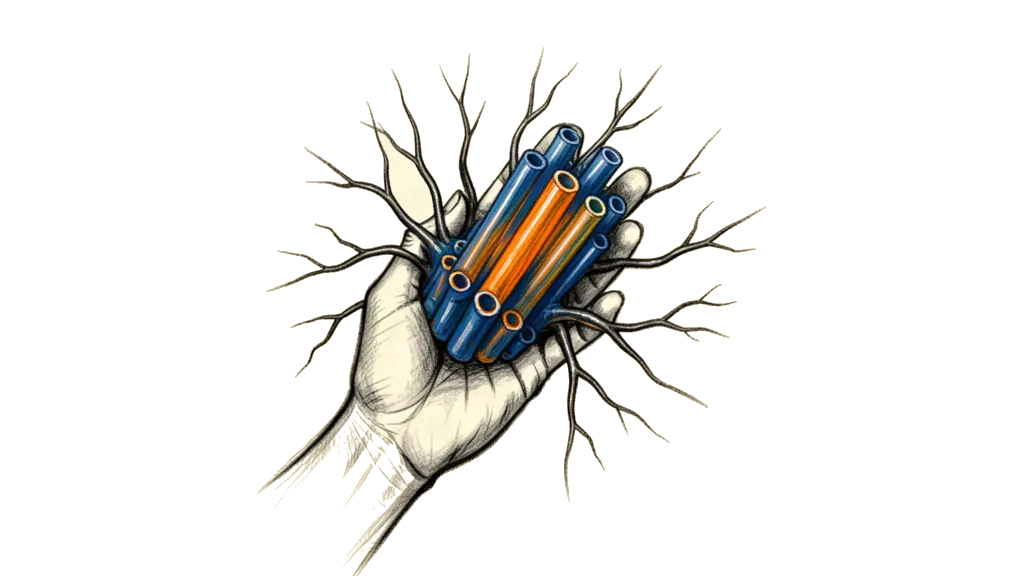
The Orch-OR model of Penrose–Hameroff puts Penrose's objective reduction idea together with Hameroff's microtubule hypothesis.
The core claim is that quantum processes in the microtubules of neurons are part of conscious moments. And the collapse is tied to the geometry of spacetime, not only to decoherence from the environment.
It matters because it makes a concrete proposal for the physical base, and it links consciousness to ideas close to quantum gravity. The main criticism is that in a warm brain decoherence may be too fast for stable quantum computing.
Hameroff's own part is the biology, the idea that microtubules are structures that really compute something and may matter at the quantum level.
The good part is that he brings real brain anatomy into a field that is often too abstract. The weak part is that it needs proof at a precision that most people don't accept yet.
Stapp and Bohm

Henry Stapp says that a conscious intention can play a role in processes that look like quantum measurement. This is often read along the lines of von Neumann and Wigner.
What he does is open the question of mental causation again inside physics. The risk is that people can easily say he puts agency into the quantum math without an experiment that really decides it.
David Bohm's implicate order, and his metaphysics inspired by pilot waves, shaped a lot of consciousness thinkers. The key idea is that reality may be an unfolded expression of a deeper enfolded order.
For consciousness that means mind and matter may be two projections of one underlying process. Bohm is still rich for philosophy, even where his claims about the world are debated.
Chalmers, McQueen and Wolfram

Chalmers and McQueen stand for the attempt to bring rigorous philosophy of mind, like the hard problem and structural realism, together with formal options from physics or information theory.
They focus on what counts as an explanation and what is just saying the same thing in new words. And they test if new physics helps with qualia, or if it only changes the vocabulary.
Wolfram-style approaches, with the computational universe, rewriting systems and hypergraph dynamics, say that spacetime and physics come out of deeper computational rules.
For consciousness that means if reality is computation and rewrites at its base, the mind may need new bridges from computation to how things feel. The strength is the goal to unify everything in one formal frame. The weakness is that the bridge from formal structure to lived experience is still thin.
Faggin and Kauffman

Federico Faggin argues for consciousness first frameworks, where the subjective side is basic and doesn't come from something else.
He pushes back hard against views that only look from the third person, and he takes first person data as the foundation. The challenge is that he needs a clear formal bridge to mainstream physics to get from a manifesto to a theory that most people accept.
Stuart Kauffman works on complexity, emergence and how living systems organize themselves without reduction.
That's relevant here because consciousness may come up in systems where lawful novelty goes beyond simple reduction. And biology may need principles beyond strict algorithmic closure.
Carr and Smolin
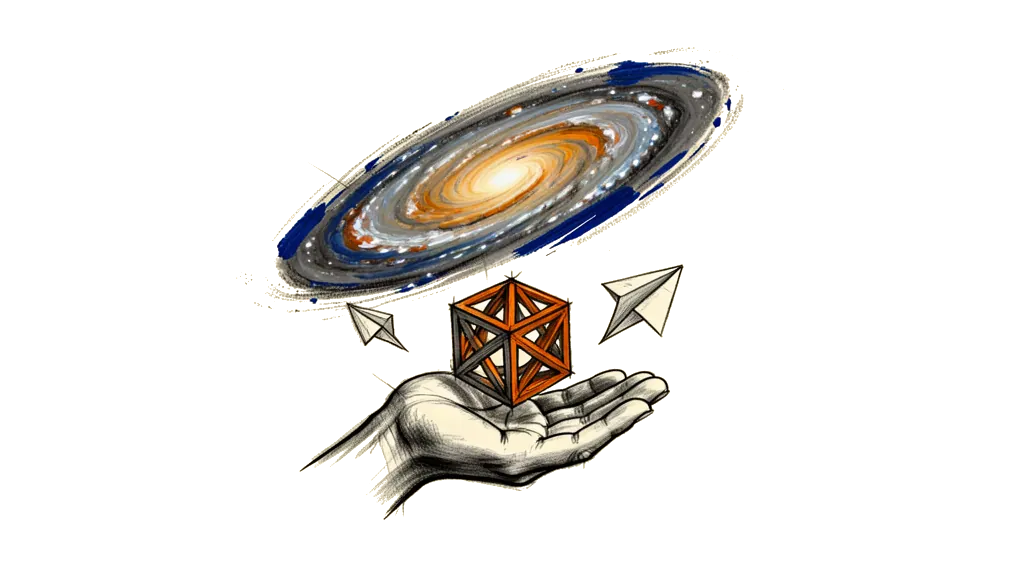
Bernard Carr's work often sits where cosmology, dimensions and speculation about consciousness meet.
The value is that he widens what we can even think about dimensions and what exists. The limit is that it needs stronger anchors in data to tell a useful hypothesis apart from metaphysics that goes too far.
Lee Smolin puts weight on background independence and relational realism, and he criticizes the idea of a static block universe.
For consciousness that means if time and relations are basic, models of the mind that are tied to a static structure may be incomplete. Smolin adds pressure against accounts that are too abstract and timeless.
Pylkkänen and Keppler

Paavo Pylkkänen, influenced by Bohm, looks at active information and conceptual thought next to deeper physical processes. What he brings is careful philosophy between the quantum math and questions about thinking and experience.
Keppler-style models often explore frameworks based on fields or resonance that link consciousness to dynamics in the background of the universe.
The upside could be one shared base with consequences for how experience feels. The key test is if they make specific predictions that can be reproduced and told apart in experiments.
A disciplined pluralism

Quantum consciousness has both overstatement and real new ideas in it. The best way forward is a disciplined pluralism, and it comes down to four things. One, keep experience at the center. Two, ask for formal clarity. Three, ask for real results in data. And four, avoid both the reductionist brush off and speculation that blows up.
Quantum and dimensional approaches are not settled science yet. But they are still a live frontier, and that is exactly because the standard accounts still leave core parts of the subjective side unexplained.
A few words in plain English

A few words in plain English, if you need them. Consciousness is your felt inner experience, what it is like to be you. Physicalism is the view that reality is fully part of nature and physics. Dualism says mind and matter are deeply different in at least one important way.
Monism says reality is in the end one kind of thing or one basic principle. Emergence means complex systems can show new patterns that you can't see from their parts alone. Qualia are the felt qualities of experience, like the redness of red or pain as it feels. And the explanatory gap is the gap between describing what the brain does and explaining how it feels.