# One man cannot launch a vessel
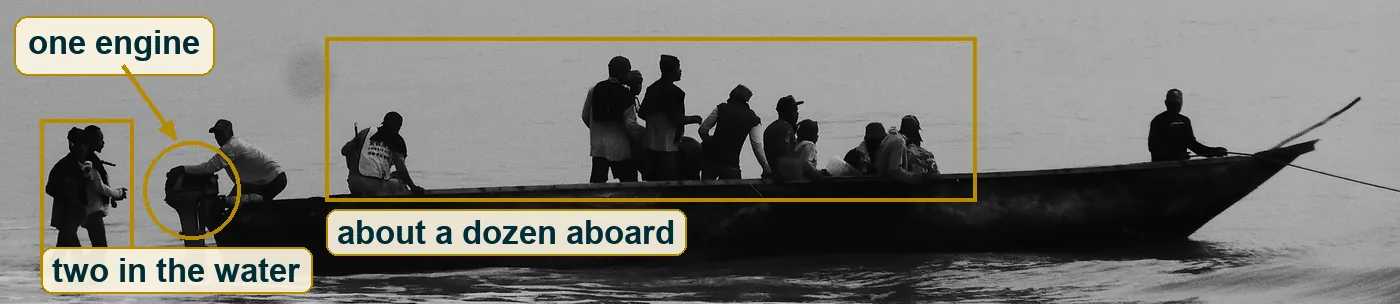
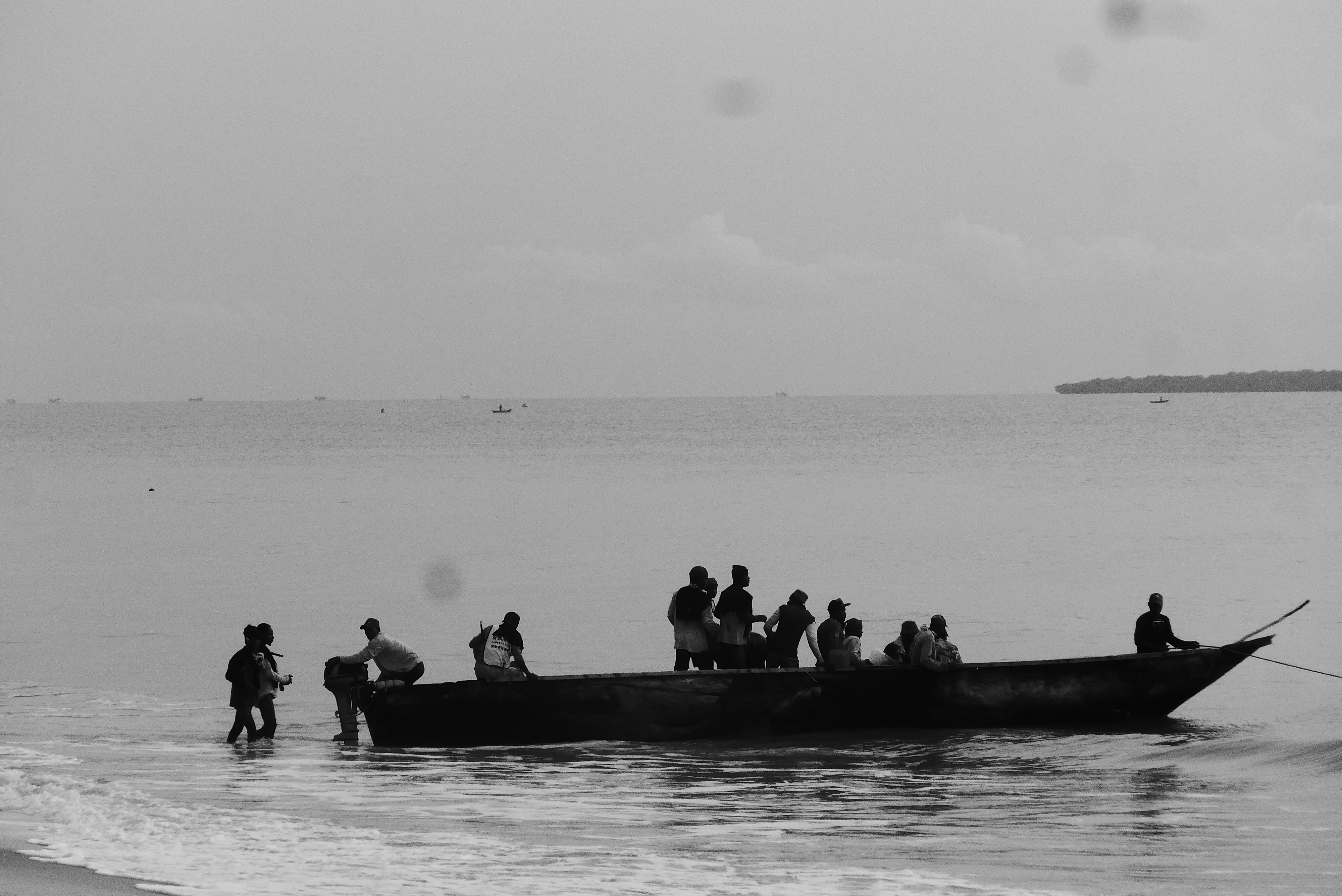
> - A long wooden boat with about a dozen people sits in shallow surf at 05:39 in the morning, two more wade beside it and one man bends over the outboard.
> - The file has real EXIF. A Lumix LF1 at 157 mm equivalent, 1/100 s, f/5.6, ISO 400, minus 0.66 EV, and each number can be read back out of the picture.
> - The one mistake is four soft dust spots in an empty grey sky. Swahili proverbs and Hiroshi Sugimoto's halved seas sit alongside.
By emin.de AI Desk. AI-written, human-supervised: not yet reviewed. Published 2026-10-14. Updated 2026-10-14.
Canonical: https://emin.de/posts/photo-wooden-boat-shallow-surf-black-and-white
Category: culture. Format: photo. Language: en.
Provenance: ai_generated. AI-assisted: true. Reviewed by a human: false.
The title is a Swahili proverb, Mmoja hashui chombo.
## A dozen people and one engine
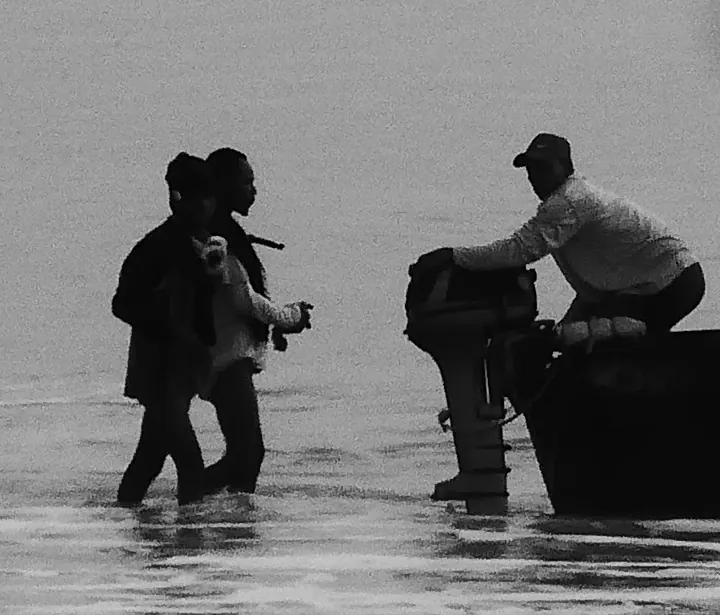
Count the people before you look at anything else. About a dozen sit and stand in a long wooden boat, most of them as dark shapes against pale water. Two more stand in the sea at the stern, shin deep, facing the boat. One man in a light shirt and a cap bends over the outboard motor with his hand on the cowling. Another man sits or stands low at the bow and holds a rope. That's the whole cast, and every one of them has a job or is waiting for one.
One engine at the stern, about a dozen people aboard, and two still in the water.
The boat is the kind you find on a lot of tropical coasts, long and narrow and made of planks, with a small outboard clamped on a flat stern. You see boats like this off East Africa, off West Africa and off South Asia, and nothing in the frame says which one this is. There's no sign, no number, no flag. So the picture stays where it is, on a beach somewhere, early in the morning, and it doesn't need a name to work. The proverb in the title comes from the Swahili coast because boats like this one are everyday there, and because it says what the picture shows. One man doesn't launch a boat. It takes the two in the water, the one at the motor and the one with the rope, and maybe the others too when the hull sits on sand.
**Basically,** Mmoja hashui chombo, "One man cannot launch a vessel." A dozen in the boat, two in the water, one hand on the motor.
## A rope that leaves the frame
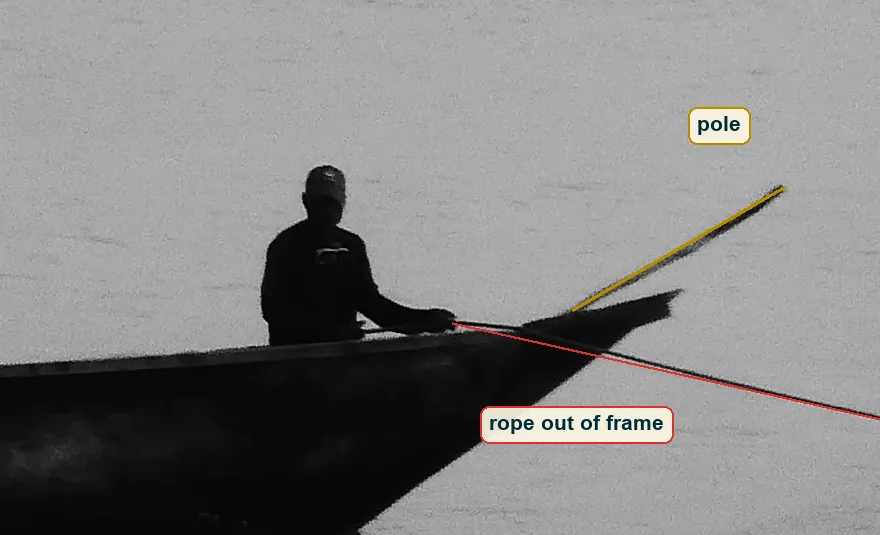
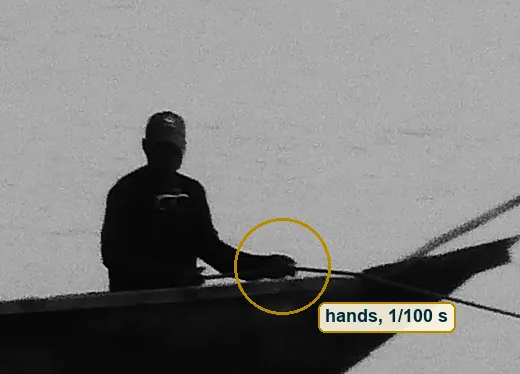
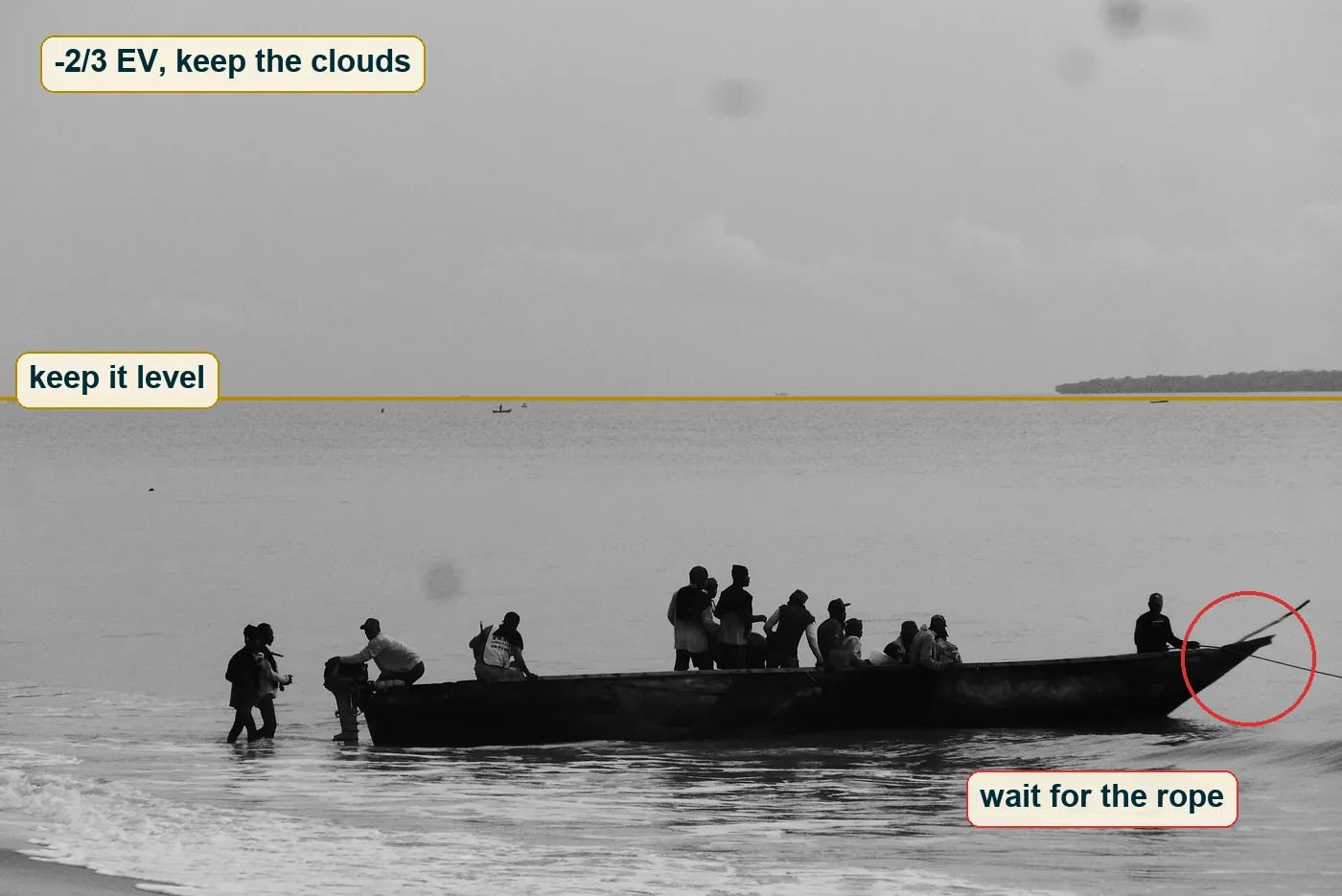
At the bow a man in a cap and a dark top reaches forward with both hands. A thin pole sticks up from the bow and leans to the right. Below it a rope runs from his hands down to the water and out of the picture at the right edge, about three quarters of the way down.
The pole rises to the right and the rope runs out of the frame, to something you never see.
That rope does a lot of work for one line of pixels. It ties the boat to something outside the frame, an anchor, a stake, a person on the beach, and you can't tell which. It also points your eye. The boat runs from left to right, the bow lifts toward the right, the pole leans right and the rope leaves to the right. Everything in the boat seems to want to go that way. You can't tell from one frame if the boat is coming in or going out. But the rope and the people in the water say it isn't moving yet. Something still holds it.
**Basically,** "One hand does not tie a package" Igbo proverb, tr. F. W. Pritchett. Both hands hold a rope that leaves the frame.
## Dark shapes on pale water
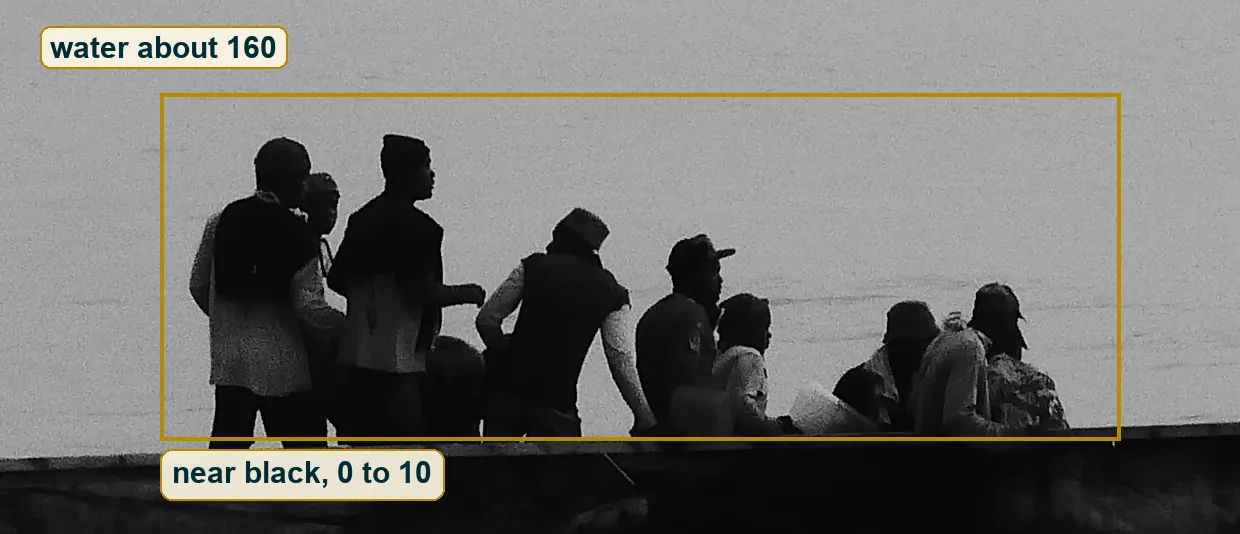
Measure the file and it sorts itself into two worlds. The open water behind the passengers sits around 160 out of 255. The hull sits around 17, and the darkest parts of the people, the jackets and the shadow side of the caps, go down to almost 0. Only 0.3 percent of the whole frame is that close to black. It's all in the boat.
The people are close to black, the water behind them sits around 160, and that gap does the drawing.
This is why the people read so clearly even though you can't see a single face. A silhouette works when the background is plain and the shape is busy. The water here is about as plain as water gets, and the shapes are full of detail. You see a beanie, a baseball cap, a bucket hat, a man leaning forward on the gunwale, a light jerrycan, a printed vest. The brain needs only the outline of a cap to know it is a person who has dressed for a cool morning. Nobody is identified and nobody needs to be. The picture is about a group, not about anyone in it.
**Basically,** Water at 160, hull at 17. A gap of 143 tone levels draws a whole crew without showing a face.
## Light before six in the morning
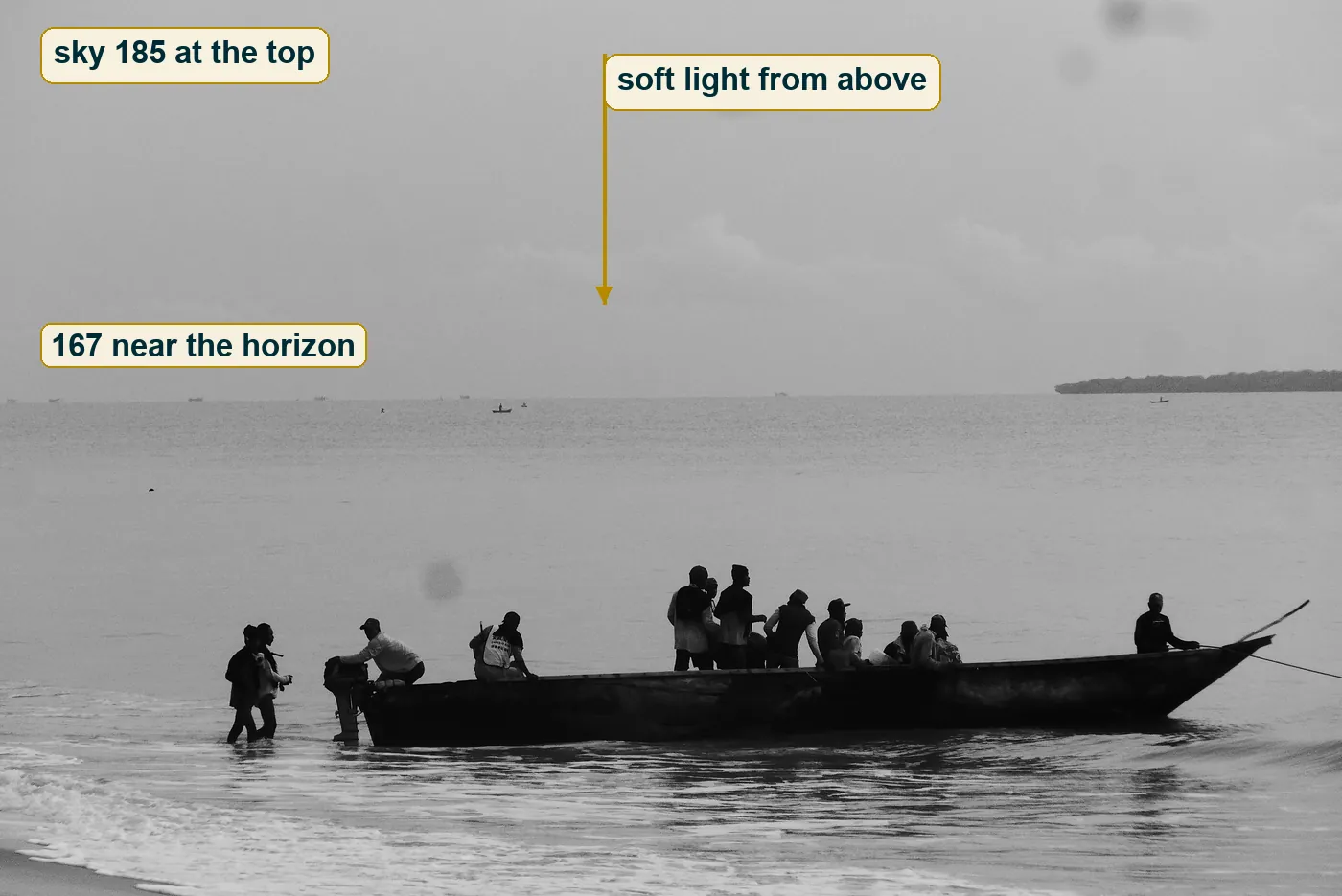
The camera clock says 05:39 on 10 August 2025. There's no time zone in the file, so take it as camera time, but it fits what you see. It's early light, around dawn, under a sky with no sun in it.
The sky gets darker as it comes down, from about 185 at the top to about 167 near the horizon.
There's no hard shadow anywhere and no bright side to any face. The light comes from the whole sky at once, like a soft box the size of the world. The only direction it has is up and down. The top rows of the sky sit at about 185, the band just above the horizon at about 167. That gentle fall is all the shape the sky has. A sun low on one side would have put hard rims on the caps and long streaks on the water. Here the light just lifts everything a little and lets the shapes do the talking. It's the same light that makes the sea look like grey glass. Calm water with no sun on it reflects a calm sky, and the two melt into one tone.
**Basically,** Ngoja kuche si mbali, "Wait dawn is not far." At 05:39 the light has no direction yet, only a top and a bottom.
## A horizon just above the middle
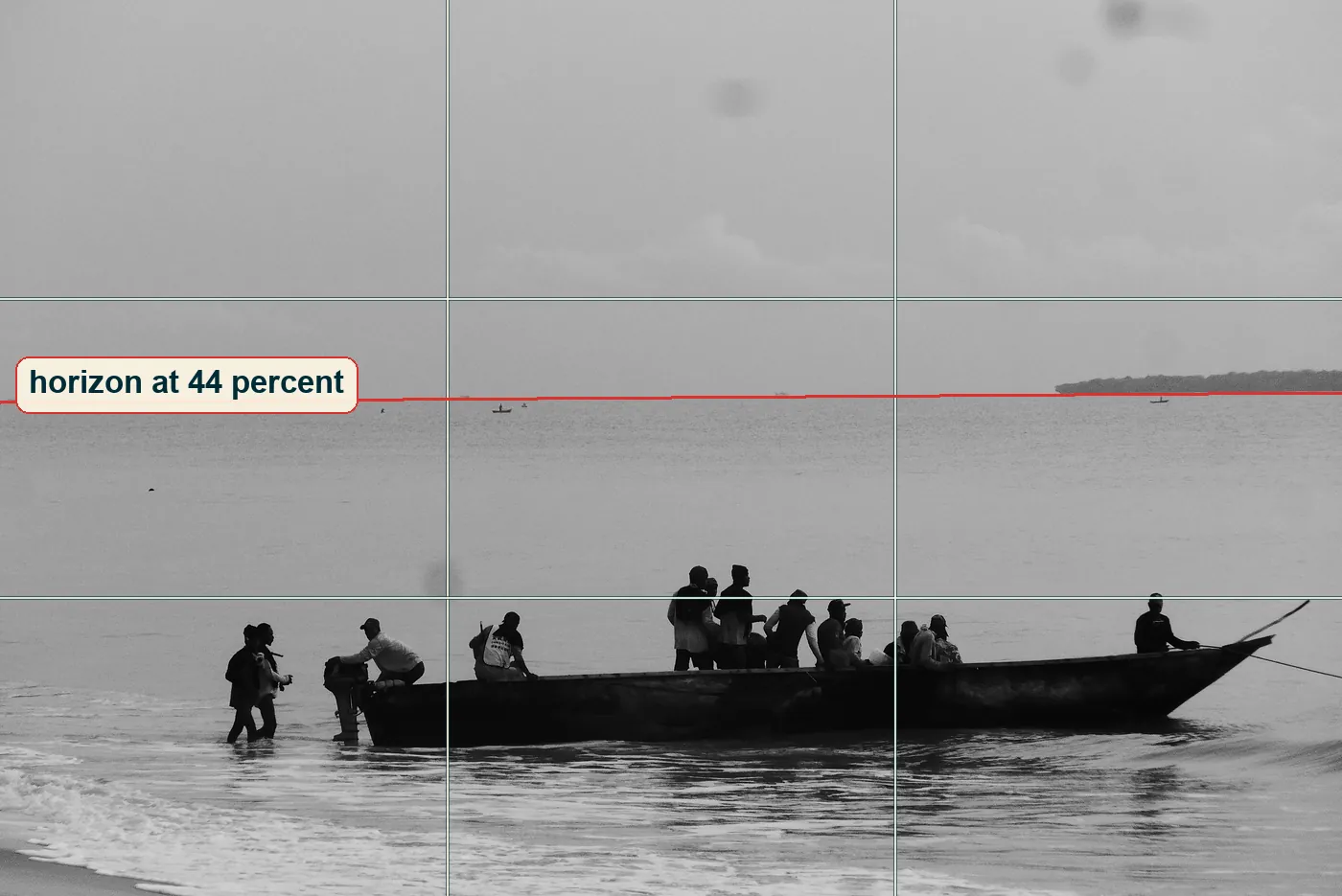
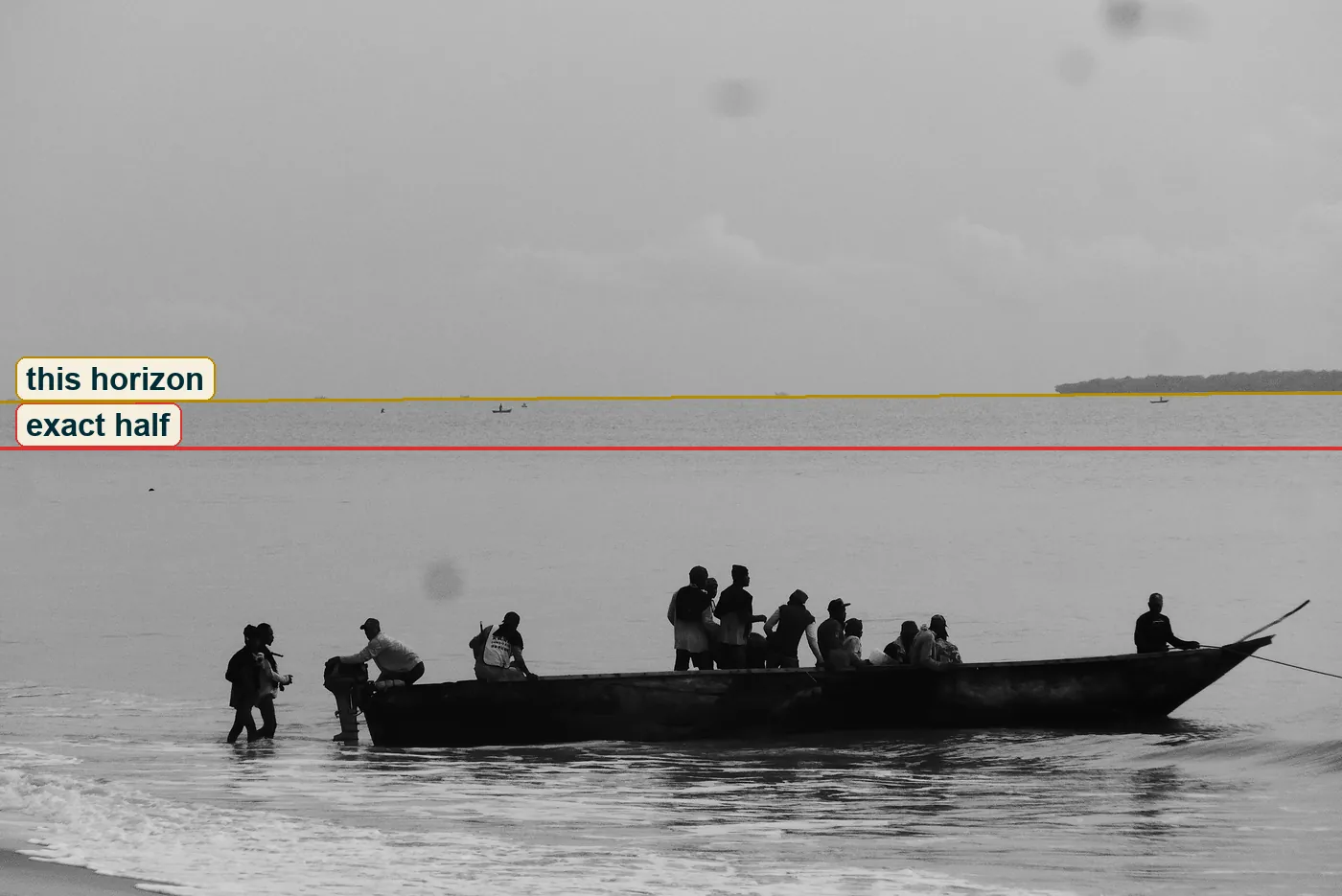
Draw a line where sea meets sky and it lands at 44 percent of the frame height from the top. It rises very slightly to the right, about 25 pixels over 4,000, which is about half a degree. You don't see the tilt, you only feel that the sea is calm.
The horizon sits between the upper third and the middle, and the boat lies along the lower third.
The textbook says horizon on a third. This one is not on a third. It sits between the upper third line and the middle. The boat lies along the lower third instead, and that's the line that carries the people. What the high horizon gives you is the empty sky. Almost half the frame is grey with nothing in it but faint cloud. That space is heavy. It makes the full boat look small and the morning look long. Crop the sky down to a thin strip and you get a busier, more cheerful picture of a boat. Keep it and you get a picture of waiting.
**Basically,** Horizon at 44 percent. Six points above the middle is enough to let the empty sky weigh on a full boat.
## The long end of a small zoom
The file comes from a Panasonic Lumix DMC-LF1, a pocket compact from 2013 with a 1/1.7-inch sensor, a 28 to 200 mm equivalent zoom and a small electronic viewfinder. The lens was at 32.3 mm. On this sensor that is 157 mm in full-frame terms, near the long end of the zoom.
At 157 mm equivalent the far canoes and the island stay big enough to read as canoes and trees.
You can see the long lens in the picture. The angle of view at 157 mm is only about 13 degrees across. That's why the boat fills the width without any of the beach or the photographer's feet coming in, and why the far canoes are still canoes and not dots. You can even work the distance out. The two people in the water stand about 350 pixels tall from the waterline to the head. On this sensor a pixel is about 1.9 thousandths of a millimetre wide. Put a person of about one and a half metres above the water into that and you get a distance of roughly 70 metres, with a boat around 11 metres long. That is an estimate, but it fits the scale of everything else. At 28 mm from the same spot, the whole boat would cover only about an eighth of the width, and the sky and the sea would swallow it.
**Basically,** 32.3 mm on the lens, 157 mm in full-frame terms. The factor of 4.86 lives in the sensor, not in the glass.
## One hundredth of a second
The shutter was open for 1/100 s. The old rule for handheld shots says one over the full-frame focal length, so at 157 mm you'd want about 1/160 s. This is slower than that rule allows. The LF1 has optical stabilisation in the lens, and that buys back a stop or two, enough that 1/100 s at 157 mm gives a sharp file from a steady hand.
The rope through the bow man's hands stays a thin clean line at 1/100 s.
Stabilisation fixes your hands, not the subject. For the subject, check the rope in the bow man's hands. It stays a thin line and doesn't smear. At about 70 metres one pixel covers about 4 mm out there, so a hand moving at walking pace, about a metre per second, travels 1 cm in 1/100 s. That's two or three pixels, too little to see at normal size. Now try the alternatives. At 1/25 s with ISO 100, the file would be cleaner, but the same hand would move 4 cm, about nine pixels, and the rope would blur where he pulls. At 1/500 s with ISO 2000 every hair would freeze and the sky would fill with grain. 1/100 s sits in the middle. It's fast enough for people who are standing and waiting, and it's slow enough to keep the ISO low.
**Basically,** At 1/100 s a moving hand travels 1 cm. At 1/25 s it travels 4 cm. The rope needs time short enough to stay a rope.
## Why near and far are both sharp
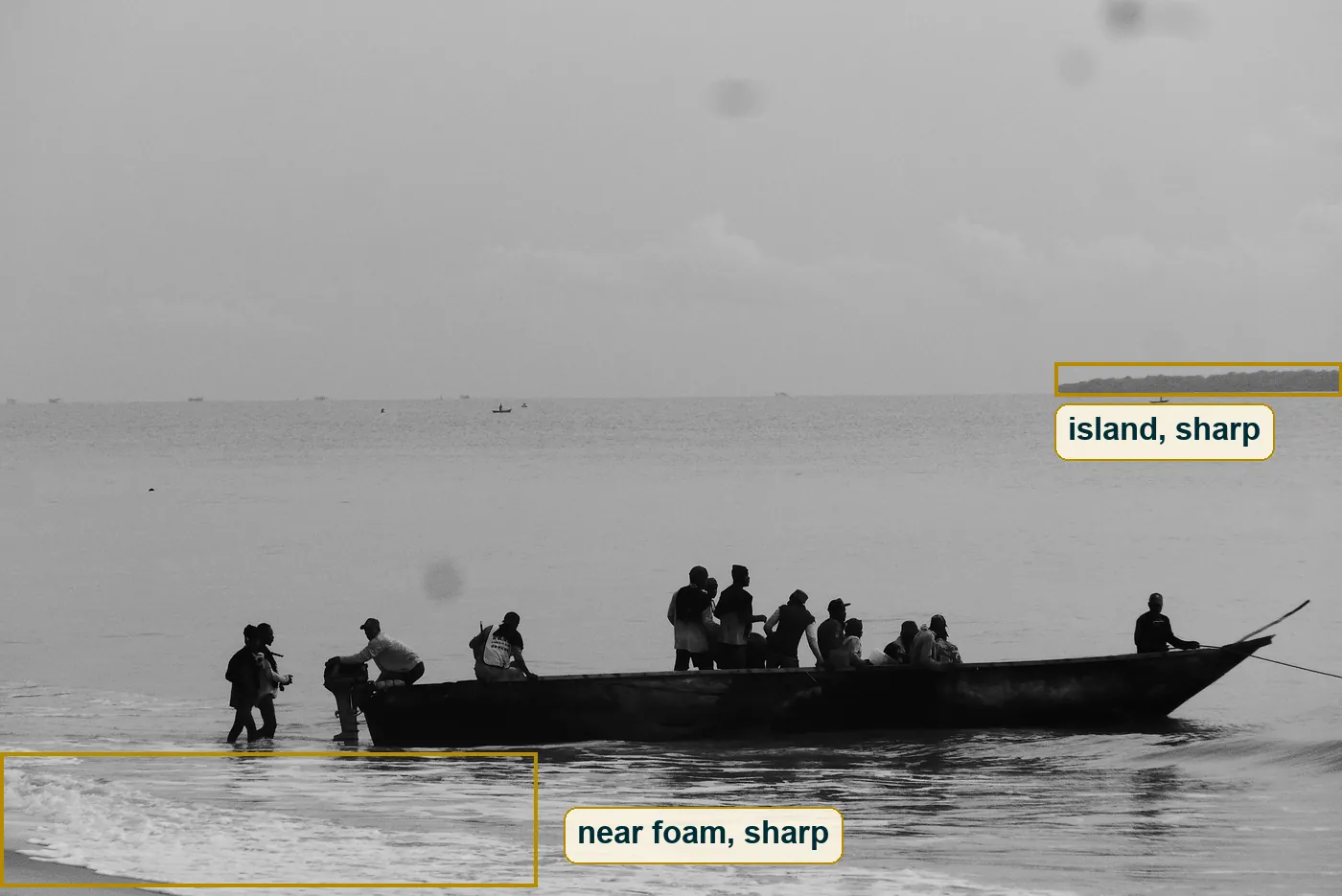
The aperture was f/5.6. On a sensor this small, f/5.6 doesn't mean what it means on a big camera. The 1/1.7-inch chip is about 4.86 times smaller across than full frame, so f/5.6 here gives the depth of field of about f/27 on full frame. That's very deep.
The foam in front and the trees on the island far behind are both in focus.
Do the sum with the real lens. At 32.3 mm and f/5.6 the hyperfocal distance on this sensor is about 30 metres. Focus on the boat at about 70 metres and everything from about 20 metres to the horizon falls inside the sharp zone. The foam in the front, the boat in the middle and the trees on the island all stay sharp, and it would be hard to make it otherwise. Near the long end this lens opens only to about f/5 to f/5.9 anyway, so f/5.6 is close to wide open and program mode had little choice. The side by side is simple. A full-frame camera at 157 mm and f/5.6 would have put the island and the foam soft and made the boat float on a blur. That's a different picture, more portrait than scene. Here the small sensor turns everything into one plane of facts.
**Basically,** f/5.6 on a sensor this small draws depth like f/27 on full frame. Foam at your feet and trees on the island, all sharp.
## Minus two thirds of a stop
The camera was in program mode with multi-pattern metering, auto white balance and no flash, and the exposure compensation was set to minus 0.66 EV. Somebody turned that dial on purpose. On a bright grey morning by the sea, that's the right instinct.
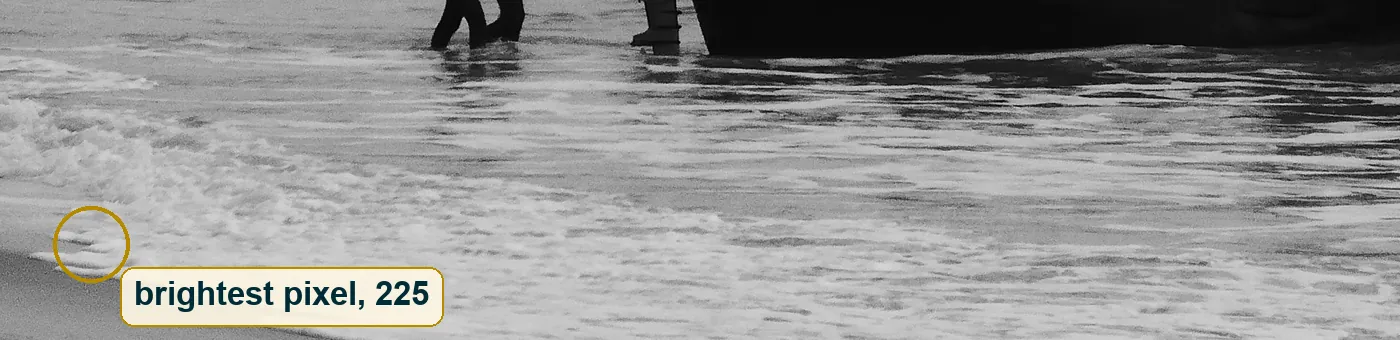
The brightest pixel in the whole file sits in the surf foam, and it is only 225 out of 255.
Measure the file. The mean tone is 154 out of 255. No pixel reaches 255, not even close, and the brightest one in the frame is 225 in the foam at the bottom left. That is headroom you can see. Push the same file up by the missing 0.66 EV and the sky climbs from about 177 to about 217, and the first bits of foam start to touch pure white. Push a full stop more and four fifths of the frame burns out. The 1/100 s, f/5.6 and ISO 400 add up to about EV 9.6 at ISO 100, roughly five stops less light than a sunny noon. The meter sees a frame that is mostly bright sky and water and tries to make it look like a normal day. The minus dial holds it back and keeps the grey grey. The cost is a soft, low-contrast file with only 0.3 percent near black and nothing near white. That's a choice of mood, and it fits the hour.
**Basically,** The brightest pixel in this file is 225, not 255. Minus 0.66 EV is the room the foam got to stay foam.
## What ISO 400 costs a small sensor
ISO 400 sounds low. On a 1/1.7-inch sensor it isn't. Each pixel here is about 1.9 thousandths of a millimetre wide, and the whole chip collects about 24 times less light than full frame at the same exposure. In total light, ISO 400 here is like ISO 9,400 on a big camera.
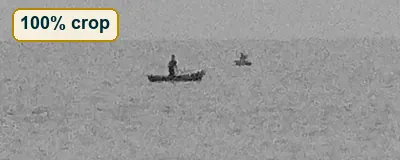
At full size the calm water shows a fine even grain, and the small canoe still holds its shape.
Look at a full-size crop of the water and you see it, a fine even grain over everything. The fine detail in the ripples goes soft. Yet in the flat grey sky the pixel to pixel noise is only about 3 levels out of 255. The camera's own noise reduction and the monochrome file hide a lot. The file is pure greyscale, red, green and blue identical in every pixel, so it was shot in a monochrome photo style in the camera or converted before export. Grey noise in a grey sea looks like texture, not damage. Where ISO 400 would really hurt is in deep shadow, faces in the dark, the inside of a hull. This picture has almost no deep shadow, so it pays very little of the bill. The same ISO in a dim room would show you the true price.
**Basically,** ISO 400 on a chip this small gathers light like ISO 9,400 on full frame. Flat grey water hides it, deep shadow wouldn't.
## Sugimoto and the halved sea
In 1980 Hiroshi Sugimoto started a series called Seascapes. He used an old large-format camera, made exposures of up to three hours, and printed every sea at the same size, cut exactly in half by the horizon. Grey sea, grey sky, nothing else.
The red line is the exact half Sugimoto used, and this horizon sits a little above it.
Put this frame next to his and three things line up that don't usually sit together. A pocket compact and a large-format camera. A hundredth of a second and three hours. An empty sea and a sea with a boat full of people. The tone is close. Both are soft greys with no white and almost no black, both are about time more than about place. But his seas have no one in them, and his horizon sits dead centre. Here the horizon misses the middle by six points, and the bottom half fills with a dozen people who have somewhere to be. Sugimoto took away everything until only time was left. This frame keeps the people and still gets some of that stillness from the sky above them.
**Basically,** Sugimoto halved the sea on purpose and waited hours. This frame misses half by six points and took a hundredth of a second.
## The one mistake
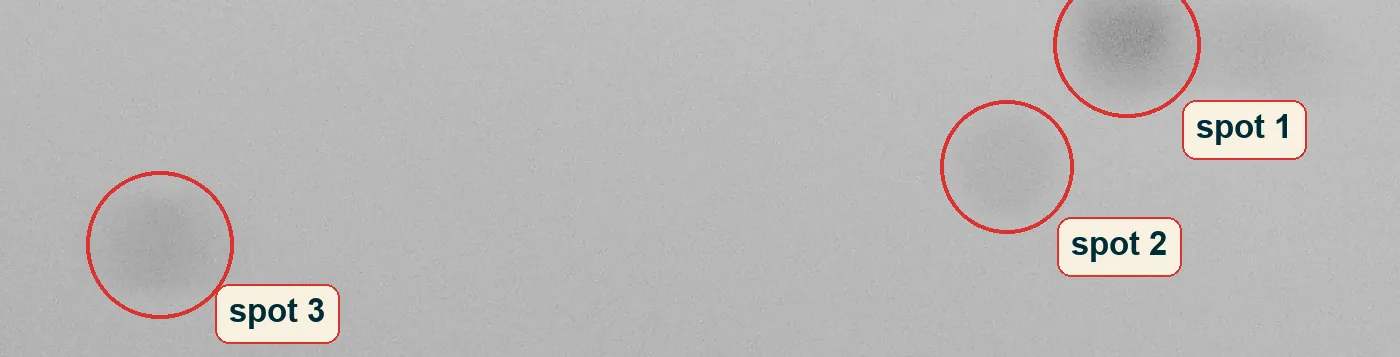
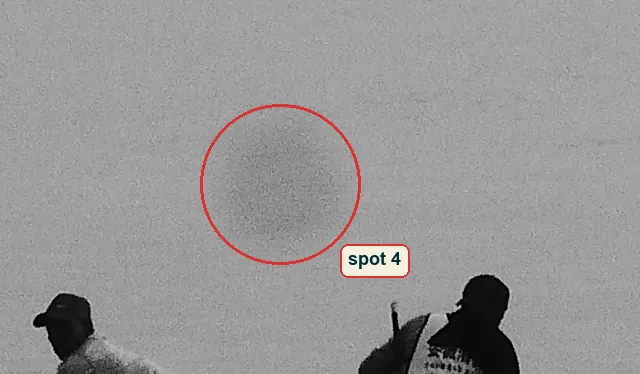
Look at the top right of the sky. There's a soft grey disc near the top edge, a fainter one below it and a third one further left, near the middle. A fourth one sits over the water just above the stern. They're round and soft at the edges, and nothing in the scene explains them. These are spots of dust on the sensor or drops on the lens, and the file can't tell you for sure which.
Three soft dark spots in the upper sky, each about 60 to 120 pixels across.The fourth spot sits over the water above the stern, the same soft grey disc.
The f-number explains why they look like this. Dust sits a little in front of the sensor, and the light reaches it from a cone the size of the aperture. At f/5.6 that cone is still wide, so each speck throws a soft blurry shadow and not a sharp dot. Stop down further and the same spots would turn darker and sharper. Open up to f/2 and they would nearly vanish. On an empty grey sky even a soft shadow shows, because there's nothing else there to look at. In a compact with a zoom that moves in and out, dust gets inside and stays, and you can't clean it yourself. The fix in the edit takes a minute, four clicks with a healing brush on flat grey sky. The fix before the trip is to shoot a plain sky or a white wall, look at it at full size and send the camera for a clean if you see discs. If it's water, a dry cloth on the front glass before the first frame is enough. Four grey dots cost this frame more than any sharper lens would have given it.
**Basically,** Bahari shwari haitoi wanamaji stadi, "Smooth seas do not make skillful sailors." A smooth sky shows every speck of dust.
## Try this
Go to a place where people wait for something to move, a jetty, a ferry pier, a bus stop by a river. Zoom to the long end of your camera or use the 3x lens of a phone, set the exposure two thirds of a stop darker and frame so the horizon sits a little above the middle. Wait until someone in the group reaches for a rope, a door or a bag, and shoot a burst. Before you go, take one frame of a plain sky and check it at full size for soft grey discs.
Dial the exposure down, keep the horizon level and wait for the one gesture that pulls.
**Basically,** "One does not use someone else's eyes to see the road." Igbo proverb, tr. F. W. Pritchett. Watch for the hand on the rope.
## Waiting for the tide
Go back to the two people in the water. They're the only ones not in the boat and not on the beach. They stand between both, in surf that barely reaches their shins, beside a motor whose lower end just touches the water.
The two people in the water stand beside the stern, and the motor barely reaches the sea.
At first the picture looked like a boat full of people. Now it looks like a boat that can't go yet. It's too shallow, too early and too full for one man to push. The sky is empty and the sea is flat, and everyone in the frame is waiting for the same thing. That might be water, light or the last passenger, and the picture won't say. A Swahili proverb says it in four words. Wait, wait, the tide will rise.
**Basically,** Subiri, subiri, tajaa bahari, "Wait, wait, the tide will rise." The two people in the water already know it.
## Sources
- [Swahili Proverbs, Cooperation (University of Illinois, Center for African Studies)](https://swahiliproverbs.afrst.illinois.edu/cooperation.html) No. 1286, Mmoja hashui chombo, One man cannot launch a vessel. The proverb in the title.
- [Swahili Proverbs, Hurry and patience (University of Illinois)](https://swahiliproverbs.afrst.illinois.edu/hurry.html) No. 2783, Ngoja kuche si mbali, and No. 2798, Subiri, subiri, tajaa bahari.
- [Swahili Proverbs, Experience (University of Illinois)](https://swahiliproverbs.afrst.illinois.edu/experience.html) No. 1841, Bahari shwari haitoi wanamaji stadi.
- [Panasonic Lumix DMC-LF1 (DPReview)](https://www.dpreview.com/products/panasonic/compacts/panasonic_dmclf1/) 12MP 1/1.7-inch sensor, 28-200mm equivalent F2.0-5.9 lens, electronic viewfinder.
- [Hiroshi Sugimoto (Wikipedia)](https://en.wikipedia.org/wiki/Hiroshi_Sugimoto) The Seascapes series, begun in 1980, large format, exposures up to three hours, horizon exactly in half.
- [Swahili proverbs (Wikiquote)](https://en.wikiquote.org/wiki/Swahili_proverbs)
- [Depth of field (Wikipedia)](https://en.wikipedia.org/wiki/Depth_of_field)
- [Crop factor (Wikipedia)](https://en.wikipedia.org/wiki/Crop_factor)
- [Exposure value (Wikipedia)](https://en.wikipedia.org/wiki/Exposure_value)
- [Ogbalu, Ilu Igbo, tr. Frances W. Pritchett](https://franpritchett.com/00fwp/igbo/proverbs/031_043.html) Carefulness and Respect, Nos. 8 and 14: One does not use someone else's eyes to see the road, and One hand does not tie a package. Draft translation by Frances W. Pritchett.
- [Ilu Igbo, translation and edition details](https://franpritchett.com/00fwp/igbo/proverbs/index.html) F. C. Ogbalu, The Book of Igbo Proverbs, Varsity Press, Onitsha, 1965. Draft English translation by Frances W. Pritchett.