A white colt glimpsed through a crack in the wall
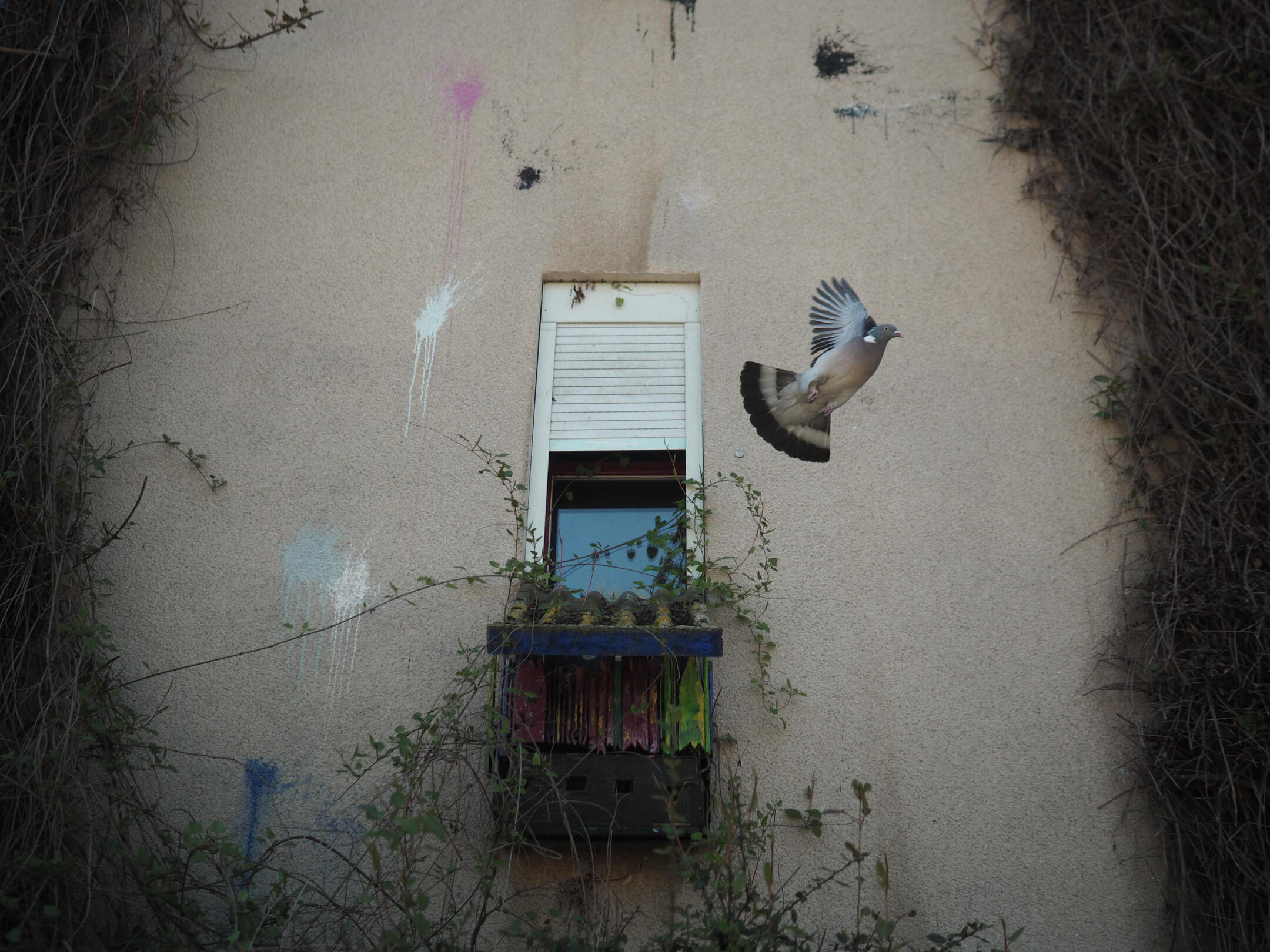
TL;DR: A wood pigeon is caught at the top of its wingbeat beside a narrow shuttered window on a stained, paint-splattered wall. Soft wingtips and a sharp eye point to about 1/1000 s, and the 4:3 frame, deep focus and smoothed noise lean towards a small-sensor digital camera. All of it is estimated, no EXIF exists. The one mistake is the dark edge. Vines plus a darkened border put about a quarter of the frame below 40 out of 255, and the fix is to lift it or step closer.
The title is a Chinese proverb, 白駒過隙 (bái jū guò xì), from the Zhuangzi.
A bird leaves and a wall stays
You see the bird first. A wood pigeon hangs in the air just right of a narrow window, wings up high, tail spread wide like a hand of cards. Then your eye slides left and the real subject arrives, and it is a wall. Sand coloured render, a dark rain stain, thrown paint in pink and white and blue, a shutter half down, and a crooked stack of planks and a crate under the window.
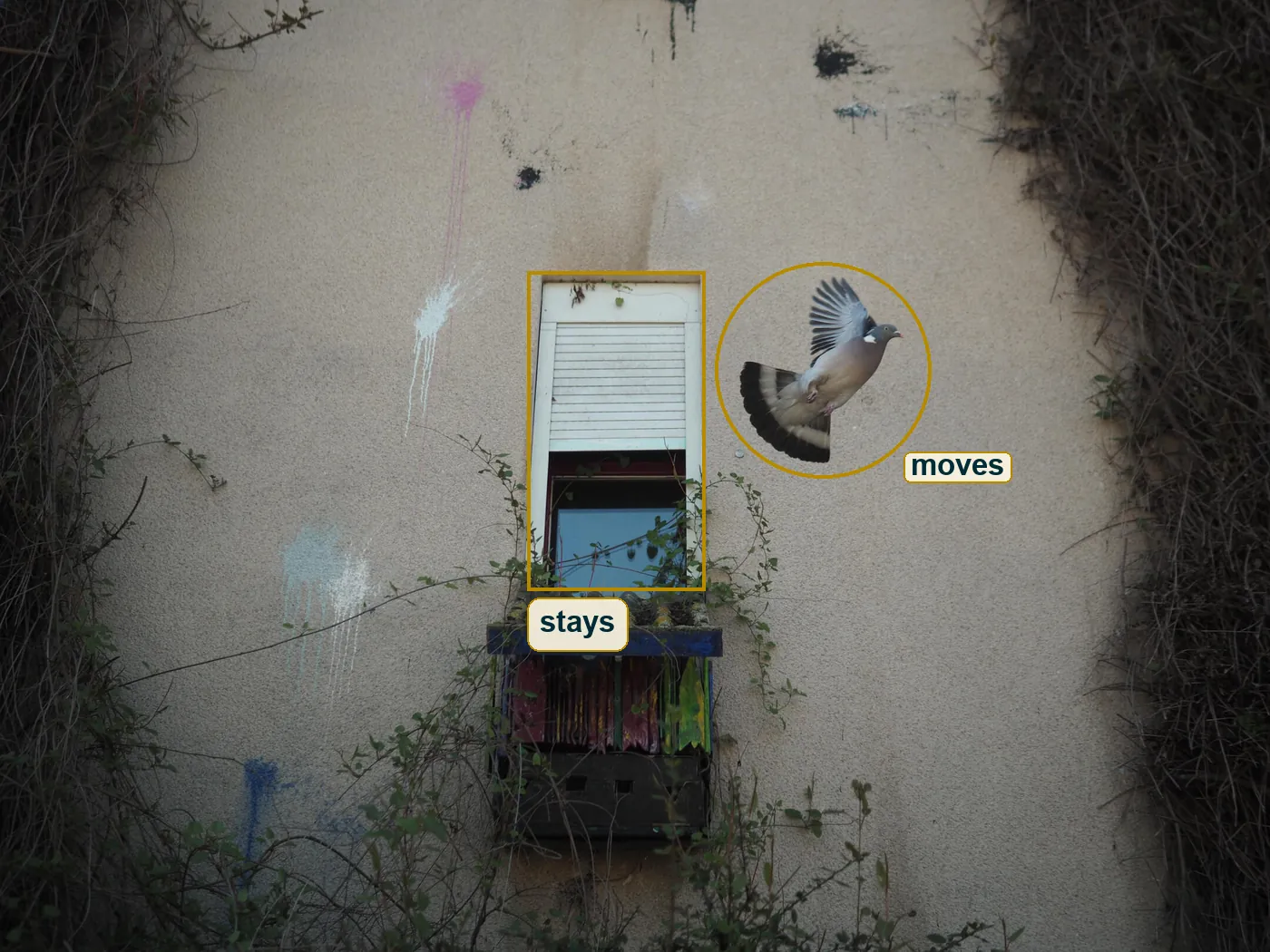
The photograph is about that pairing. One thing in it will be gone in a second and everything else has been piling up for years. A camera is the one tool that gives both the same weight in the same rectangle, and this frame does exactly that. Keep the two circles in mind, the bird and the window, because every part of this reading comes back to them.
How you know it is a wood pigeon
Look at the neck before you look at anything else. There is a small white patch on the side of it, and a white crescent shows on the wing. That is the mark that tells a wood pigeon from the grey city pigeon that sits on every station roof. The breast is a dusty pink, the head is blue grey, and the beak is pink with a pale tip.
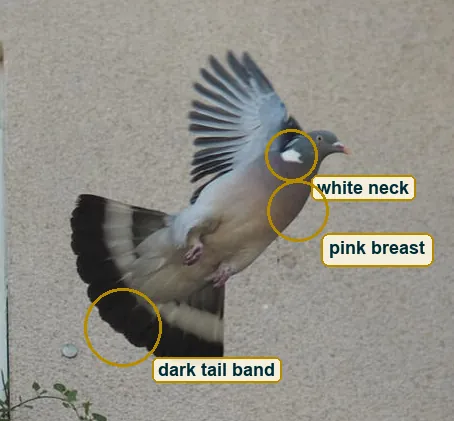
The tail tells you the rest. It is fanned wide, grey at the base, with a pale band across the middle and a broad dark band at the tip. Wood pigeons are big, about 38 to 44 cm long with a wingspan up to about 80 cm, and that size matters later, because a bird of known size is a ruler you can use to measure the whole scene. The feet hang pink below the belly. A pigeon only shows its feet like that close to a take-off or a landing.
Years of paint and rain
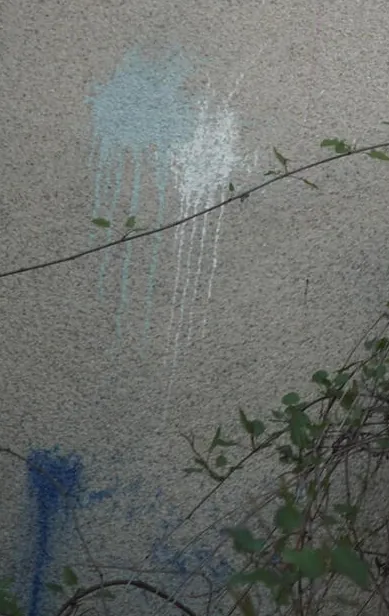
Now go back to the wall and read it like a page. Up left there is a pink burst with two thin drips running down. Below it a white splash with longer drips. Further down a pale blue blot, and near the bottom a strong cobalt one. Somebody threw paint at this wall, more than once and in more than one colour.
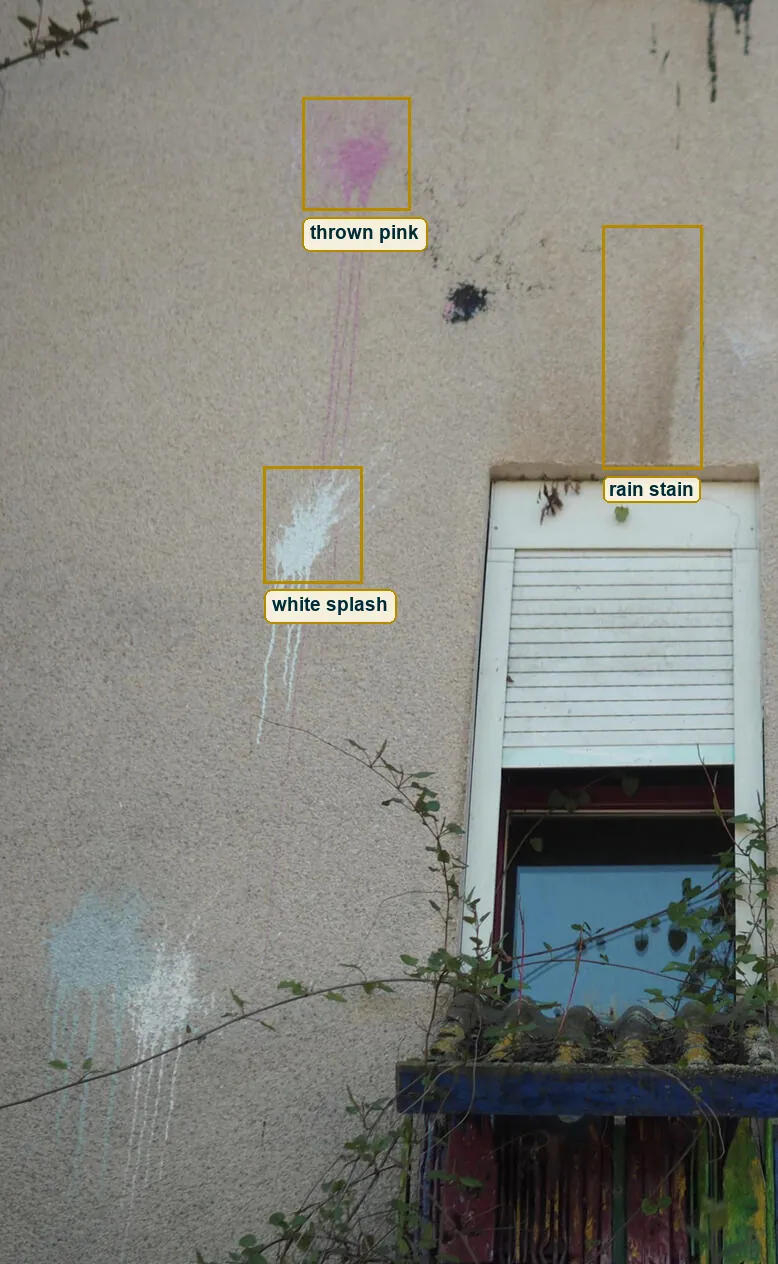
Over the window runs a darker vertical stain, the brown of water that has come down the same path for years. Black spatter sits near the top edge. Under the window someone has built a little ledge out of what was around, a mossy sheet of corrugated roofing, a blue plank, a panel of slats in red, yellow and green, a dark plastic crate. Dry vines hang in from both sides like curtains. None of this was made for a photograph. It was all just there, and the photographer only had to stand in front of it and see it.
Grey light and no shadow
The light has no clear direction. Nothing in the frame throws a hard shadow, and the brightest wall sits near the centre and upper middle. There is one thin dark line under the top lip of the window recess, and the undersides of the blue plank and the corrugated sheet are a bit darker. That says the light comes softly from above and in front, an overcast sky or a facade in open shade.
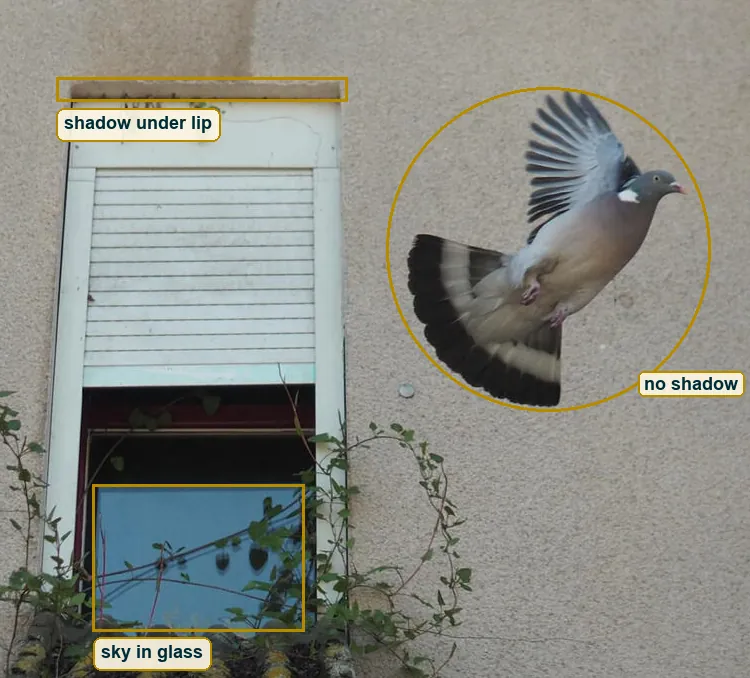
The glass is the brightest cool thing in the picture. It shows pale blue sky, so the window faces out to open sky and not into a narrow street. That light is generous to the wall. Every grain of render shows, the drips have body, and the white shutter slats keep their lines without burning out. Hard sun from the side would have made the paint splashes look like stickers and thrown the vine shadows all over the wall.
It is less kind to the bird. The pigeon gets almost no modelling, its belly is barely darker than its back, and it throws no shadow on the wall. Under a grey sky a bird some metres in front of a wall leaves only a faint wide shadow or none, so this is physics and not a trick. But it makes the bird look a little flat, almost laid on top.
One window in the middle
The window sits almost dead on the vertical centre of the frame. It is the spine of the picture, and the shutter slats, the plank and the crate stack on it like a column. Centring the main shape is usually a way to make a picture stand still and do nothing. Here it gives the moving bird something fixed to push away from.
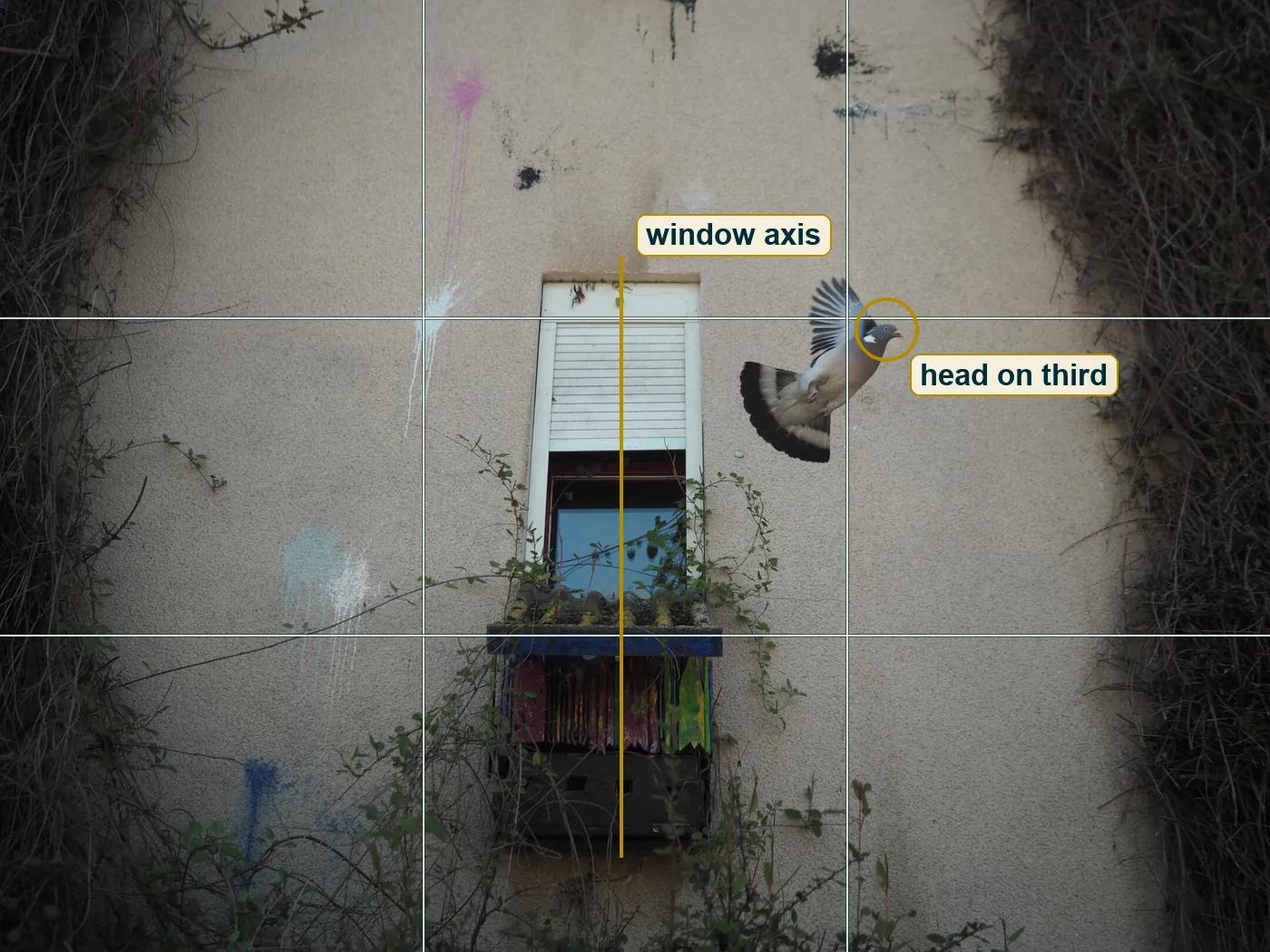
The bird breaks the grid on a diagonal. Tail down and left, head up and right, and the head lands about 3% of the frame width from the upper right third. It faces right and flies right, into the open wall, so it has room to go. Turn it around to face the vines and it would feel trapped. The vines on both sides act like a theatre curtain, and the whole thing reads as a stage set with the actor just walking off.
How far away and which lens
No EXIF exists for this file, so every number from here on is a reading and not a record. Start with the bird as a ruler. From tail tip to beak it spans roughly 300 pixels of the 2160 pixel width. A wood pigeon is about 40 cm long, and its body is a little foreshortened here, so call it 1.3 mm of real world per pixel at the bird.
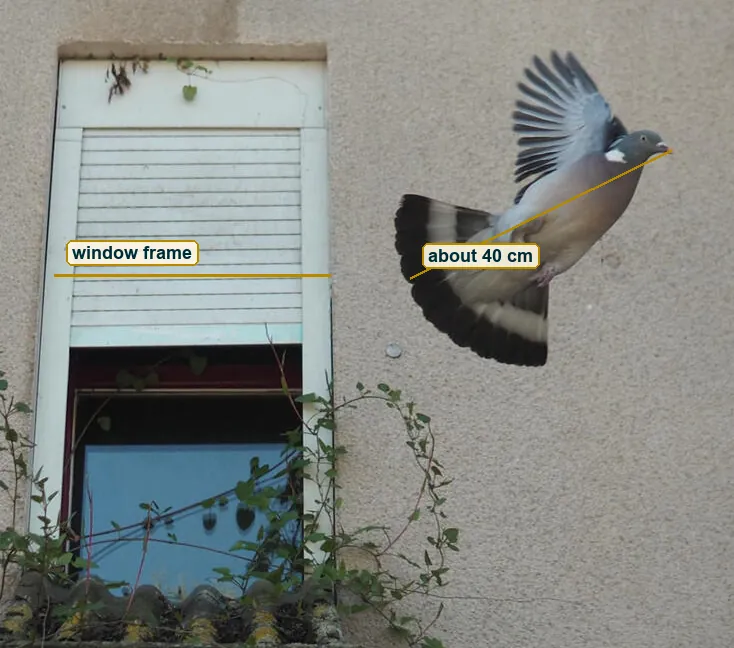
That makes the frame about 2.8 m wide at the distance of the bird. With a normal lens, 50mm in full frame terms, a 2.8 m wide view means you stand about 4 m away. With a 35mm it would be under 3 m, with an 85mm closer to 7 m. Now look at the window frame. It is about as long on screen as the bird, and a real window is wider than 40 cm. So the wall is further back than the bird, probably a few metres behind it.
The verticals help too. The window opening is about 270 pixels wide at the top and about 295 at the bottom, a mild keystone. The camera was below the window and tilted up a little. The flat look of the wall and the even size of the paint marks from left to right fit a normal lens or a short tele, roughly 40 to 90mm in full frame terms. A 24mm from close up would have bent the edges and made the window lean much harder.
The top of the wingbeat
A wing moves fastest in the middle of each stroke and slows near the top and bottom, where it turns. This frame catches the top. The near wing is raised almost straight up, the long primary feathers fan out with clear gaps between them, and the tail is spread and angled down. The feet hang. That is the shape of a bird climbing hard, the shape of a take-off.
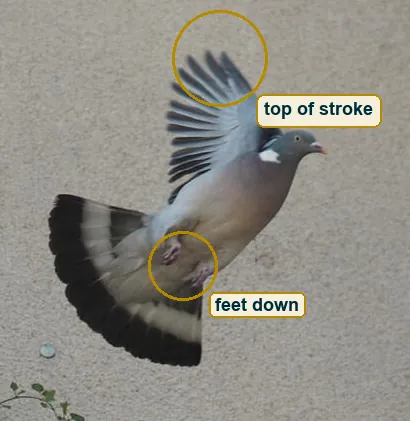
Lab work on city pigeons found that wingbeat frequency and downstroke speed are highest during take-off and drop with each beat after. So the first beats are the hardest to freeze. The bird is close to the ledge under the window and heading away from it, so the likely story is that it just left. The frame can't prove that. What it does show is timing. Either the photographer had the frame set and waited, or fired a burst as the bird went. A few hundredths of a second later and the wing would be sweeping down through the body as a grey smear. Wood pigeons take off with a loud clatter of wings, so the sound may well have come before the picture.
Shutter, aperture and ISO estimated
Shutter first, because the bird tells you. Look at the eye. It is a small dark dot with a pale ring and a clean edge. Now look at the tips of the raised primaries. They are softer, their edges smeared into the wall, but you can still count the feathers. That gap between sharp eye and soft tips is the reading.
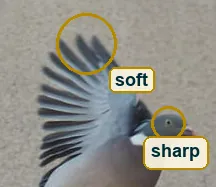
Say the tips smear by 3 to 5 pixels. At 1.3 mm per pixel that is 4 to 7 mm of movement while the shutter was open. Near the top of the stroke a wingtip slows down a lot. Guess about 5 m/s, and in 1/1000 s that is 5 mm. So 1/1000 s fits. Side by side, 1/250 s would turn the same tips into a smear of 12 to 20 pixels and you would lose the separate feathers. At 1/4000 s the tips would look as hard as the eye. 1/500 s is possible too, because the slow top of the stroke buys some slack.
Aperture follows from depth. The bird at about 4 m and the wall a few metres behind both hold detail at this size. On full frame that needs about f/8. On a Micro Four Thirds camera the same depth comes at about f/4, and on a phone it comes for free. Side by side again, a full frame lens at f/2 from 4 m would keep the bird and melt the paint drips into soft colour, and the wall would stop being half the subject.
ISO follows from the light. 1/1000 s at f/5.6 needs about three stops more light than an overcast sky gives at ISO 100, so ISO 800 is a fair guess, and in open shade closer to 1600. Working guess is 1/1000 s, f/5.6 on a small sensor, ISO around 800. A reconstruction, not a record.
Film or digital
The frame is 4:3, 2160 by 1620 pixels. That is not the 3:2 of 35mm film or most full frame and APS-C cameras. 4:3 is the native shape of Micro Four Thirds and the default of most phone cameras. Anyone can crop to 4:3, so this leans but doesn't prove.
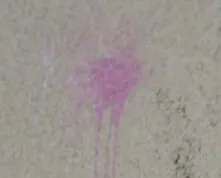
The flat wall is where film grain would show most, and there is none. Grain is crisp and clumpy at every scale. Here you see soft blotches a few pixels across that melt into each other, and a faint colour mottle in the grey. That is digital noise after noise reduction, the look of a small sensor or a phone in modest light. Measured on a plain patch of wall near the bird, the fine pixel noise is tiny, under 3 levels out of 255, which says the file was cleaned and probably downsized. The white shutter slats also roll off cleanly with no hard clipping.
A wall for Siskind, wings for Stevens
Two traditions meet in this frame. The first is the wall as a picture in itself. Aaron Siskind spent decades on close details of painted walls and graffiti, tar on asphalt and peeling surfaces, and shot them flat until they read as abstract paintings. He was close to Franz Kline, Mark Rothko and Willem de Kooning, and MoMA later showed his work in its Abstract Expressionist New York show.
The second is the frozen instant. Harold Edgerton at MIT made strobe light the tool that stopped bullets and milk drops, and one of his known photographs is called Pigeon Release, from 1965. What took a lab and a flash then is now a setting on a phone. This frame refuses to choose. It is a wall study with a decisive moment dropped into it.
The writer for this picture is Wallace Stevens. His poem Sunday Morning, from Harmonium in 1923, ends on birds, "At evening, casual flocks of pigeons make / Ambiguous undulations as they sink", and the last line takes them down into the dark. It is about evening and about death, and the same poem says "Death is the mother of beauty". The pigeon here does the opposite. It climbs, wings up, into the brightest part of the wall. Emily Dickinson wrote "Hope is the thing with feathers / That perches in the soul". This one doesn't perch. It has just stopped perching. Put the two poems next to the photograph and you get a small argument about whether birds mean leaving or staying, and the picture votes for leaving.
The one mistake
The dark edge is too heavy. Measured on the file, about a quarter of all pixels sit below 40 out of 255, and the outer tenth on each side is almost all near black. The corners have a median around 20 to 27 while the bright wall in the upper middle sits around 150, about six times brighter.
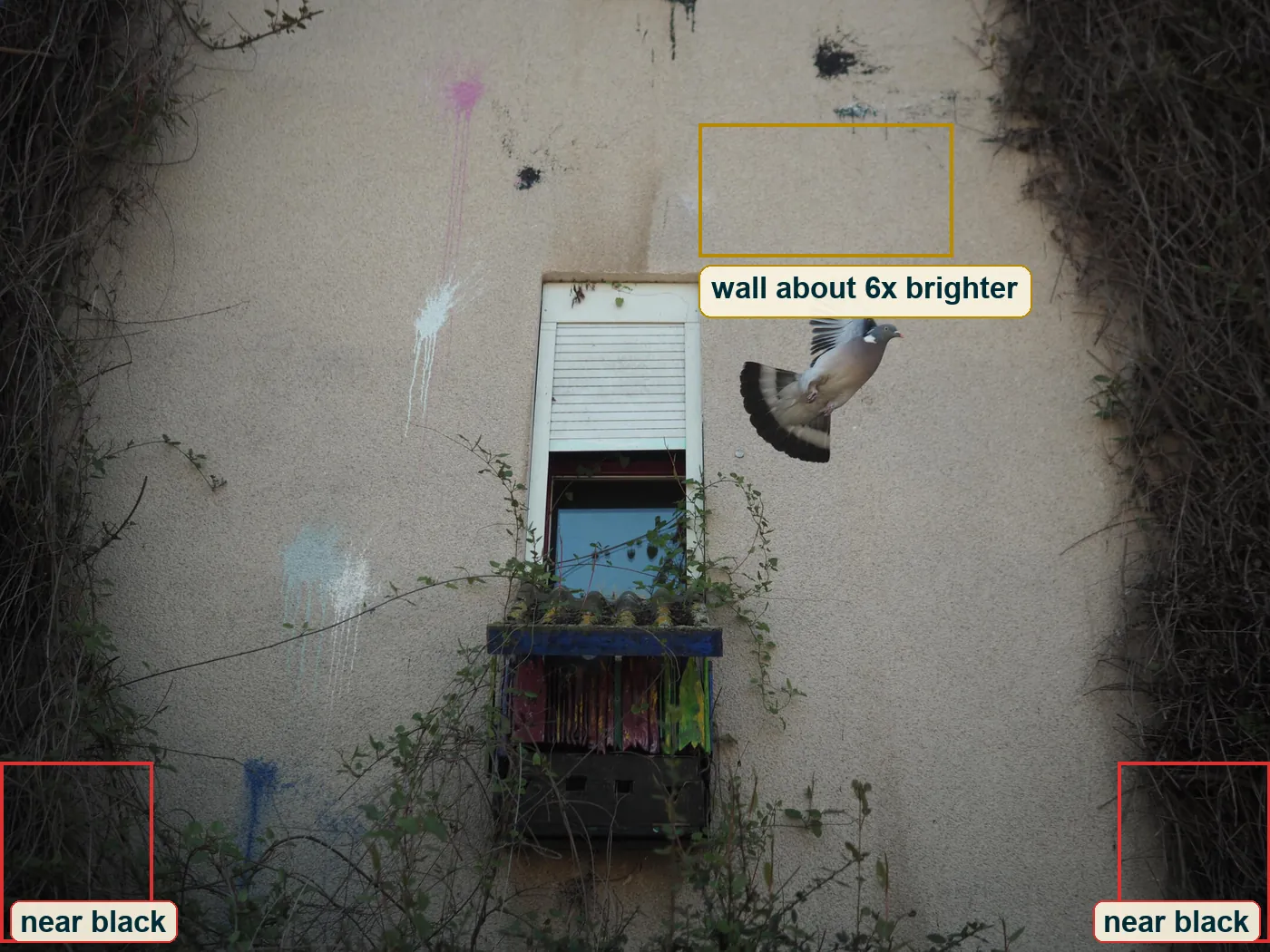
Most of that is honest, because the vines really are dark. The plain wall also gets a bit darker towards its edges, from about 155 in the middle to about 130 near the top and sides, and the round shape of the dark border looks like a vignette was added on top. The file can't tell you how much is vine and how much is filter. The result is clear anyway. The bottom corners carry almost nothing you can read, they make the picture look filtered, and they eat frame space that the wall could use. The fix is cheap. In the edit lift the deep shadows and drop any vignette, or at the scene take one step closer so the vines take less of the frame. The eye would still go to the centre, because that is where the light is.
Try this
Find a wall you like, with texture, some colour and one clear shape like a window or a door. Put that shape near the centre and leave an empty patch of wall on one side, then lock focus and exposure on the wall and don't move. Set 1/1000 s with auto ISO, or on a phone hold burst and stay off night mode. Wait twenty minutes for anything alive to cross the empty patch, and shoot the moment it enters.
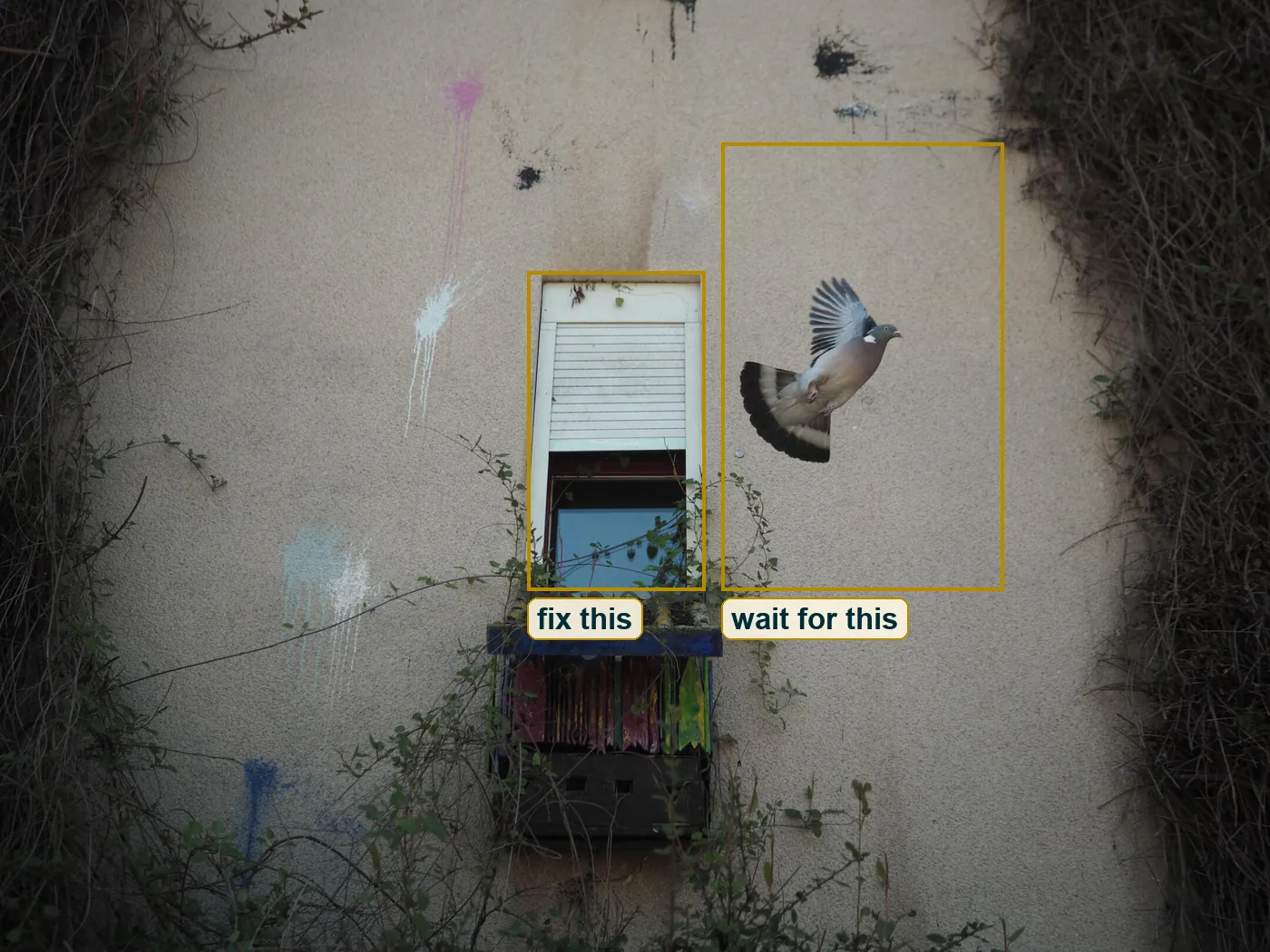
A photograph about leaving
Look at the opening pair again, the bird and the window. At first it was a contrast between fast and slow. After the reading it is something else. The window has a shutter half down and a ledge someone built by hand, so somebody lives or lived behind it, and the bird has just left that ledge.
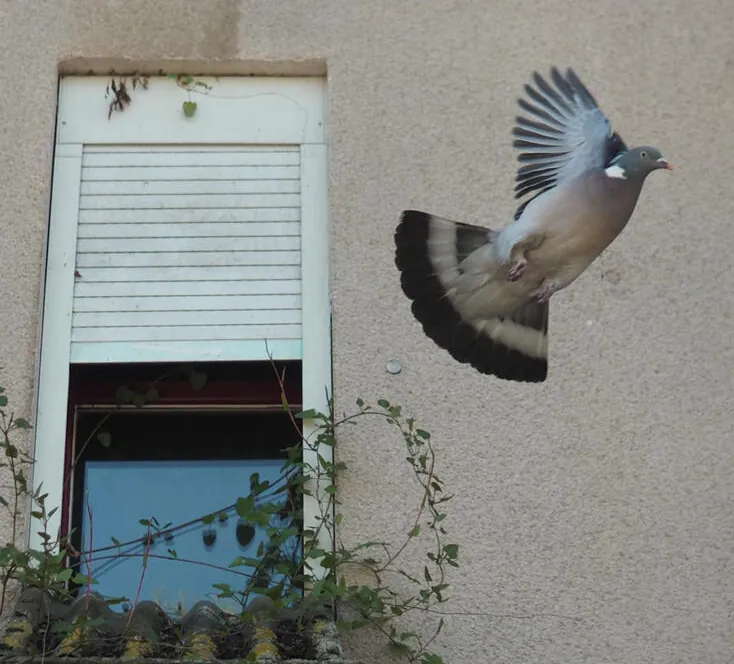
Take the pigeon out and you have a good wall study. With it you have a photograph about leaving, one thousandth of a second against years of paint and rain, and the wall stays.