Walls have ears, paper screens have eyes
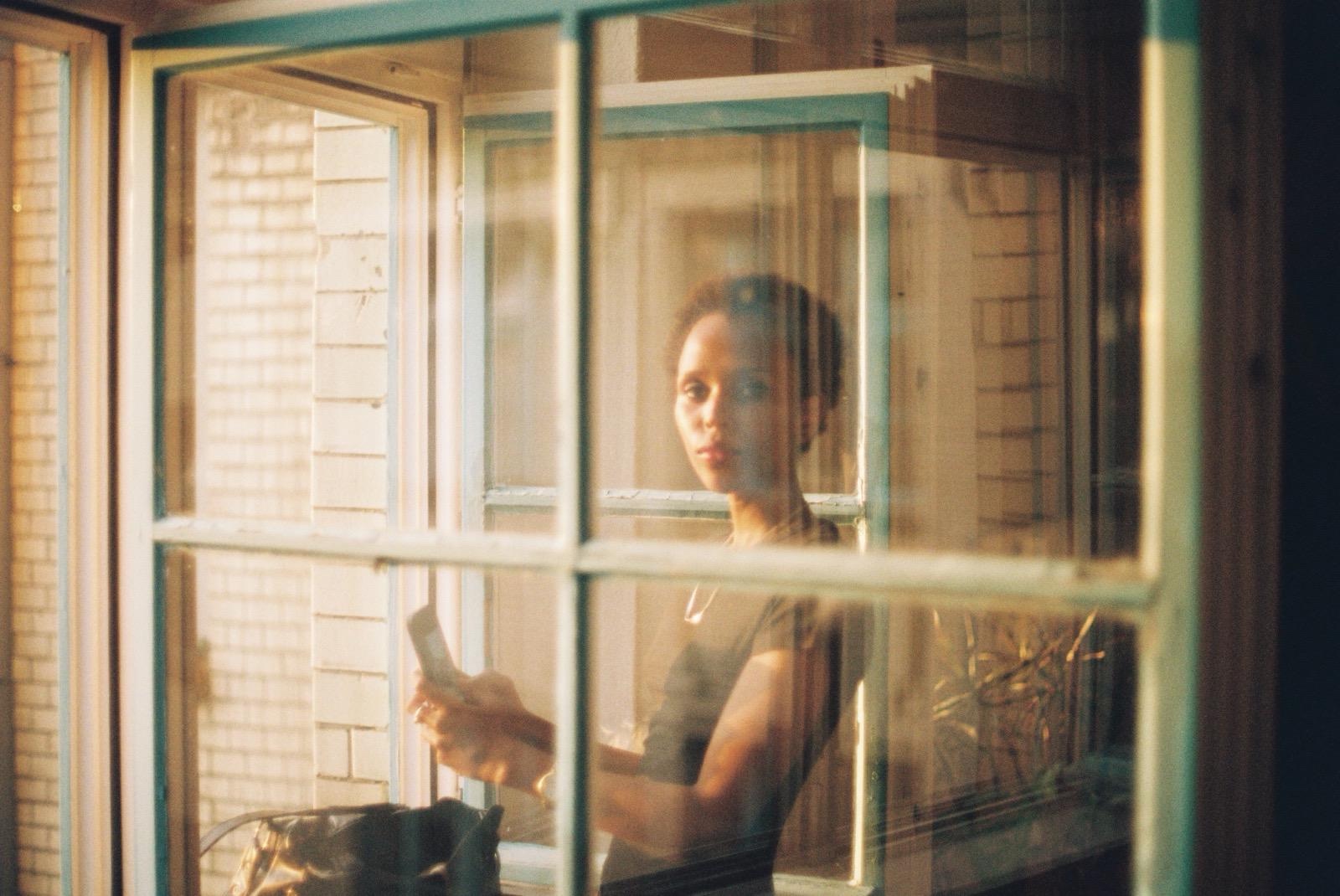
TL;DR: A woman behind a shut window looks up from her phone and straight at the lens, while low sun turns the scene amber. Two window grids split her face from her hands, and reflections lay a second street over the room. The bright brick wall is the one flaw. No settings are known. The reading is a 35 to 50mm lens at 2 to 2.5 m, about f/5.6 and 1/250 s, probably colour negative film.
The title is a Japanese proverb, 壁に耳あり障子に目あり (kabe ni mimi ari, shōji ni me ari).
Her eyes come first
You see her eyes before you see the window. That is strange, because the window takes up most of the frame. Cream bars, teal edges, chipped paint, a rail that slopes. And behind all of it a woman with her body turned to the left and her head turned back, looking straight into the lens. Her eyes sit a little right of centre and a little above it, and they hold you there before anything else gets a chance.
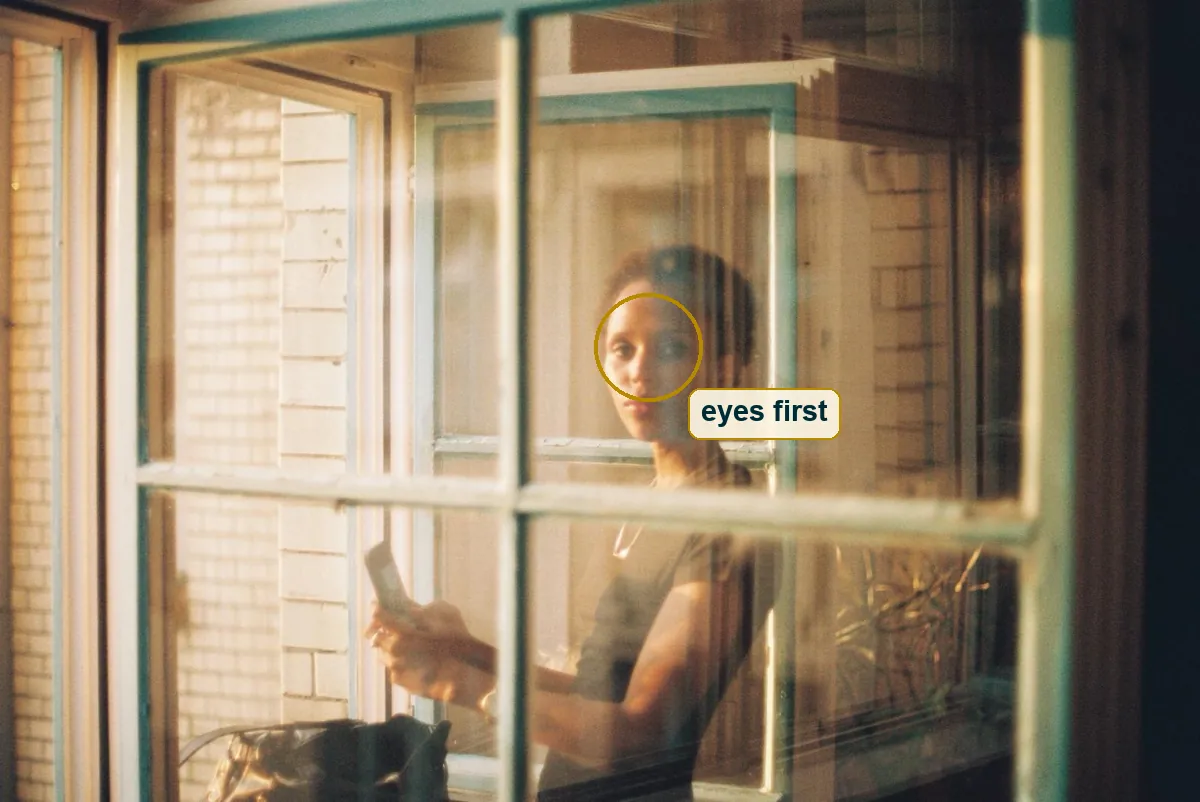
Your eye goes to a face before almost anything else in a picture, and inside the face it goes to the eyes. Here that habit gets help, because her eyes are the one place where the picture looks back at you. Everything else in this reading is about what keeps you there and what pulls you away.
A phone with its back to us
In her hands, held low on the left, is a small pale phone. You see its back or its closed shell, not a screen. There is no glow on her fingers and none on her face. It is too soft to say what kind of phone it is, and the picture doesn't need that.
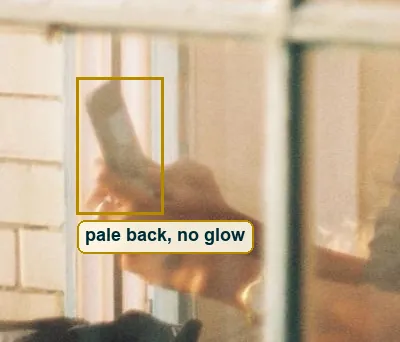
What matters is the job it does. The phone is where her attention was a second ago. Her hands still hold it ready, the way you hold a phone when you plan to look down again soon. Her head has already left it. So the picture holds two moments at once. The hands are still in the moment before and the face is in the moment now. That split is the story, and it costs nothing, just one turned head.
A grid laid over a person
Now look at the bars. A thick cream mullion runs top to bottom at about 42 percent of the width. A second one stands at about 86 percent, and past it the frame falls into dark wood. A wide rail crosses a little below the middle and slopes down to the right by about 3 degrees.
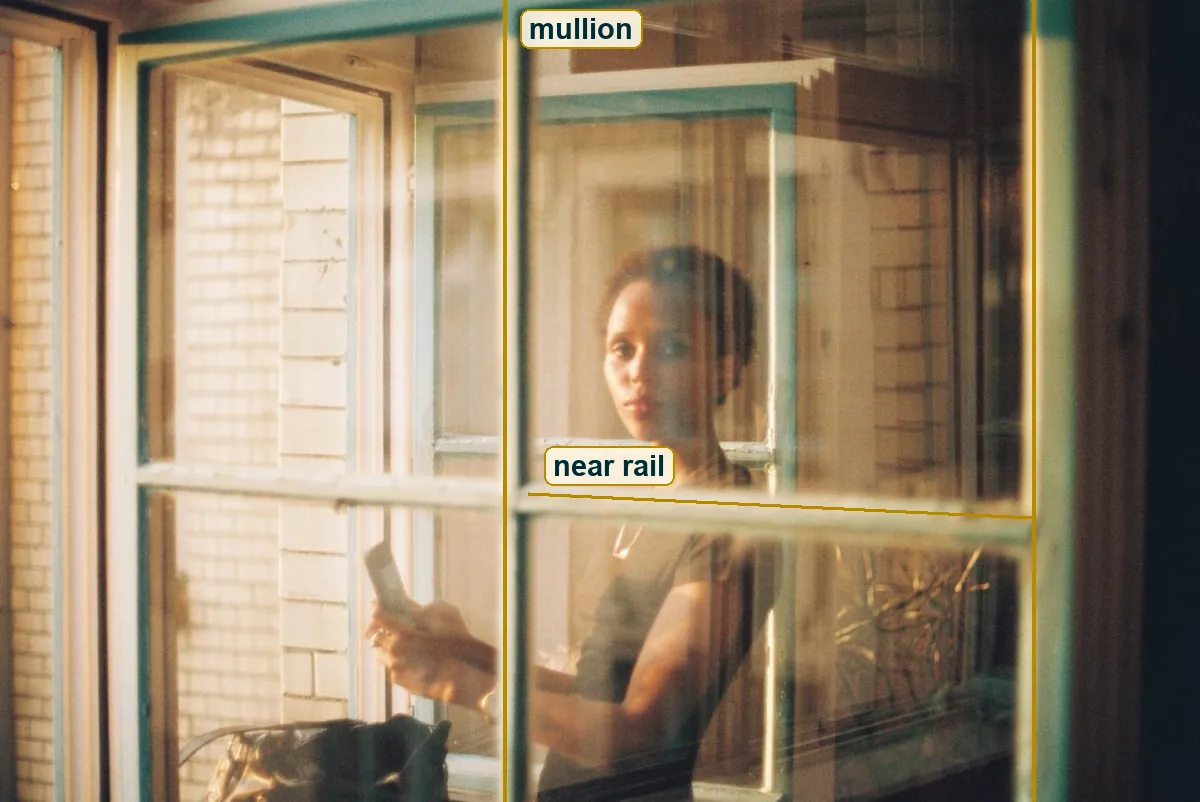
There are really two windows. The near one, the one the camera looks through, is soft because it's close to the lens. The far one stands behind her in the room, with its own thin rail and teal frame. The far rail crosses her neck. The near rail crosses her collarbones. So she is boxed twice, once by her own window and once by ours.
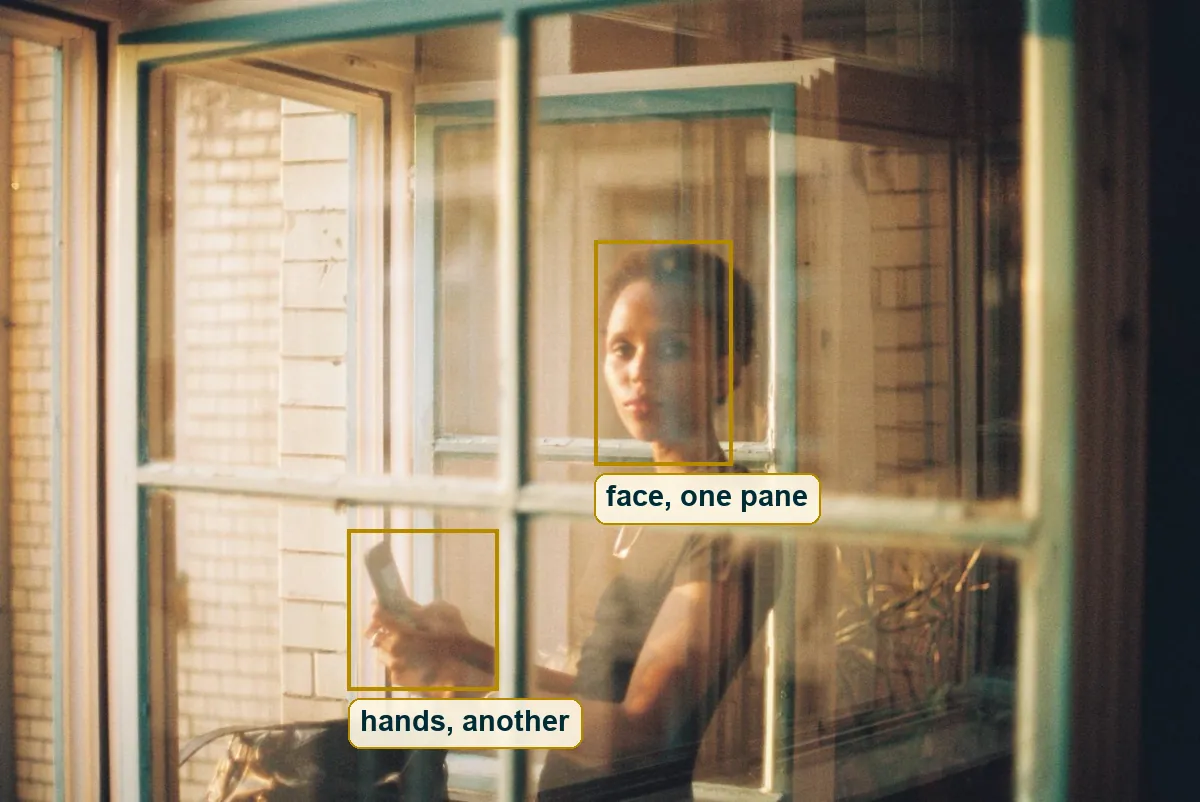
The grid does the editing for you. Her face sits alone in the upper right pane. Her hands and the phone sit in the lower left pane, on the other side of both bars. Two activities in two cells, like two panels of a comic that you have to join yourself.
The slope is a clue too. The vertical bars stay straight, so the camera wasn't tipped up or down much. A rail that slopes while the verticals stay straight usually means the photographer stood a little to the side of the window and not square to it.
Off the thirds, on purpose
Put a thirds grid over the photo and her face lands in the middle cell, a little right and a little high. Not on a thirds point, and not near the classic placement for a portrait.
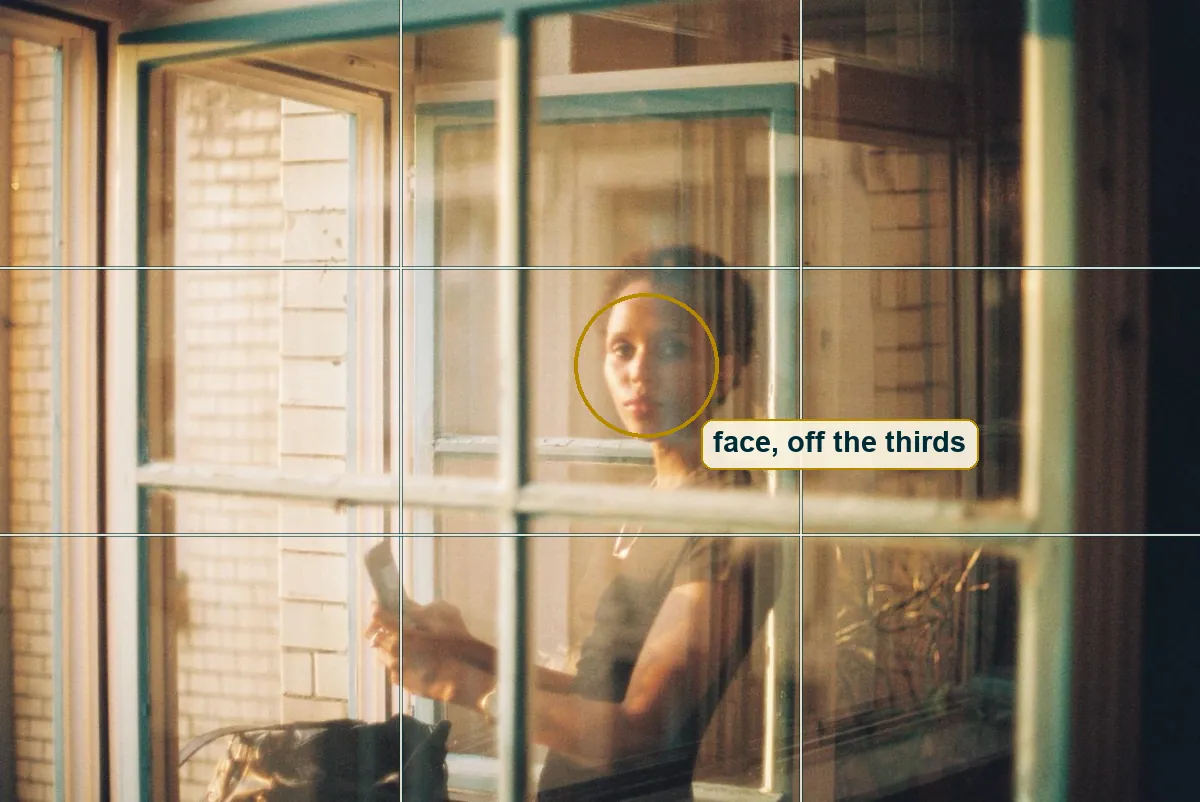
It still doesn't feel centred, and the reason is the window. The mullion left of her and the bright brick on the far left pull weight to that side. The figure on the right is darker and fuller. So the picture balances like a scale with a small bright weight on one side and a big dark one on the other. The thirds rule is only a shortcut for this kind of balance. When the scene already has strong lines, you can let the lines do the off-centre work and keep the face where it is strongest, near the middle, looking out.
Light from the left, softened twice
The light is late and low and comes from the left. You can read it on her face. The left cheek is bright and warm and the right side falls off into brown. Measured on the file, the shadow side is about a stop and a half darker than the lit side, which is a soft ratio for sun.
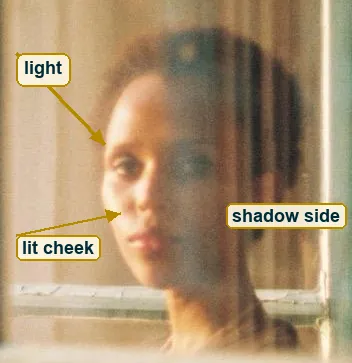
Why so soft if it's the sun? Because it reaches her filtered. Part of it bounces off the cream brick and paint outside, and all of it passes through glass. The brick wall itself is lit hard, you can see the mortar lines and the seams between the blocks. Her face, behind the glass, gets the gentle version of the same sun. One source and two qualities of light.
The colour tells you the hour. Golden hour light sits around 3,500 K, against about 5,500 K at midday. That is why the cream wall turns honey and her skin warms. A digital camera on auto white balance would likely pull half of this warmth out again. Film shot with daylight balance keeps it.
Ghost bricks on the glass
In the upper right pane, over the room behind her, there is a second picture. Faint brick courses, evenly spaced, a bright stepped edge at the top like a roof line, and a teal frame that isn't in the room at all. That is the outside, reflected in the glass and lying over the inside.
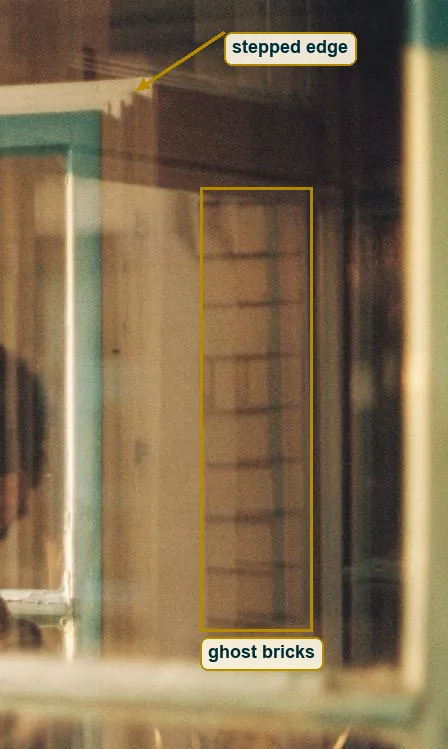
They show on the right and not on the left for one reason. A reflection only shows where the thing behind the glass is darker than the thing being reflected. On the left the view through the glass is the sunlit wall, brighter than any reflection, so that glass looks clear. On the right the room is in shade, so the reflected wall wins. Glass is a mirror wherever the room behind it is dark.
That gives you more control than you'd think. Move half a step and the reflections slide across her. Here they stay mostly on the dark pane next to her, with only a thin veil over the shadow side of her face. A polarising filter could cut them, but then you lose the second layer that makes this a picture about glass.
Teal paint, amber hour
Two colour families carry the frame. Teal in the window paint, on the top rail and along the edges of the bars. Amber, cream and peach everywhere the sun falls, on brick and skin and the near wood.
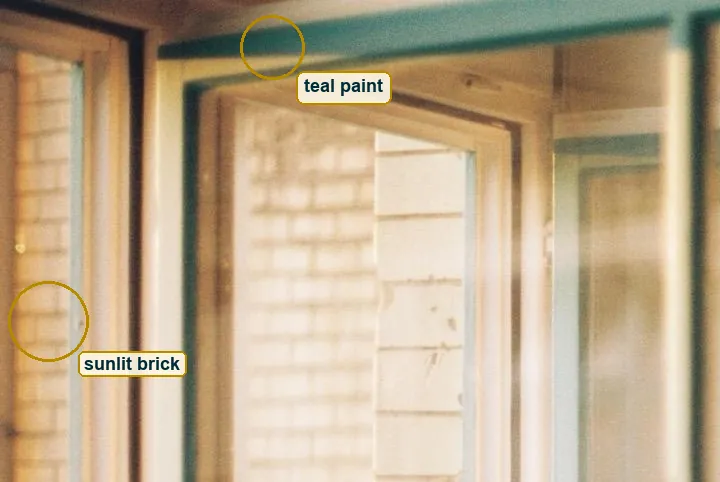
Teal and orange sit opposite each other on the colour wheel, and film colourists have pushed that pair for years. Here nobody had to push. The paint is old and real, and the hour does the orange. The teal is quiet too, darker and greyer than in a grade, because it sits in shade under the top rail. That restraint is what makes it look found and not made.
Saturation stays moderate. The blacks lift to dark brown, and the darkest corner of the file sits around 20 out of 255 and never at zero. The highlights roll into cream, and fewer than one pixel in two thousand touches full white. This is a picture with room at both ends.
How far away, which lens
No camera data came with this file, so the lens has to be read from the picture. The file is 1600 by 1070 pixels, almost exactly 3:2, the shape of a 35mm film frame and of most system cameras. Most phones shoot 4:3. That points to a camera, or a crop to that shape.
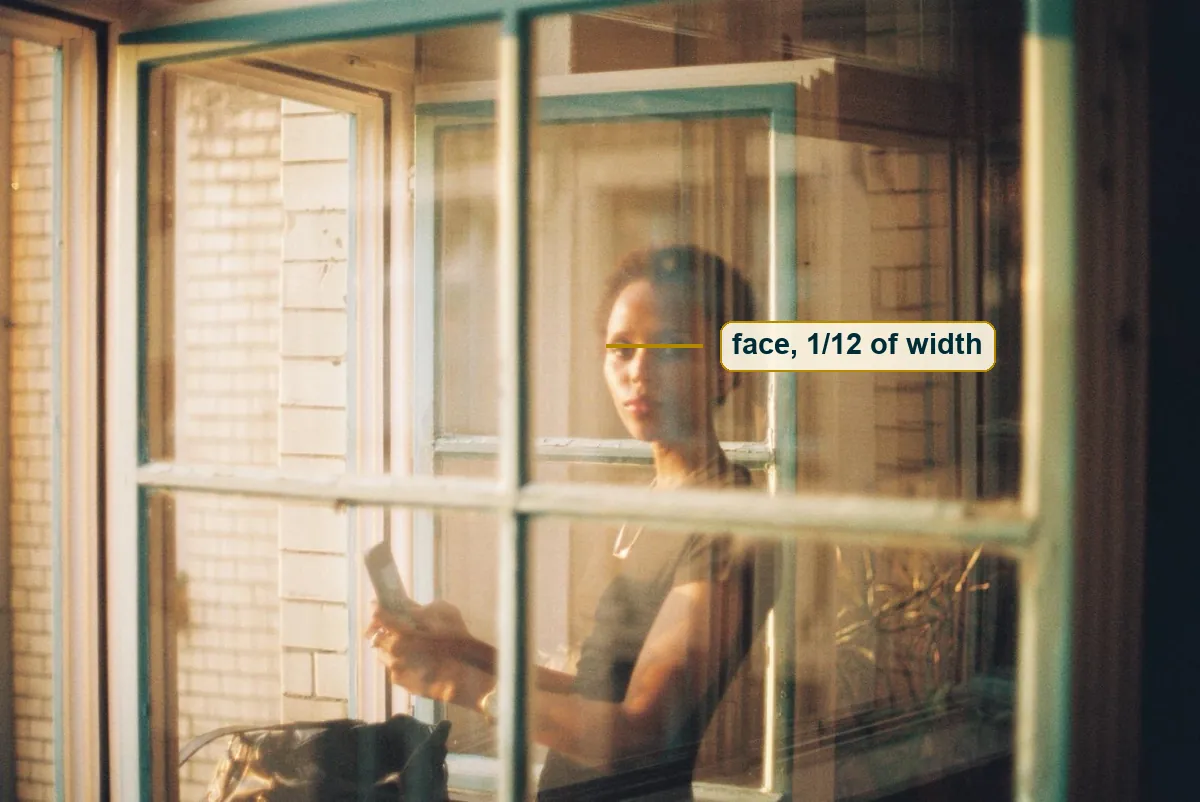
Then measure. Her face is about 130 pixels wide, roughly one twelfth of the frame. An adult face is about 14 cm across, so the frame covers about 1.7 m of width where she stands. With a 50mm lens that puts the camera about 2.4 m from her. With a 35mm lens, about 1.7 m. These are estimates, and a few centimetres of face change them a little.
Perspective narrows it down. The bars don't lean outwards or stretch at the edges, which rules out a wide lens. The near window and the far wall don't stack flat either, which rules out a long one. So something between 35 and 50mm, a normal lens, held at about her face height.
Aperture, shutter and one other setting
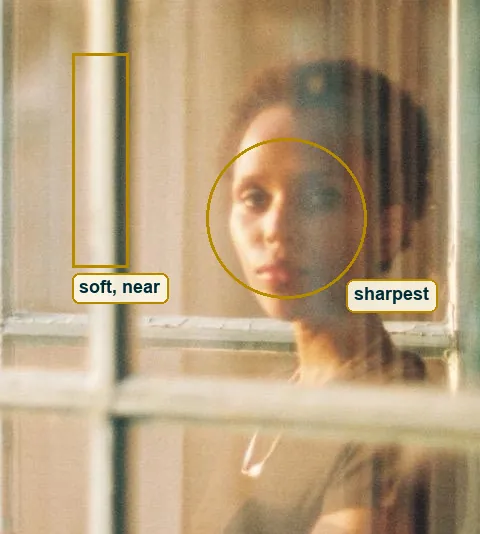
Depth of field gives the aperture. Her face is the clearest thing in the frame. The near mullion is soft and so is the brick through the open casement. So the zone of focus is moderate, not deep. At 50mm and 2.4 m, f/5.6 gives a sharp zone from about 2.1 to 2.9 m, which fits.
Movement gives the shutter. Her hands are soft but not streaked, and the small bright ring on her finger shows as a round blob and not a line. So nothing moved much during the exposure. A handheld normal lens is safe at 1/125 s and comfortable at 1/250 s.
The sunny 16 rule checks it. In full sun it's f/16 at one over the ISO. Low sun is about three stops weaker, and her spot behind glass maybe another stop. On ISO 400 film that lands near f/5.6 at 1/250 s. Every number here is a guess with a reason, not a fact.
Now swap one setting and keep the light. At f/2 the shutter goes to about 1/2000 s. The bars would turn to cream fog and her face would float in a soft box. Prettier maybe, but the grid that splits her face from her hands would go, and that split is the picture. The other way, f/11 at 1/60 s. The bars and the ghost bricks come sharp and start to fight her face, and at 1/60 s a handheld camera starts to shake.
Film or digital
Look at the pixels at full size, on her bent arm and dark T-shirt. The grain is clumpy and uneven, with soft colour blotches, teal in the dark parts and magenta in the skin. It isn't the fine even speckle you get from a digital sensor.
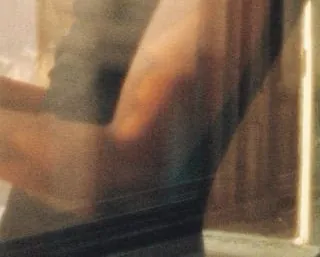
Three traits point the same way. The grain is strongest in the shadows, which is where colour negative film shows it. The highlights roll into cream instead of cutting off. And there is a faint orange fringe along some bright edges, like the line where the sunlit brick meets the casement. That fringe is halation. Strong light passes through the emulsion, bounces off the film base and exposes the red layer a second time. The anti-halation backing is there to stop it, and it never stops all of it.
None of this is proof. A careful digital file with a good film preset can fake all three. But the three together, plus the 3:2 shape, make film the better bet, probably a colour negative stock around ISO 400. That is a reading and not a label.
Baudelaire's shut window
Paris Spleen came out in 1869, after Baudelaire died. One of its prose poems is called Windows, and in Arthur Symons's translation it begins, "He who looks in through an open window never sees so many things as he who looks at a shut window."
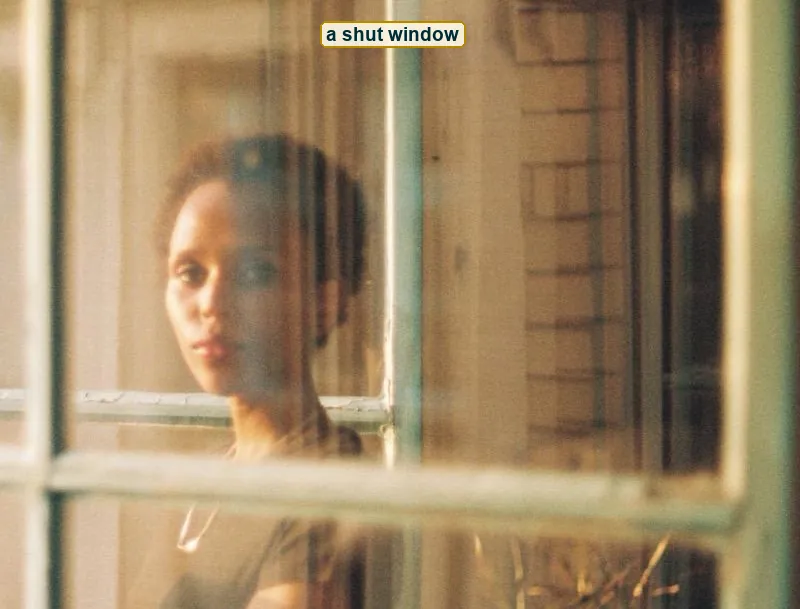
That is the odd thing about this photo, and Baudelaire saw it long before cameras could. The glass doesn't get in the way. It adds. The reflection, the haze and the bars give you more to look at than an open window would. Later in the poem he watches a woman across the roofs, and out of her face, her dress and her attitude, "out of nothing almost", he makes up her whole story.
This picture won't let you do that. She looks back, and it's hard to invent a life for someone who has just caught you looking. Susan Sontag wrote that photography "first comes into its own as an extension of the eye of the middle-class flâneur, whose sensibility was so accurately charted by Baudelaire." The flâneur watches and isn't watched. Here the watched one answers.
The photographer this frame sits closest to is Saul Leiter, who shot New York through steamed glass, shop windows and reflections from the late 1940s on. The Guardian put it in one line. "Often what we most want to see is held tantalisingly out of reach." Leiter's glass usually hides people. This glass hides her too, and she looks through it anyway.
The one mistake
The brightest thing in this frame isn't her. It's the sunlit brick pillar through the open casement on the left, close to a stop brighter than her lit cheek. The eye goes to the brightest patch early, so every time you look, the wall pulls you away from her face for a beat.
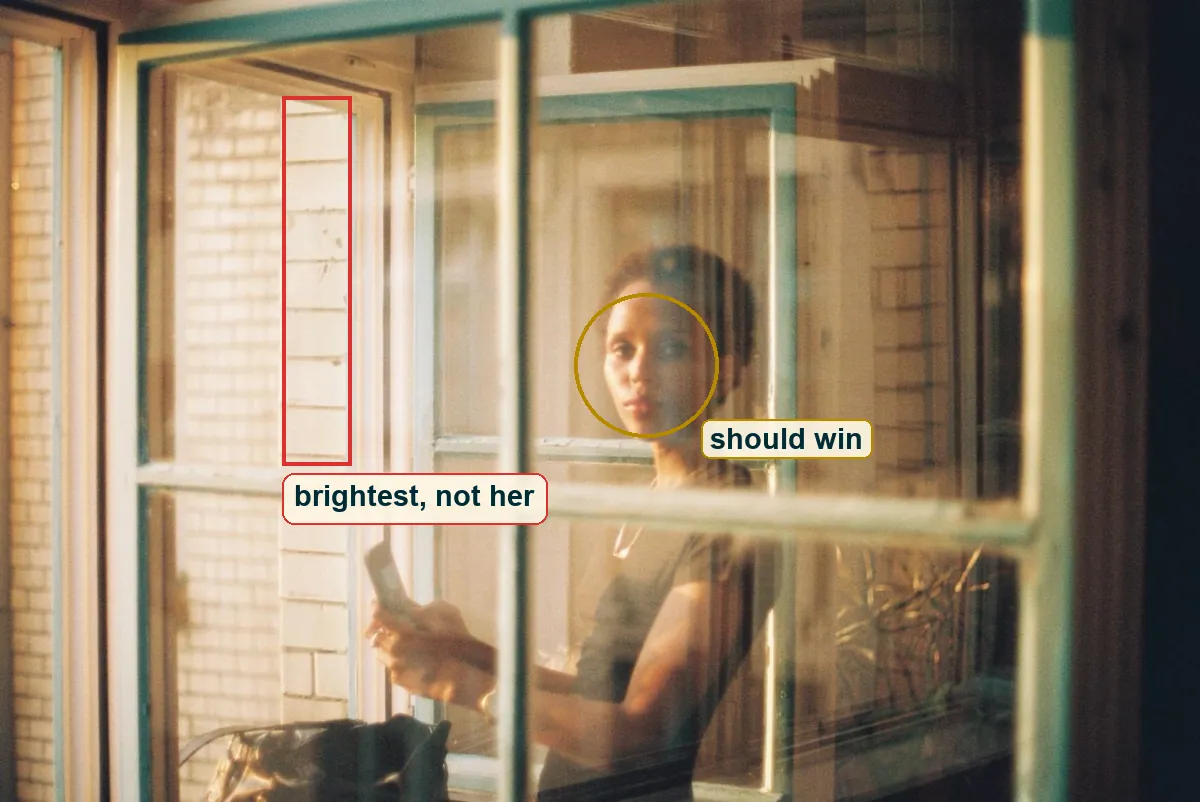
The fix is small and doesn't cost the picture anything. In the scan or the edit, burn the left quarter down by about a stop, so the pillar goes from near white to warm cream. Her face then becomes the brightest thing that matters, and the casement and its light still read. It's a two minute change that does more for this frame than any lens upgrade.
Try this
Find a window with bars and a friend on the other side of it, in the last hour before sunset with the sun coming from the side. Put their face in one pane and their hands in another, and ask them to look at their phone and then up at you when you say so. Lock focus and exposure on the face, not the bright wall, and shoot ten frames while you move half a step left and right so the reflections slide across. Then lay the frames side by side and keep the one where the reflections sit on the dark glass and not on the eyes.
The look, again
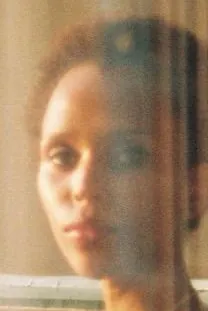
Go back to her face, cropped tight. Now you can see what the glass does to it. The left side is warm and clear. Over the right side lies a thin pale veil, a reflection too weak to show any shapes but strong enough to cool and flatten that half. Her expression is level. It's not a smile and not alarm. She is checking.
At the start her eyes came first because faces always do. Now they come first for reasons you can name. Two windows, two rails, a reflection, a phone, a wall a stop too bright, and through all of it one person who noticed the camera and looked back. You could make up a story for her the way Baudelaire did. The picture is better if you don't.