A tree does not burn alone
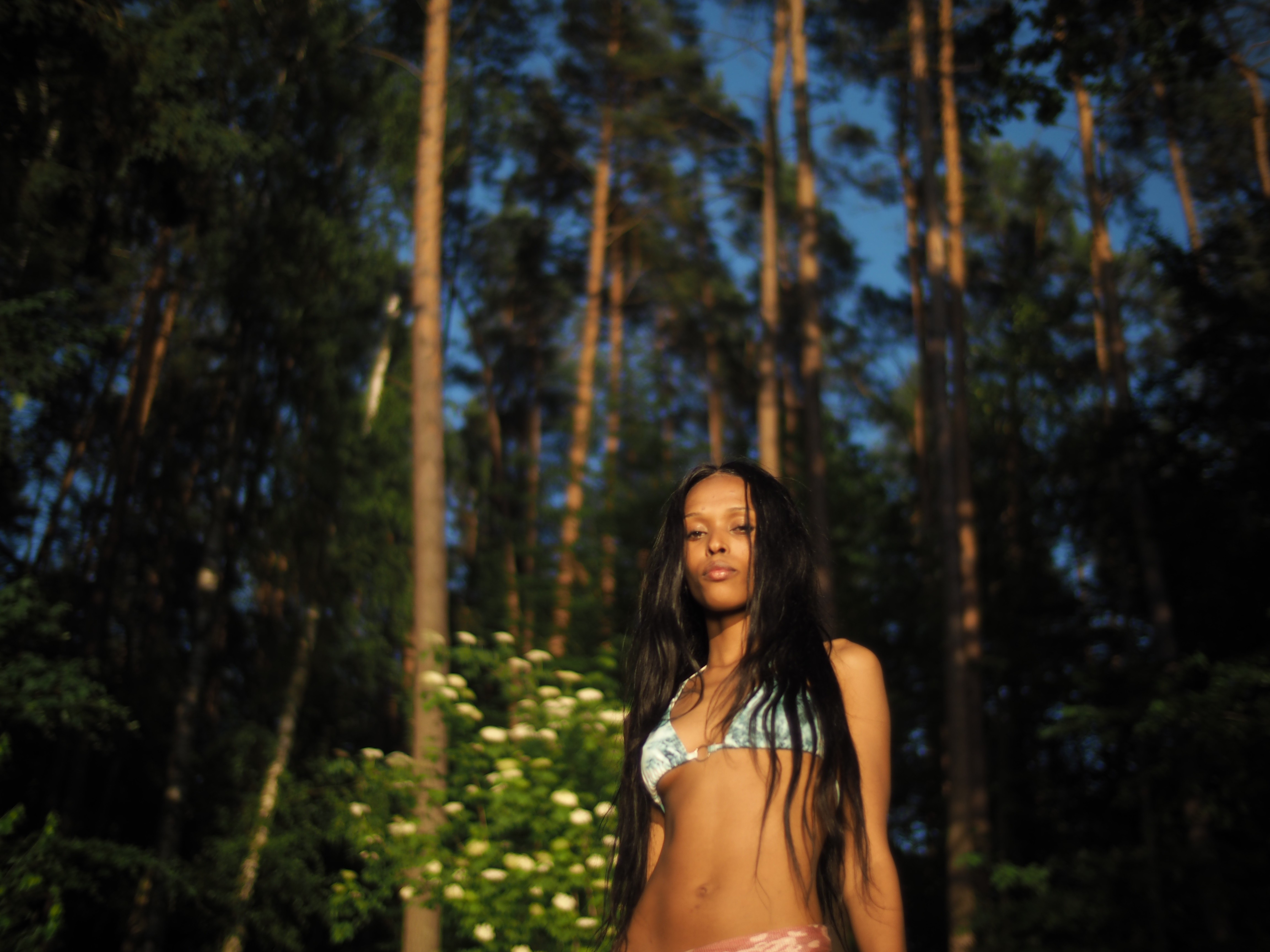
TL;DR: A woman stands in low evening sunlight under tall pine trees, looking straight into the lens as the trunks converge upward into deep blue sky. The real EXIF confirms an Olympus E-M5 Mark II in manual mode, 1/8000 s mechanical shutter, ISO 100, 6000K cloudy white balance, and empty lens fields indicating a manual lens, likely the Voigtländer Nokton 25mm f/0.95. Sunny-16 math explains why 1/8000 s is needed wide open in June sun, measured values reveal deep shadows and heavy corner vignetting, and one small crop fixes the falloff.
The title is a Finnish proverb, Ei puu yksin pala.
Standing under tall pines
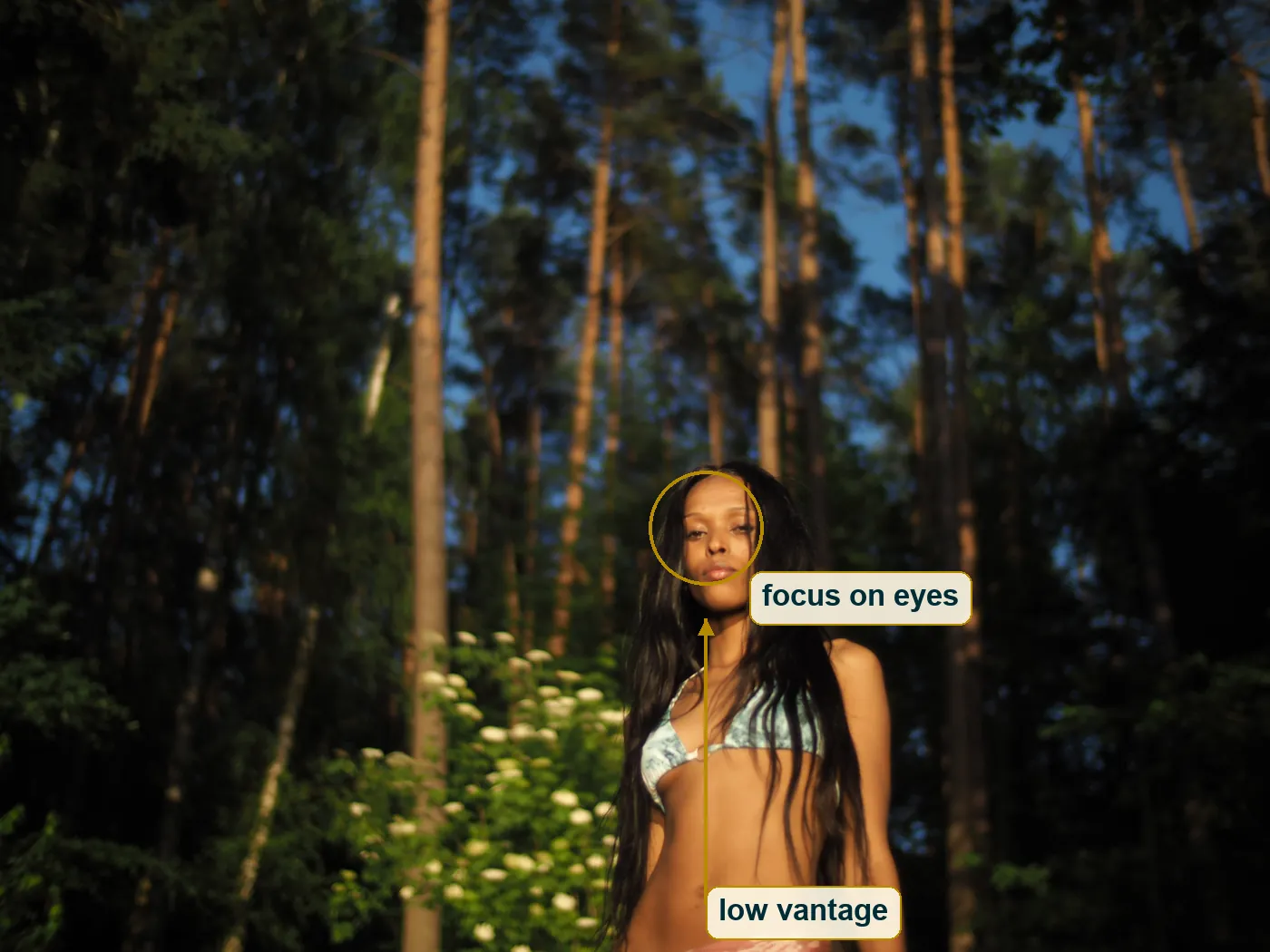
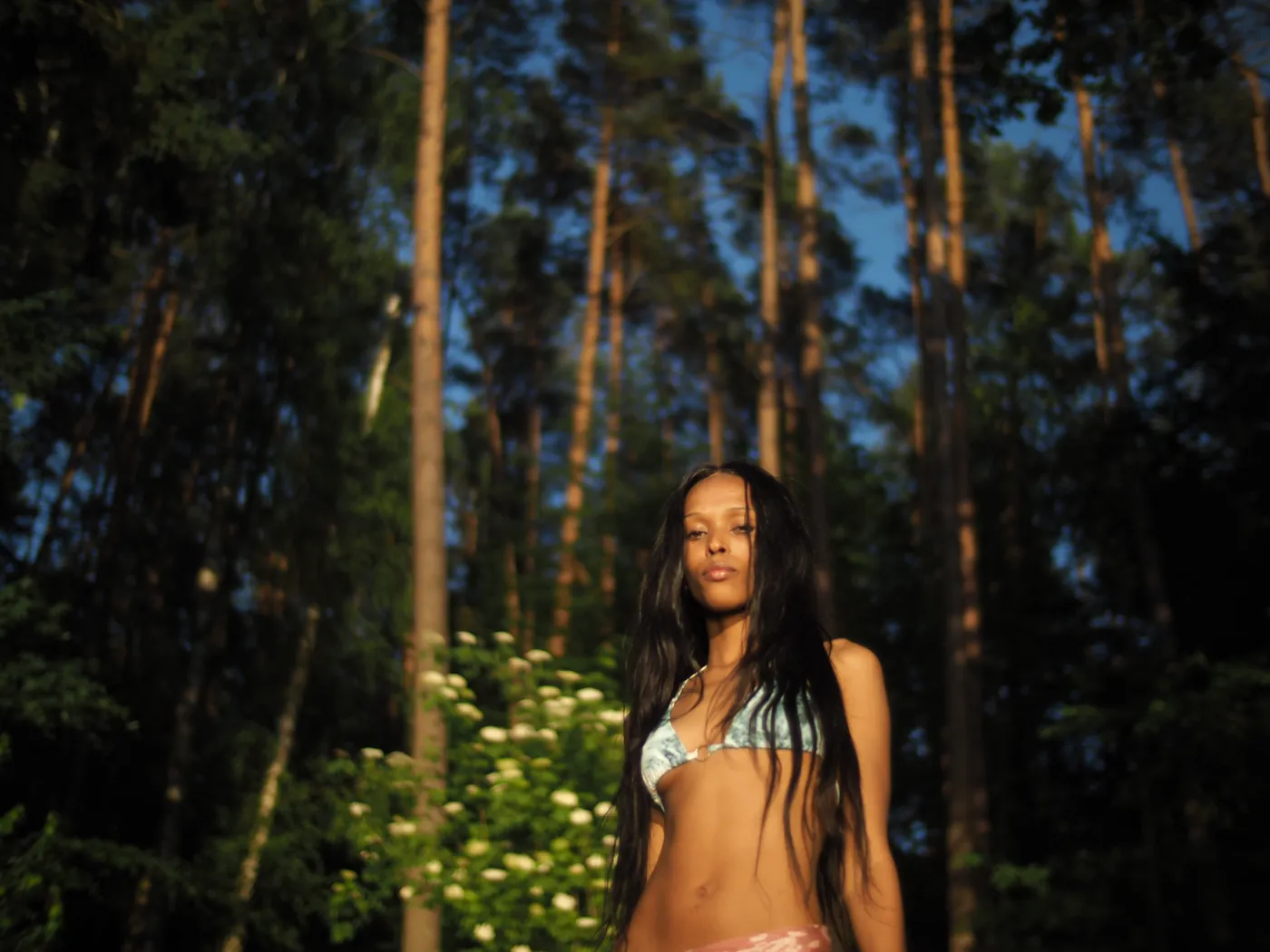
The camera sits down near the pine needles, looking up into the quiet of the grove. A woman stands upright among the trunks, framed from the waist up, her long dark hair falling straight past her shoulders. She wears a summer swimwear top with a patterned light blue and white print, fastened in the middle with a small circular loop. Her gaze comes straight into the lens, calm and direct.
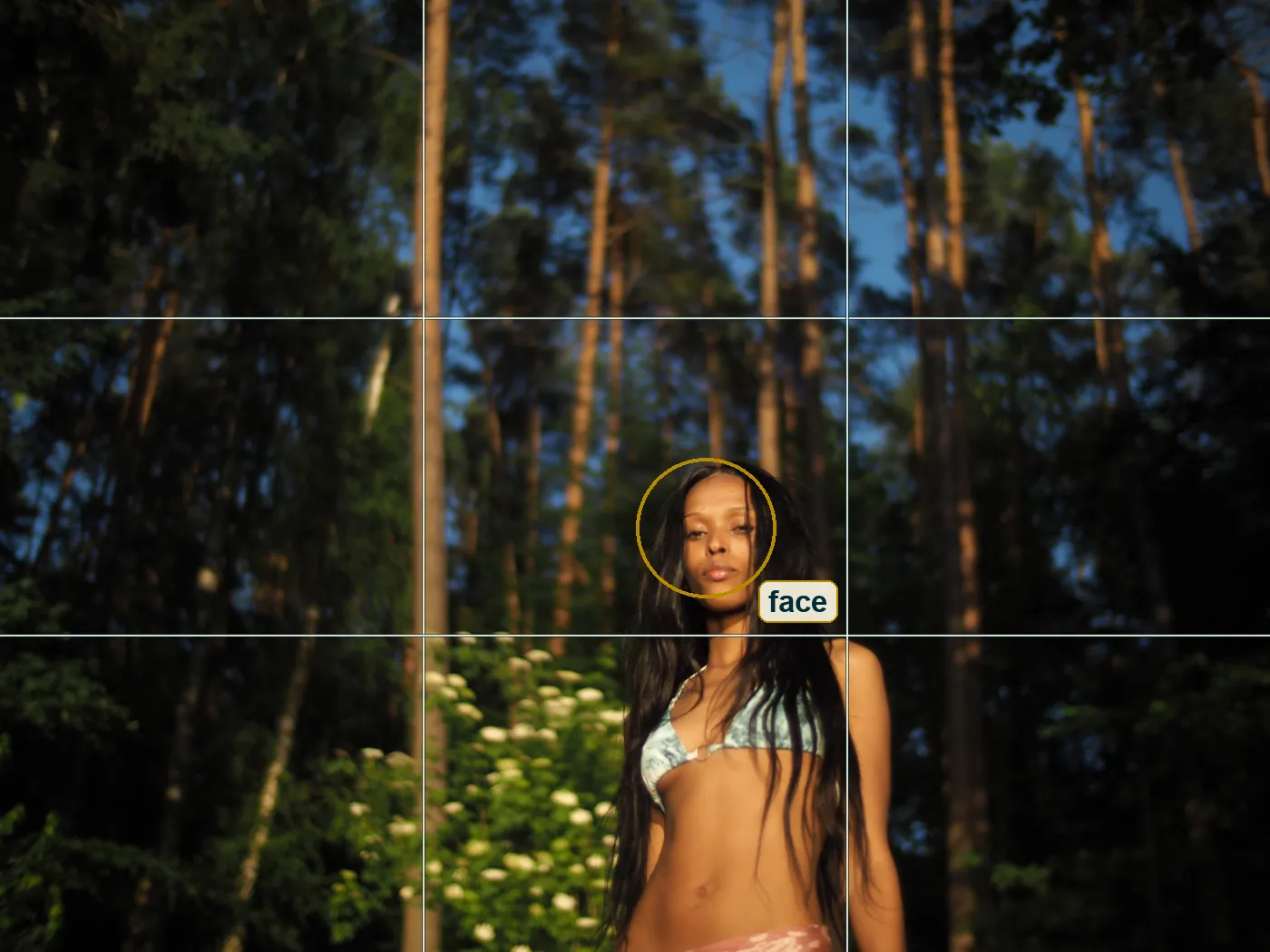
Her face and torso occupy the right third of the frame, giving the left two thirds to the rising trunks and a lush flowering shrub. Pointing the camera upward from a low angle gives her figure presence. She does not cower under the trees, but stands among them as another vertical element. At eye level, a forest portrait often feels like someone placed in front of wallpaper. Here, the ground slopes away beneath the frame and the treetops tilt inward above her head, giving the whole scene a quiet human centre.
Copper bark and cobalt sky
Two colours rule this photograph, and they sit on opposite sides of the colour circle. The bark of the sunlit pine trunks glows in rich shades of orange, copper, and warm amber. Between the dark needles overhead, the sky breaks through in patches of deep cobalt blue. That complementary pairing of orange and blue creates a natural visual tension across the entire image.
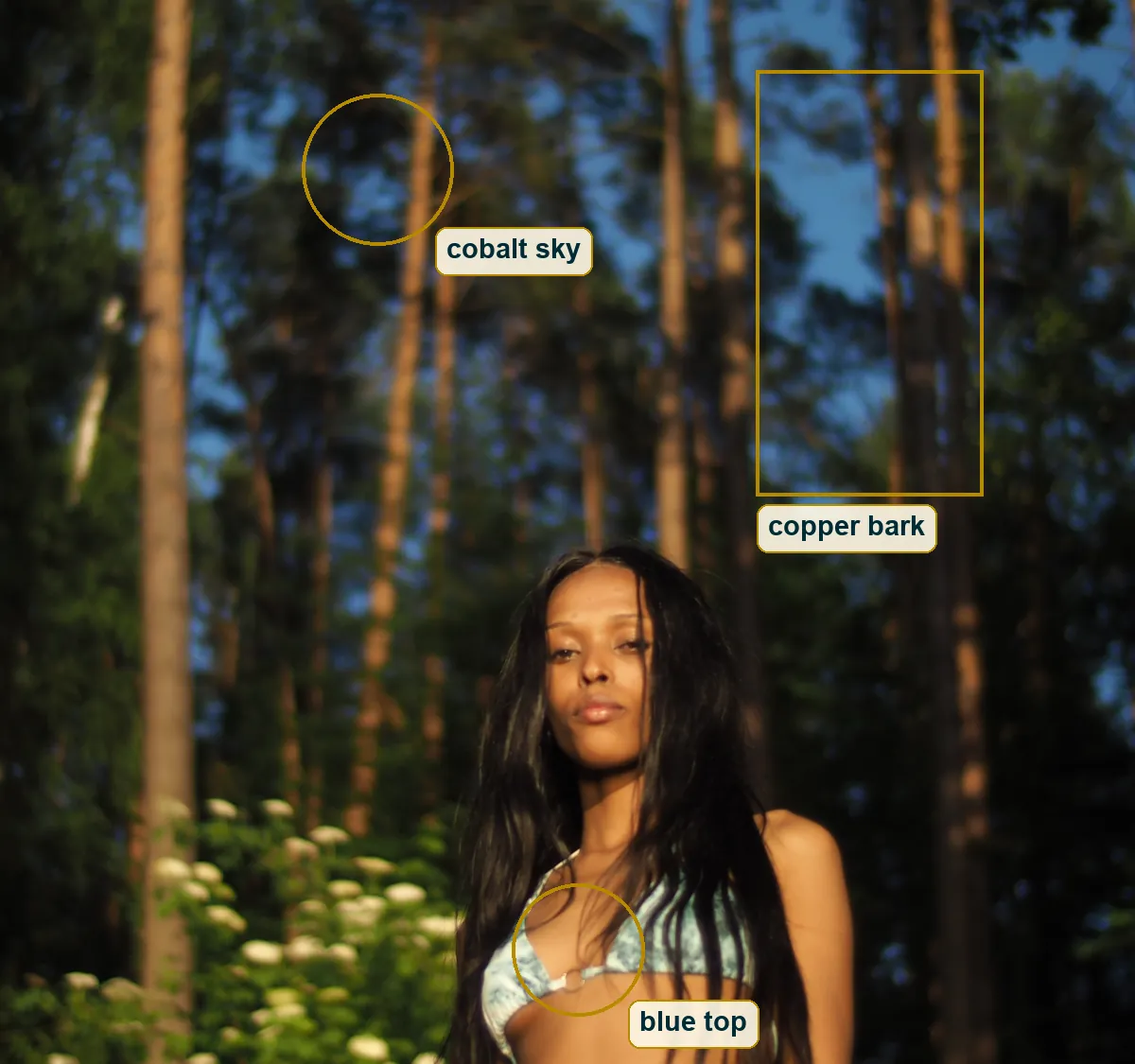
Measured with PIL, the numbers confirm what your eye feels. The sun-struck bark on the prominent right trunk averages about 127 in red, 85 in green, and 41 in blue, a warm ochre. Clear patches of open sky near the top average about 47 in red, 73 in green, and 108 in blue. Her light-blue patterned top, measuring around 111 in red, 114 in green, and 99 in blue, echoes the cool sky without fighting the warmth of her sunlit skin.
A critical choice here is the white balance preset. The camera was set to 6000K Cloudy rather than Auto White Balance. Daylight in the open sits around 5200K to 5500K. By locking the white balance to 6000K, the photographer pushed red and amber tones into the final JPEG, making the pine bark burn with copper warmth and bathing her skin in golden light. Auto White Balance would have neutralized that warmth, leaving the trunks a dull grayish brown.
A frame that tilts toward the sky
Look at the geometry of the tree trunks. They do not run parallel to the edges of the frame. Because the camera is tilted upward, the trunks on the left tilt slightly right, and the trunks on the right tilt slightly left. They converge upward, drawing the eye toward a vanishing point high in the evening sky.
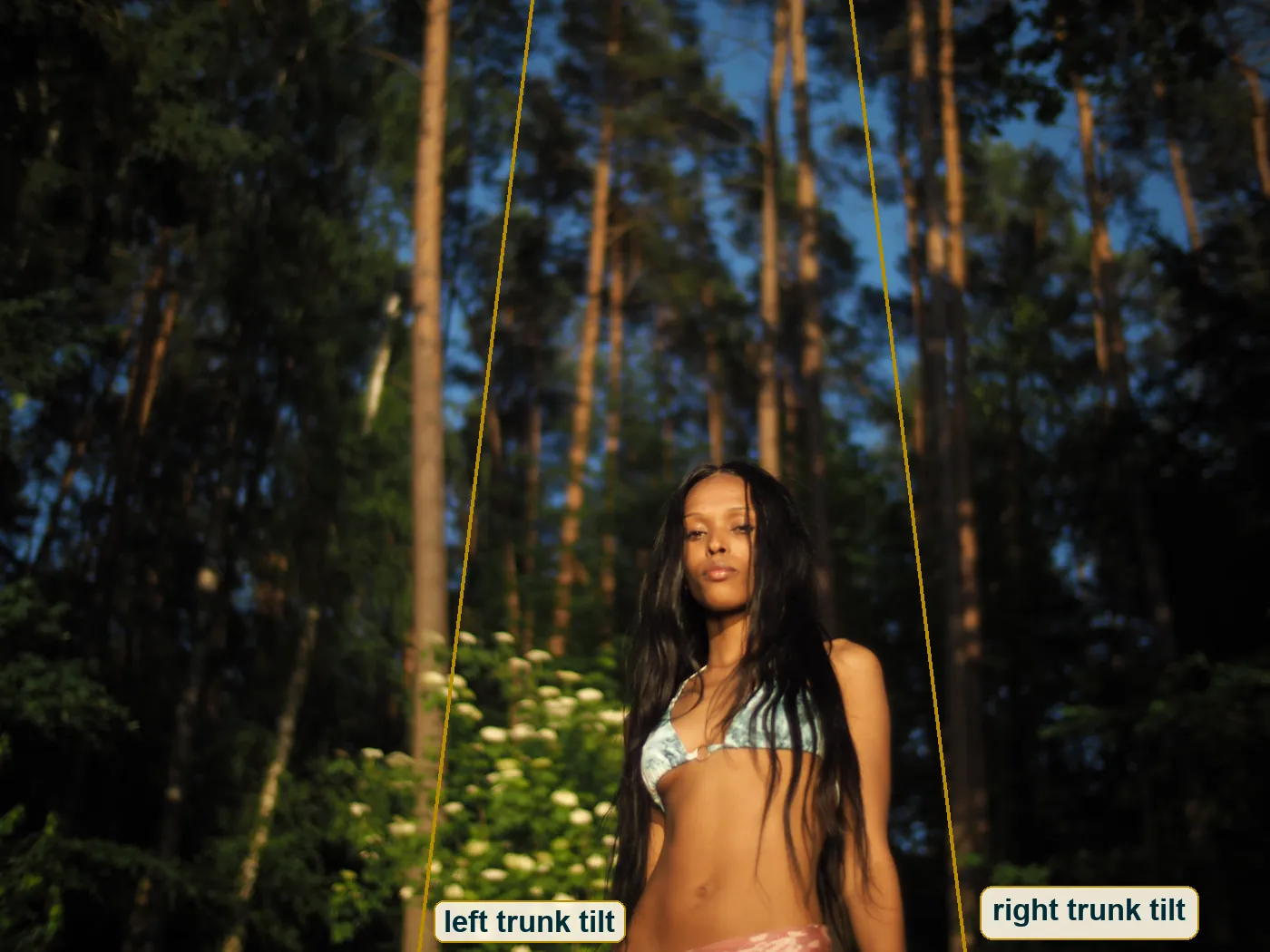
This perspective distortion is what architects call keystone effect. In building photography, tilt-shift lenses keep walls straight. In forest portraiture, keystoning is an asset. It creates a natural pointed arch above the subject, turning the pine canopy into a cathedral ceiling. The straight vertical trunks become dynamic diagonal lines that lead your eye down into the woman's face.
The frame retains its native 4:3 aspect ratio, measuring 4608 by 3456 pixels. That is the uncropped 16-megapixel canvas of the Micro Four Thirds sensor. The photographer composed the shot in the electronic viewfinder, placing her face just below the upper horizontal third line and using the convergence of the trunks to anchor her position.
Low sun from the left
The light in this photograph comes from the front-left, skimming low across the forest floor. You can see its angle on her collarbone, on her left cheek, and along the left flank of every vertical pine trunk. Her right cheek, the hollow of her neck, and the right half of each tree remain in soft, cool shadow.
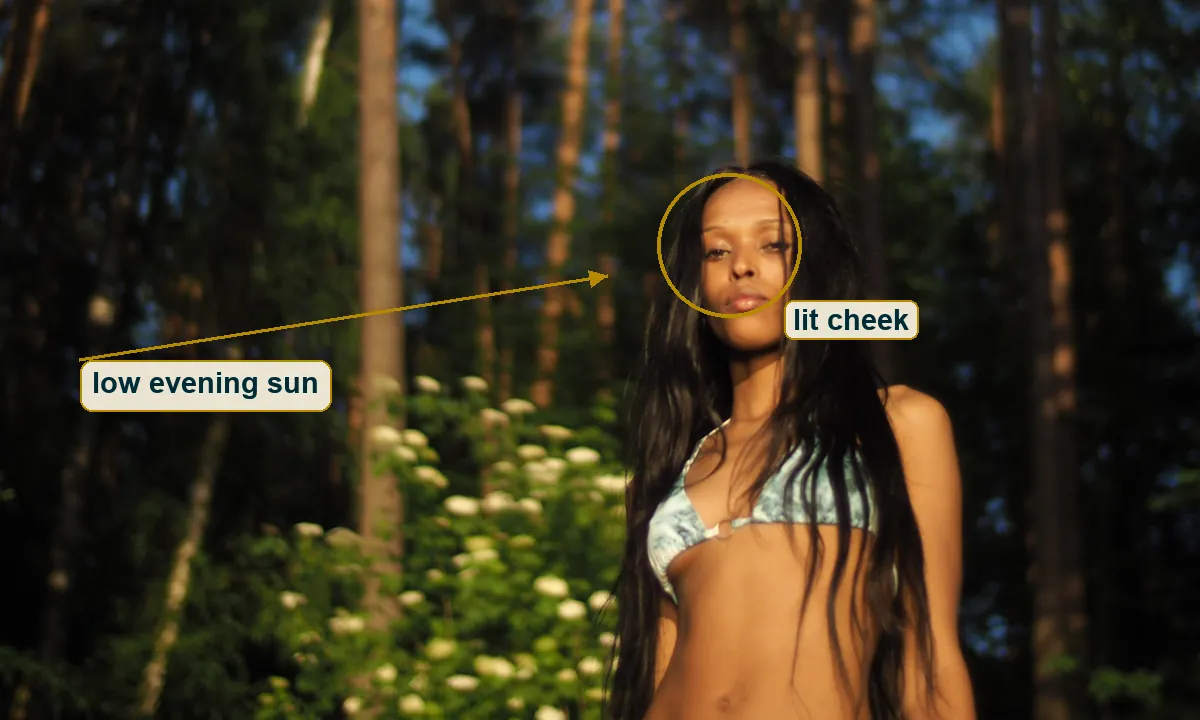
The camera clock records the moment at 20:11:42 on 12 June 2025. In the middle of June, northern evenings stretch late into the night. At twenty past eight, the sun hangs just above the horizon, casting rays through miles of thick atmosphere. The air filters out short blue wavelengths, leaving behind the warm amber and gold tones of late sunset.
Direct low sunlight on a face is difficult to handle. Facing straight into the beam causes squints and flattens facial contours. Here, the light strikes diagonally from the side. Her forehead, nose bridge, and near cheek catch the glow, while shadow wraps around her jaw. That creates sculptural depth across her face without obscuring her calm expression.
What the file says
Because this image retains its original camera data, we do not have to guess at the exposure facts. The camera is an Olympus OM-D E-M5 Mark II, a Micro Four Thirds camera with a 2.0 crop factor. Exposure mode was full manual. The mechanical shutter fired at 1/8000 s, the physical ceiling of this camera. The ISO was set to 100, image stabilization was active in S-IS Auto, manual focus was engaged, and metering was multi-segment ESP. The picture mode was Natural, with no art filters applied.

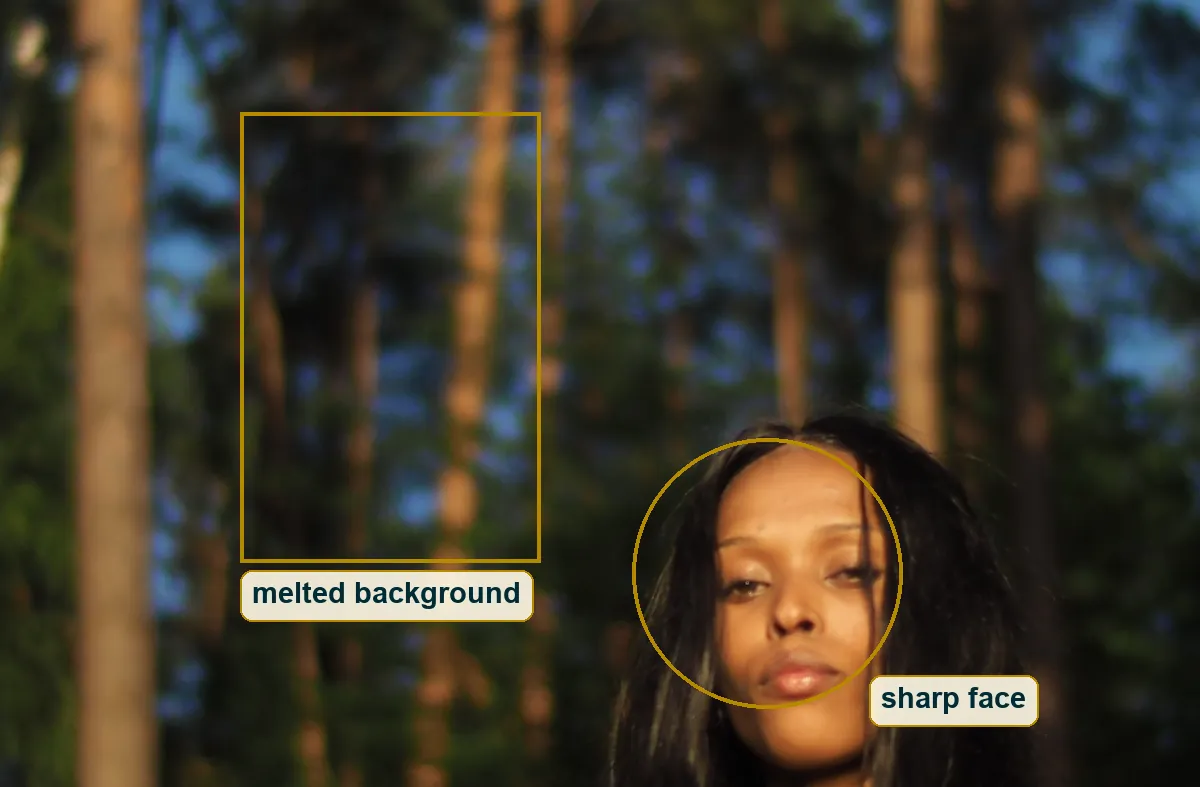
Zooming in to 100 percent confirms the manual focus. Her eyes, eyelashes, and hair strands are sharp. In her right eye, on the viewer's left, a tiny specular catchlight reflects the low evening sun, giving life to her gaze.
The choice of ISO 100 deserves attention. Base sensitivity on the E-M5 Mark II sensor is ISO 200. ISO 100 is an extended low setting, achieved by overexposing slightly and pulling the signal back down in processing. Extended ISO 100 costs about a third of a stop of highlight headroom, but here that cost is negligible because less than 0.002 percent of pixels touch 254 in any channel. In return, the extended low ISO helped keep the exposure balanced at wide aperture under direct sunlight.
The lens with no name
Look inside the EXIF data and you will find an interesting blank. The lens type is listed as None, the focal length is recorded as 0.0 mm, and the aperture value reads f/0.0. When a camera records zeroes for optical parameters, the lens has no electronic contacts. It was a purely mechanical, manual lens.
While metadata omits the model name, physical evidence strongly points to one optic. An earlier post on this site documents this camera body paired with a Voigtländer Nokton 25mm f/0.95, a high-speed manual prime designed for Micro Four Thirds. Two companion photo essays on the site, the garden path portrait and the environmental portrait by the mountain, show the same pairing of Olympus body and manual glass at work.
The optical character of the background confirms that reading. The shrubbery and tree trunks just two to three meters behind the woman dissolve into creamy blur with soft circular bokeh highlights. A standard kit zoom at f/4 or f/5.6 could never separate a subject from a forest background so smoothly at this distance. And balancing a shutter speed of 1/8000 s at ISO 100 in late evening light requires an enormous lens opening. The visual evidence and exposure settings align: this frame was made with a very fast prime operating near its widest aperture.
Sunny-sixteen in the woods
To understand why the shutter fired at 1/8000 s, we have to look at the Sunny-16 rule. Under direct midday sunlight, a correct exposure at ISO 100 requires an aperture of f/16 and a shutter speed of 1/100 s.

Moving from 1/100 s to 1/8000 s is a jump of roughly 6.3 stops less exposure time. Counting down from f/16 by 6.3 stops takes you through f/11, f/8, f/5.6, f/4, f/2.8, f/2, down to about f/1.7 in full midday light. At 20:11 in the evening, the low sun has lost about two stops of intensity compared to noon sun. In that softer illumination, balancing 1/8000 s at ISO 100 pushes the necessary aperture all the way open to f/1.4 or f/0.95. The photographer wanted the thin depth of field that f/0.95 provides, and with ISO dialled down to 100, the mechanical shutter had to run at its maximum speed of 1/8000 s.
On Micro Four Thirds with its 2.0 crop factor, a 25mm lens provides the field of view of a 50mm normal lens on full frame, and its depth of field corresponds to f/1.9. At 2.5 meters distance, the sharp zone is barely 35 centimeters deep. If the photographer had stopped down to f/8 for an exposure of 1/125 s, the sharp zone would have expanded to more than two meters, cluttering the background with twigs and bark cracks. The ultra-wide aperture is what makes this a portrait of a person rather than an inventory of a forest.
Why the trunks converge
When you photograph tall trees from down low, vertical perspective takes over. Because the camera lens tilts upward toward the canopy, the distance from the lens to the tops of the trees is greater than the distance to their bases. Perspective compresses that distance, causing the tall pine trunks to lean inward as they climb.
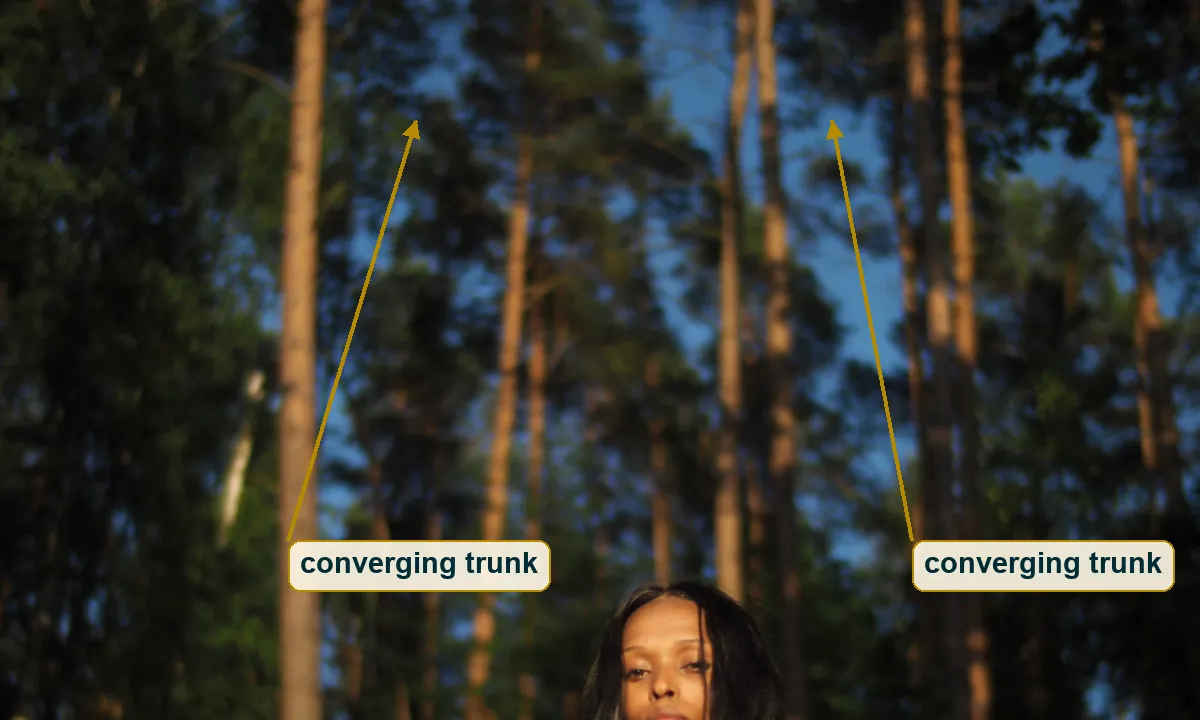
This converging geometry gives the photograph its towering scale. The trunks act like giant arrows pointing into the upper sky, guiding your gaze through the frame. You look at her calm eyes first, then follow the copper bark upward into the crowns, and then circle back down along the opposite trunks to rest on her face again.
There is a rhythm to the repetition of vertical trunks in a managed pine forest. The trees stand at regular intervals, planted decades ago, their lower branches shed as they competed for light. As they recede into the background, the trunks become thinner and more crowded, creating visual layers of wood and shadow. The Polish proverb observes that the deeper you walk into a forest, the more trees you encounter. Here, that density wraps around the subject like a protective palisade.
Letting the forest fall dark
This photograph is deeply rooted in low-key tonality. More than 40 percent of the pixels across the frame sit below a brightness value of 20 out of 255. The deep shadows in the undergrowth behind her average near 10, hovering just above pure black. The photographer did not lift the shadows with a reflector or a fill flash. The forest interior was allowed to fall into darkness.
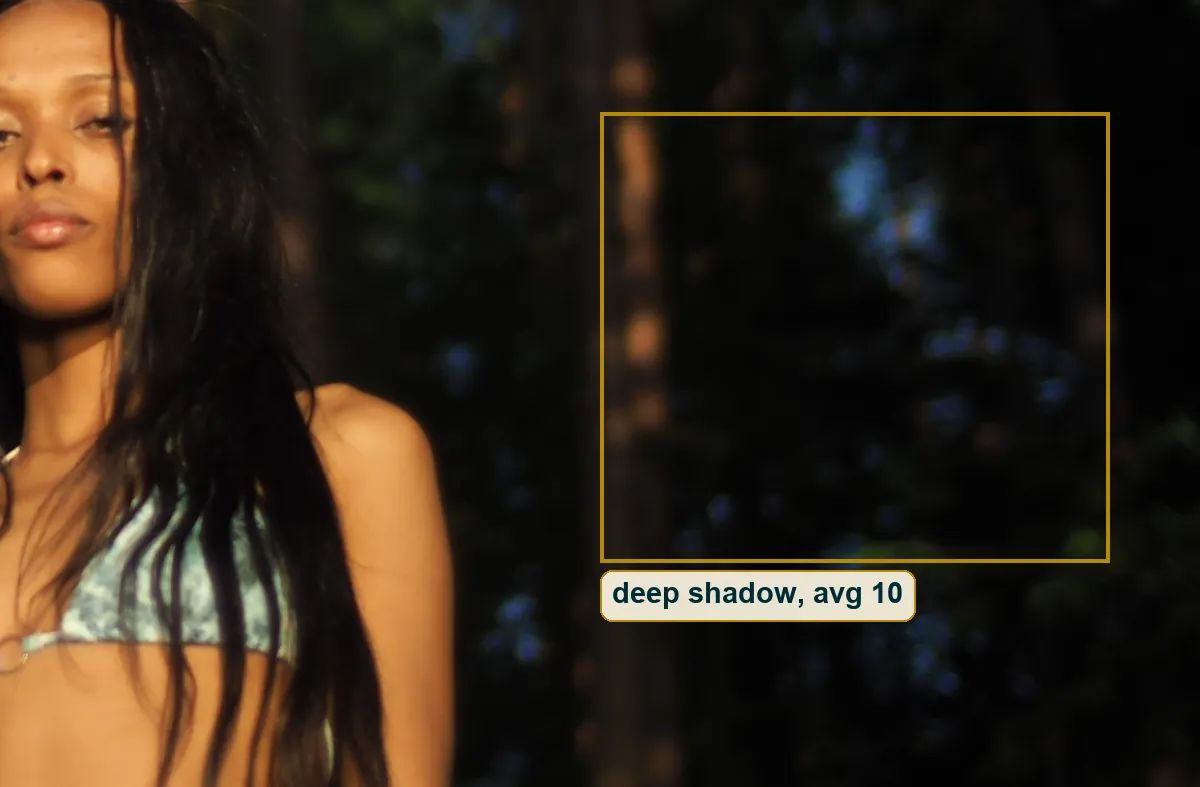
That decision produces dramatic subject separation. Because the background remains dark, the sunlit parts of the woman, her face, her shoulders, and her swimwear top, stand out with luminous clarity. If the exposure had been raised to reveal details in the dark needle bed, her skin would have blown out into featureless white highlights.
Digital capture handles this contrast differently than colour film. Film would have rolled off the sunlit highlights on her cheek with gentle latitude, but might have produced grainy shadows in the undergrowth. The Olympus sensor at ISO 100 keeps the shadows clean, while the Natural picture profile preserves subtle midtone gradations across her skin. The darkness around her is not an accident of poor exposure, but a deliberate stage on which the evening light performs.
The tree and the person
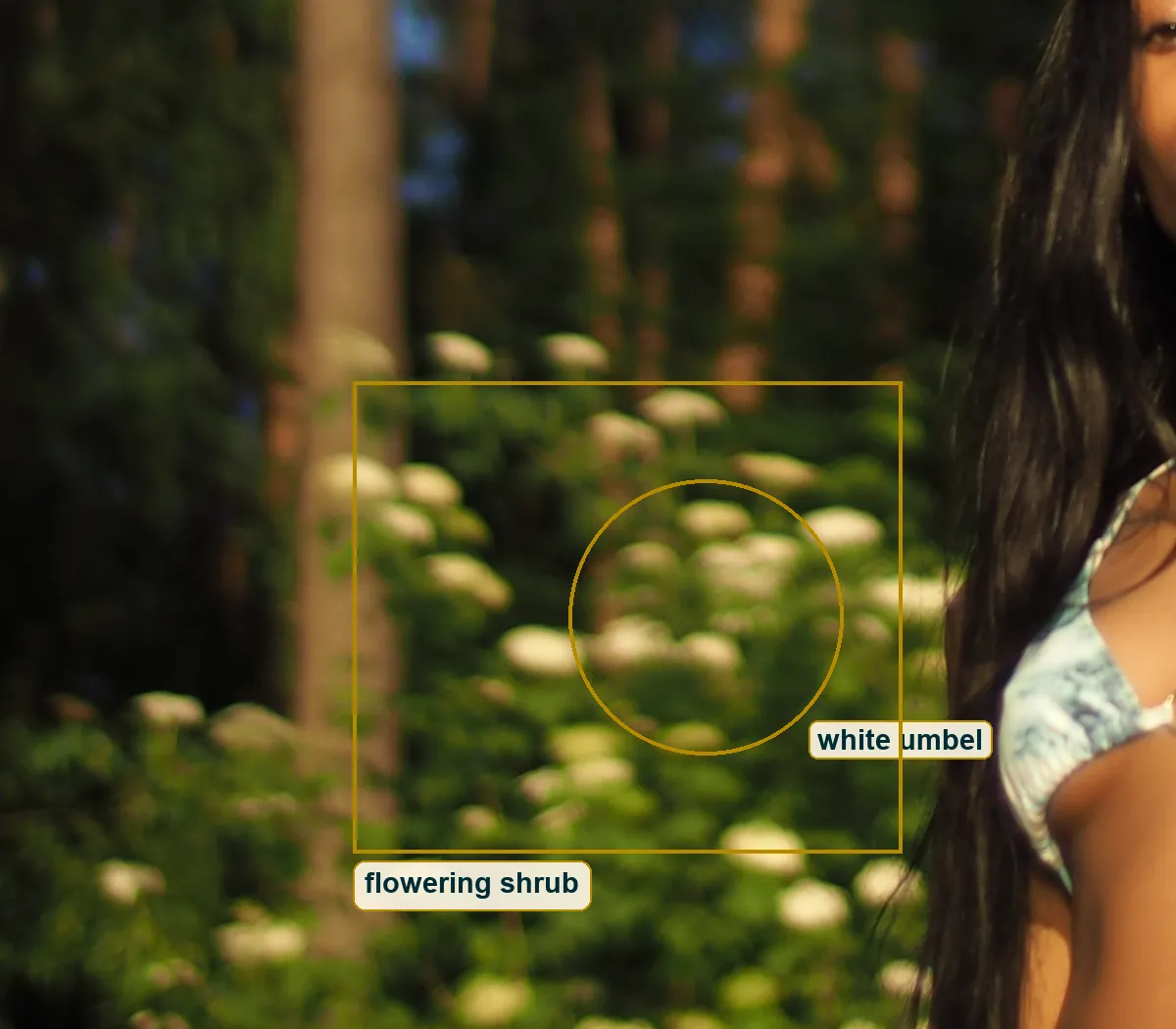
To the left of the woman stands a dense leafy shrub adorned with wide, flat clusters of creamy-white blossoms. These floral umbels, characteristic of elder or wild viburnum, provide an important counterpoint to the straight, rigid trunks of the pines. Their rounded organic shapes soften the geometry of the composition, introducing delicate white highlights that echo the pale patterns on her swimwear top.
There is a long photographic tradition of integrating human portraits into natural surroundings. In Baltic photography, masters like Valdis Brauns and Vilis Rīdzenieks photographed people in close harmony with coastal pine woods and rural meadows. Their work avoided artificial staging, treating the forest not as an exotic backdrop, but as an everyday companion to human life.
In this photograph, that connection feels immediate. The woman stands unhurried among towering pines that took half a century to grow, while the white elder blossoms beside her bloom for only a few weeks each summer. Human presence, seasonal flowering, and slow arboreal growth share a single frame.
The one mistake
No photograph is entirely without flaw, and this frame carries one distinct optical defect. Look at the upper-left corner of the image. The canopy and the sky in that corner fall into deep gloom, dropping to an average brightness of just 8 out of 255.
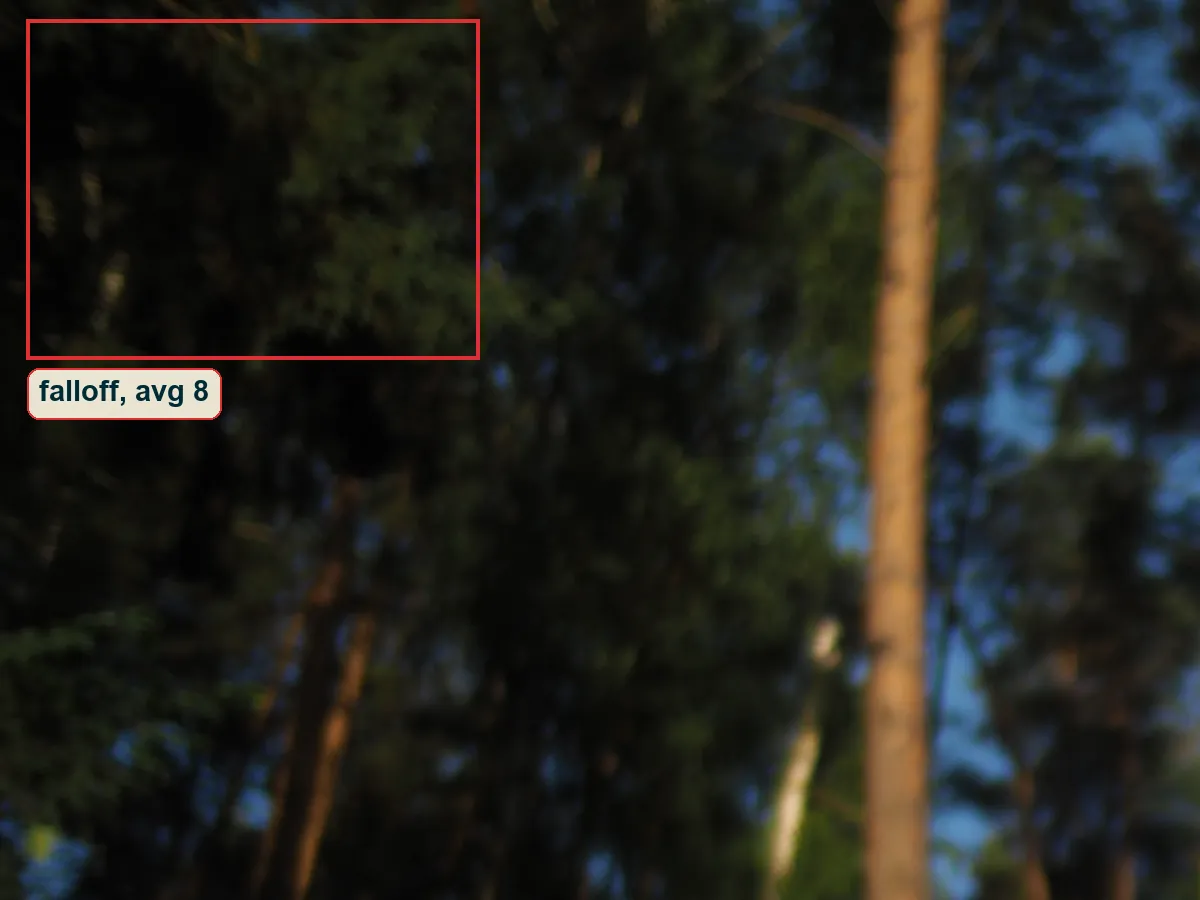
This darkening is heavy mechanical and optical vignetting, caused by shooting an ultra-fast lens at its widest aperture. When an f/0.95 lens is opened completely, the physical barrel of the lens obstructs peripheral light rays entering at steep angles, resulting in significant light falloff toward the extreme corners of the sensor. In the upper-right corner, patches of blue sky manage to push through, but in the upper-left corner, the combination of dense needles and optical shading plunges the frame into near-blackness.
The fix is straightforward and practical. Stopping down the lens by just one stop, to f/1.4, dramatically improves corner illumination and eliminates the harshest peripheral falloff. Alternatively, applying a lens vignette correction profile during raw processing can lift the darkened corners. If working with the existing file, a modest crop of about 5 percent around the perimeter trims away the darkest corner falloff without compromising the low-angle perspective or crowding the subject.
Try this
Find a stand of mature pine trees or straight-trunked woods during the last hour before sunset on a clear day. Take a fast normal prime lens, set your camera to manual exposure, and sit or lie flat on the ground with your back against the forest floor.
Position your subject standing about two to three meters away from you, angled so that the low evening sun illuminates one side of their face. Open your lens wide to f/1.4 or f/2, lock manual focus on the nearest eye, and point the camera upward so the tree trunks converge over their head. Check your exposure against the sunlit skin rather than the dark background, verify through the viewfinder that your corners are not completely clipped by vignetting, and take the picture.
The trunk that looks back
When you first look at this image, you see a portrait of a woman in evening sun. When you stay with it longer, it becomes a study in scale and patience. A human being stands barely two meters tall, yet her presence holds balance against twenty-meter pine trees that rise into the cobalt sky.
The camera captured one tiny slice of time, 1/8000 of a second, frozen by a mechanical shutter in the warm June light. The trees around her required decades of slow cellular growth, reaching toward the light ring by ring. A Finnish proverb says a tree does not burn alone, a log in the stove needs another log beside it, and so does a life. A pine forest is the same idea standing up, and she is the one trunk in it that looks back. In this quiet clearing, youth, sunlight, and old wood meet in perfect stillness, held together by a calm gaze that looks straight into the glass.