The eyes say as much as the mouth
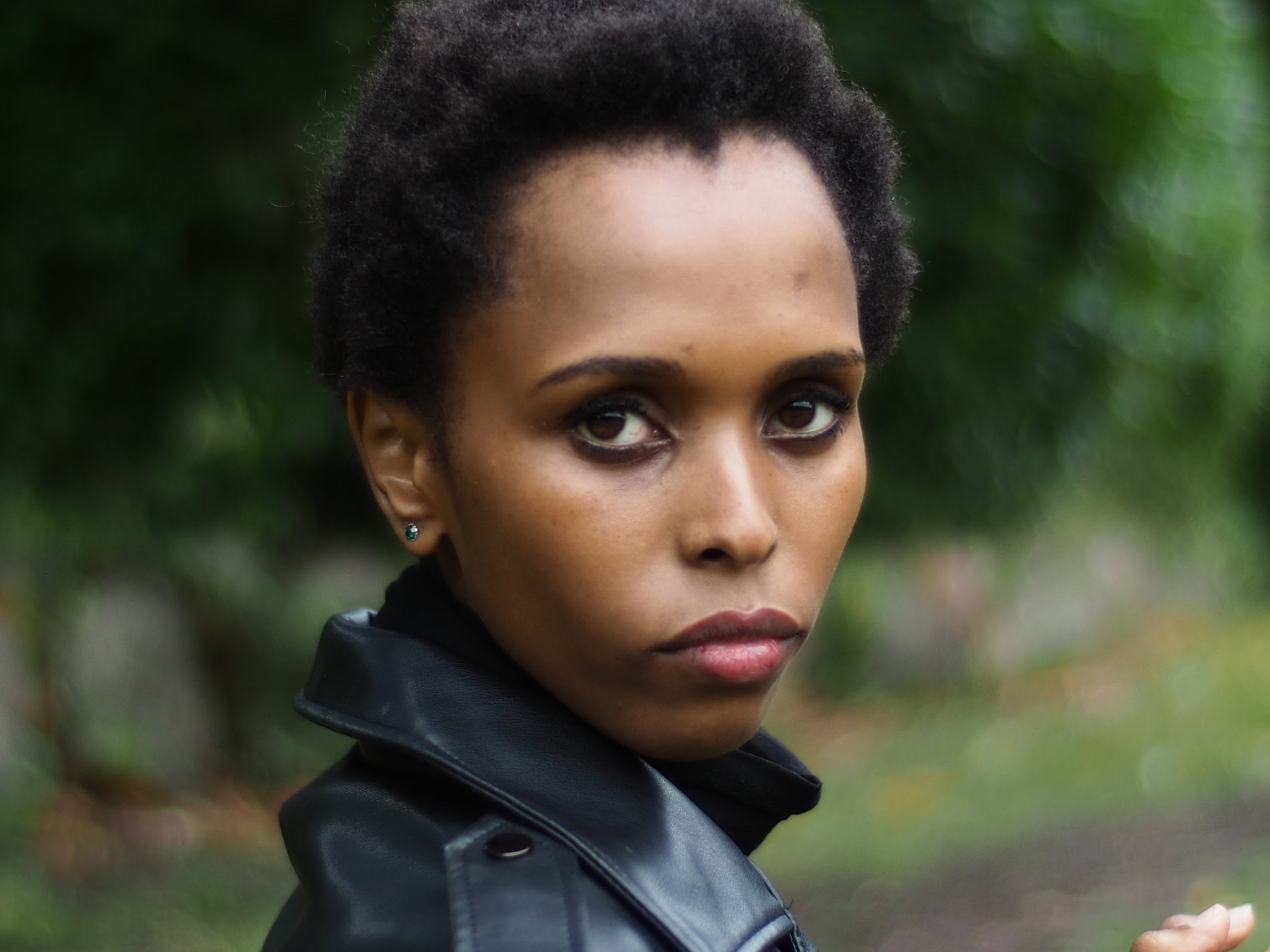
TL;DR: A woman turns back over her shoulder and her eyes do the last part of the turn, so the look feels given, not asked for. A big soft sky, a short tele from about 1.2 m and f/2-ish focus a few centimetres deep do most of the work. No EXIF exists, so every setting here is a reading of the picture, and the one fix is the half hand in the corner.
The title is a Japanese proverb, 目は口程に物を言う (me wa kuchi hodo ni mono o iu).
The look comes first
She looks at you before you look at her. That is the whole trick of this picture, and everything else in the frame is there to protect it. Her body points away to the left, her head comes back over the near shoulder, her chin drops a little, and her eyes come up from under low straight brows and land on the lens. She doesn't smile. The mouth is closed and calm. It's not a hostile look and it's not an invitation either. It's the look of someone who was busy with something else and now waits for you to say why you are here.
Then the rest comes in, slowly. Short natural hair as a dark round crown. A black leather jacket with the collar turned up. A small green stone in the one ear you can see. Behind her only green, soft and wide, with a few grey upright shapes lower down that are too blurred to name. The file is 2302 by 1726 pixels, a 4:3 frame, and it carries no camera data. So every setting in this essay is a reading of the picture, with the reason right next to it, and you can check each one with your own eyes.
One turn and two directions
The picture rests on one gesture. The body goes one way and the head comes back the other way, and the energy of the portrait sits in the twist between the two. A face squared up to the camera looks like a passport. A face that turned back looks like it chose to look.
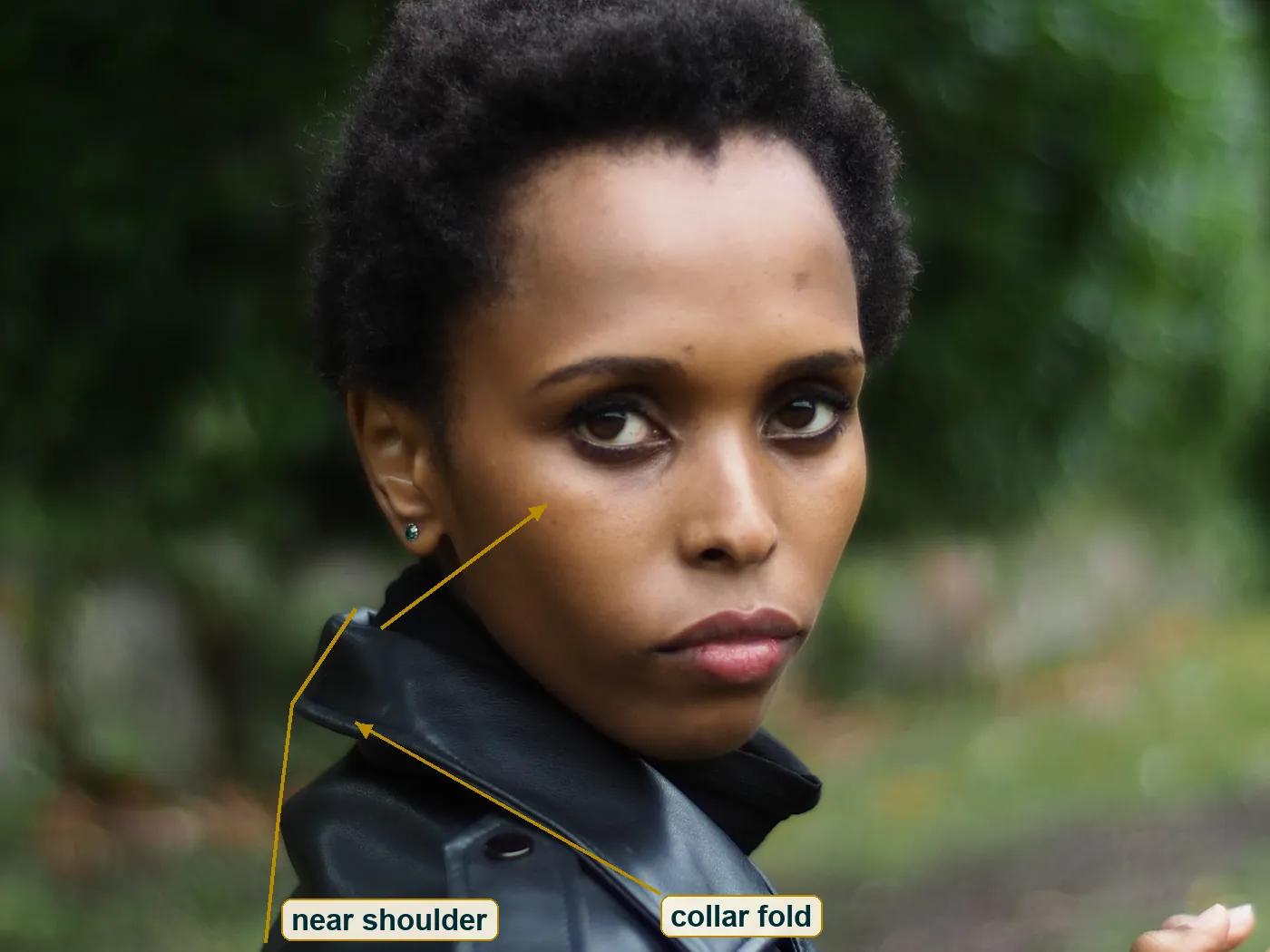
Look at the leather. The rolled edge of the collar runs as a diagonal from the bottom of the frame up toward her neck, and it works like an arrow. Your eye enters at the shoulder, rides the shiny fold up, and arrives at the jaw and the ear. The near shoulder and the collar fill the lower left, so the face sits on a base of black leather and the eye has nowhere else to rest.
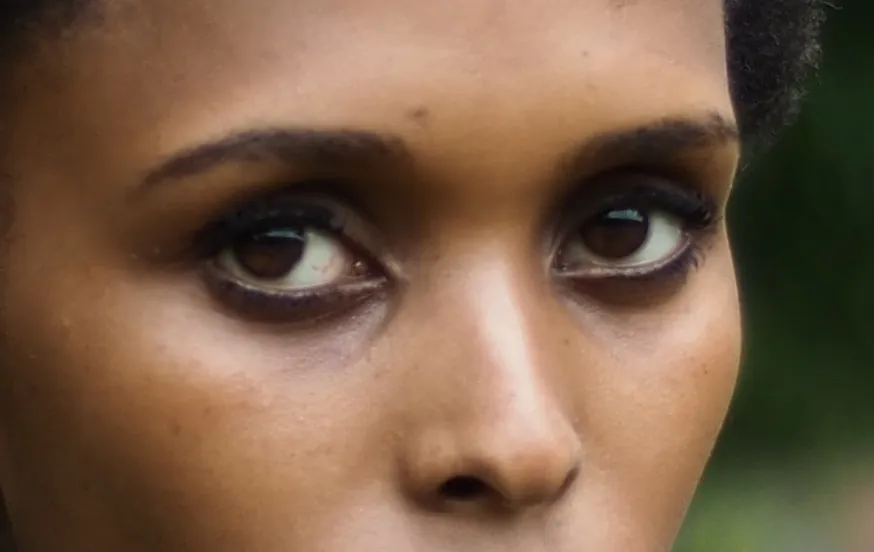
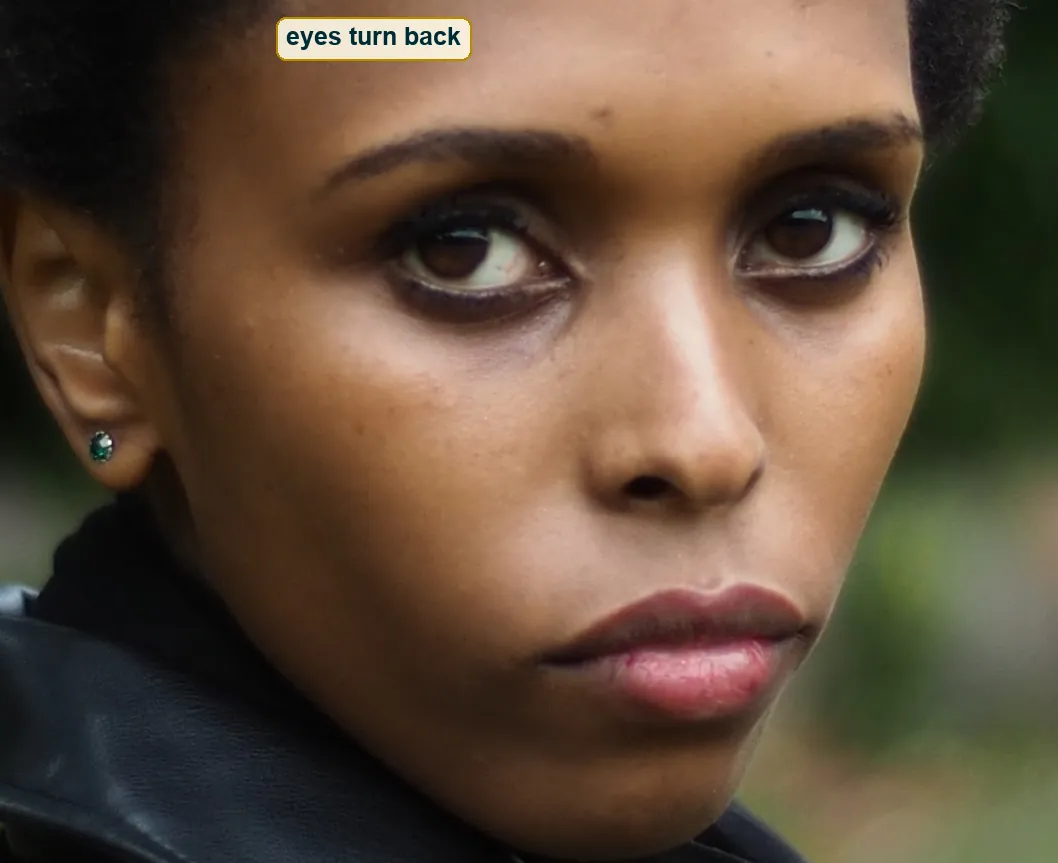
There is also a small detail in the eyes that makes the turn read. The head is not fully back. It still points a little away from you, toward the right of the frame, and the eyes turn further in their sockets to reach the lens. You see white on one side of each iris. That small extra turn of the eyes is what makes the look feel deliberate. The head says she was looking elsewhere. The eyes say she is looking at you now.
Light from a big soft sky
The light is soft, and you can tell from the shadows, or rather from how little of them there is. Under the nose, under the lower lip and along the jaw the tone rolls off slowly. There is no crisp shadow edge anywhere on the face. To get that you need a light source much bigger than the head, and outdoors the biggest source there is happens to be the sky.
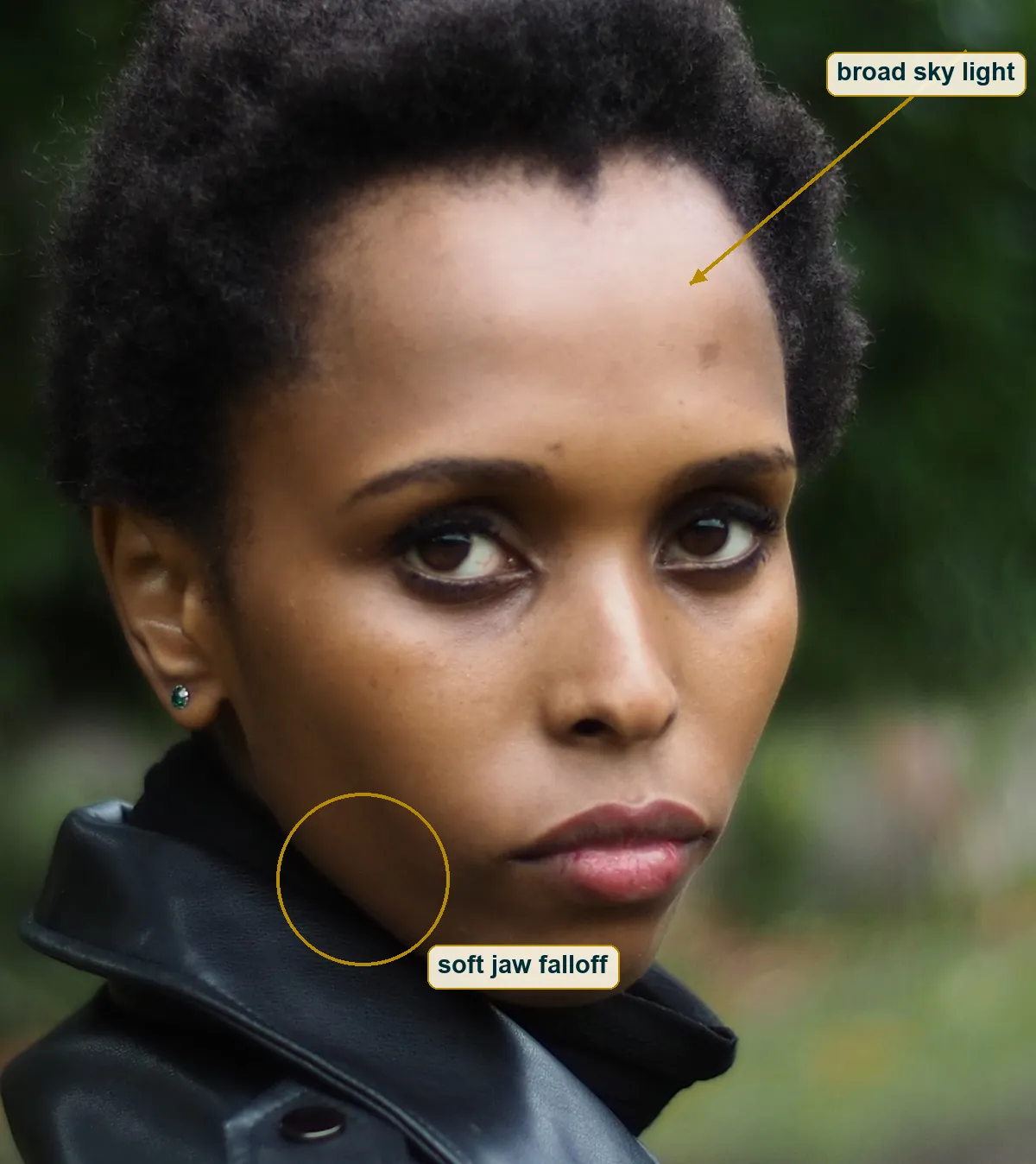
The brightest skin is on the forehead, the bridge of the nose, the cheekbones and the chin. These are the surfaces that face up and forward. The eye sockets sit a little darker, and the dark liner around her eyes makes them deeper still. That pattern means the light comes from the front and a bit from above. It also leans a little to the right of the frame, because the far cheek is a touch brighter than the near one. Photographers call that short lighting, and it makes a face look narrower.
The leather tells the same story in another language. Long soft highlights run along the folds of the collar and the shoulder. If the sun had been out you would see small hard points of light on the leather and a sharp shadow under the chin. Here the shine is wide and gentle. So the most likely reading is an overcast day or open shade, the bright shadow you find at the edge of trees.
Two slivers of sky in the eyes
The catchlights settle the light question. Zoom in on each iris and you find a thin curved line of light at the top, tucked just under the upper lid. Each one is about 40 pixels wide and only 6 or 7 tall in this file. They have a slightly cool tone against the warm brown of the eye.
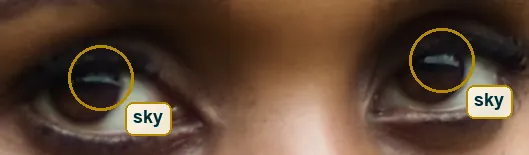
A softbox would leave a small clean rectangle. A ring flash would leave a bright ring around the pupil. The sun would leave one hard white point. A long thin curved band at the top of the iris is what the cornea does with a wide bright strip of sky above the subject, partly cut by the lid and by the trees around. Both catchlights sit a little to the right of the iris centre, which matches the brighter right cheek. Two separate clues, one direction.
The edges of the frame
The crop is tight, head and shoulders in a horizontal frame. The eyes sit at about 44 percent of the height, clearly below the upper third line, and the top of the hair runs out of the frame between roughly a third and two thirds of the width. The face sits a little right of centre, so there is more green on the right than on the left.
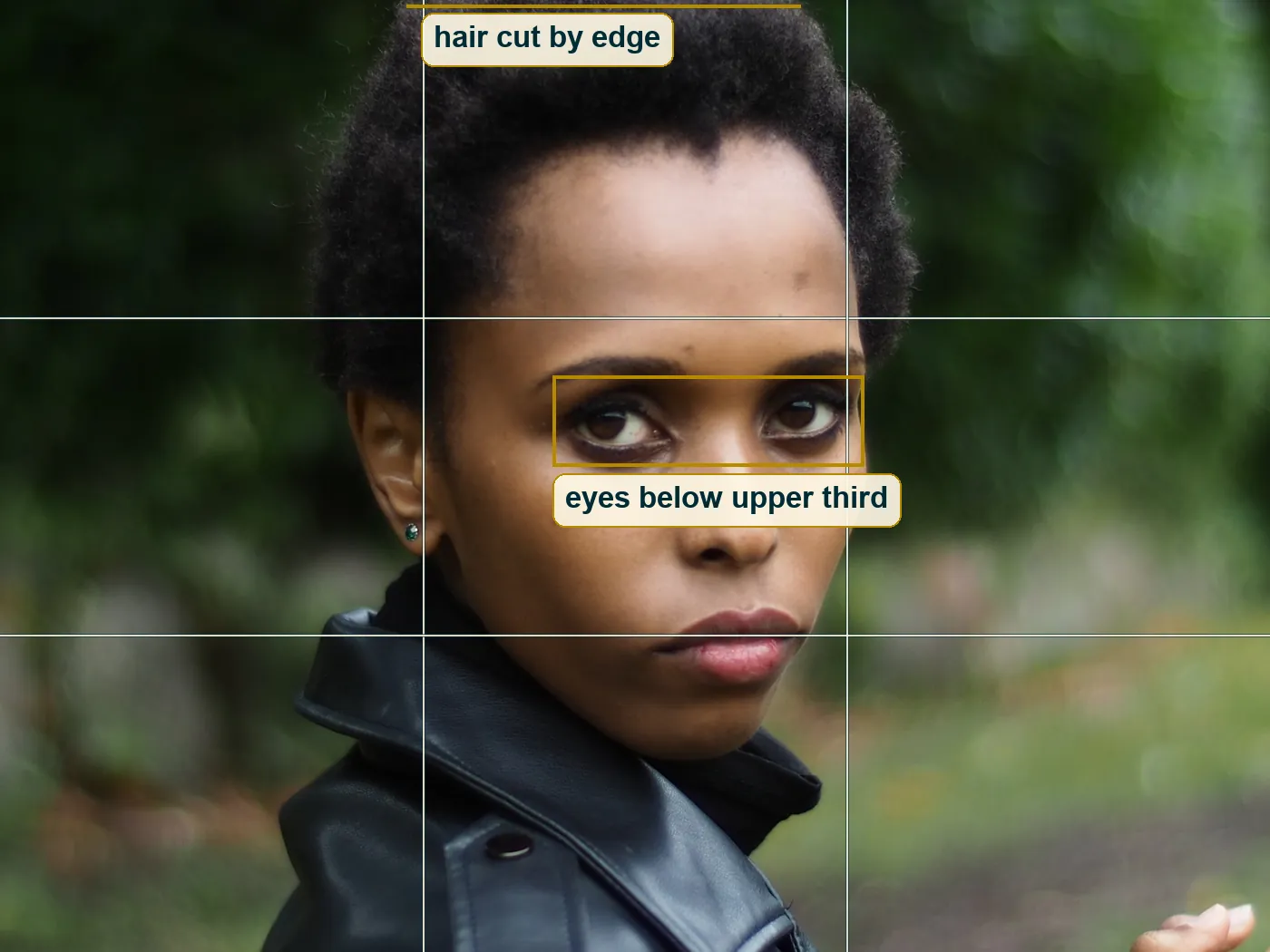
The textbook rule puts the eyes on the upper third line. If you did that here you would need to show more space above the head, or cut the chin. This frame keeps the chin and the collar and lets the hair go instead. That makes the head feel bigger and closer than it is, almost too close, which suits the look. Cutting into the hair is a decision, not a slip, and it says something. It says the face matters more than the outline of the head.
The open green on the right also does work. The body points left, the eyes look out, and the space on the right side is where the head turned from. Leave that space out and the turn has nowhere to come from.
The moment after the turn
There is no motion blur anywhere on the face. Zoom in where the hair meets the green and the single coils stay separate, with no streak and no double edge. So during the exposure neither the camera nor the head moved in any way that shows.
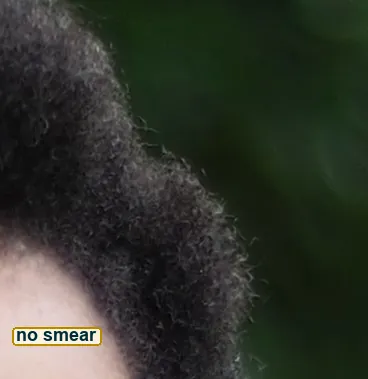
Open shade or overcast light at f/2 and ISO 100 gives a shutter of about 1/250 to 1/1000 s, so a reading of about 1/500 s fits well. Now put the other setting next to it. This frame shows about half a metre of real width across 2302 pixels, so one pixel is about a fifth of a millimetre. If the head was still moving at even 10 cm per second, 1/30 s would smear it across about 15 pixels, and the coils would melt into a soft grey halo. At 1/500 s the same movement covers about one pixel. That is the difference between a look that has landed and a look still on its way.
The picture catches the instant after a turn. A second earlier the face was moving. A second later she might have smiled or looked away. People hold a direct look into a lens only briefly before they start to perform.
Reading the lens
The face looks true. The nose is not swollen, the ear is in proportion, and nothing at the edges of the frame stretches. That alone tells you a lot about where the camera stood.
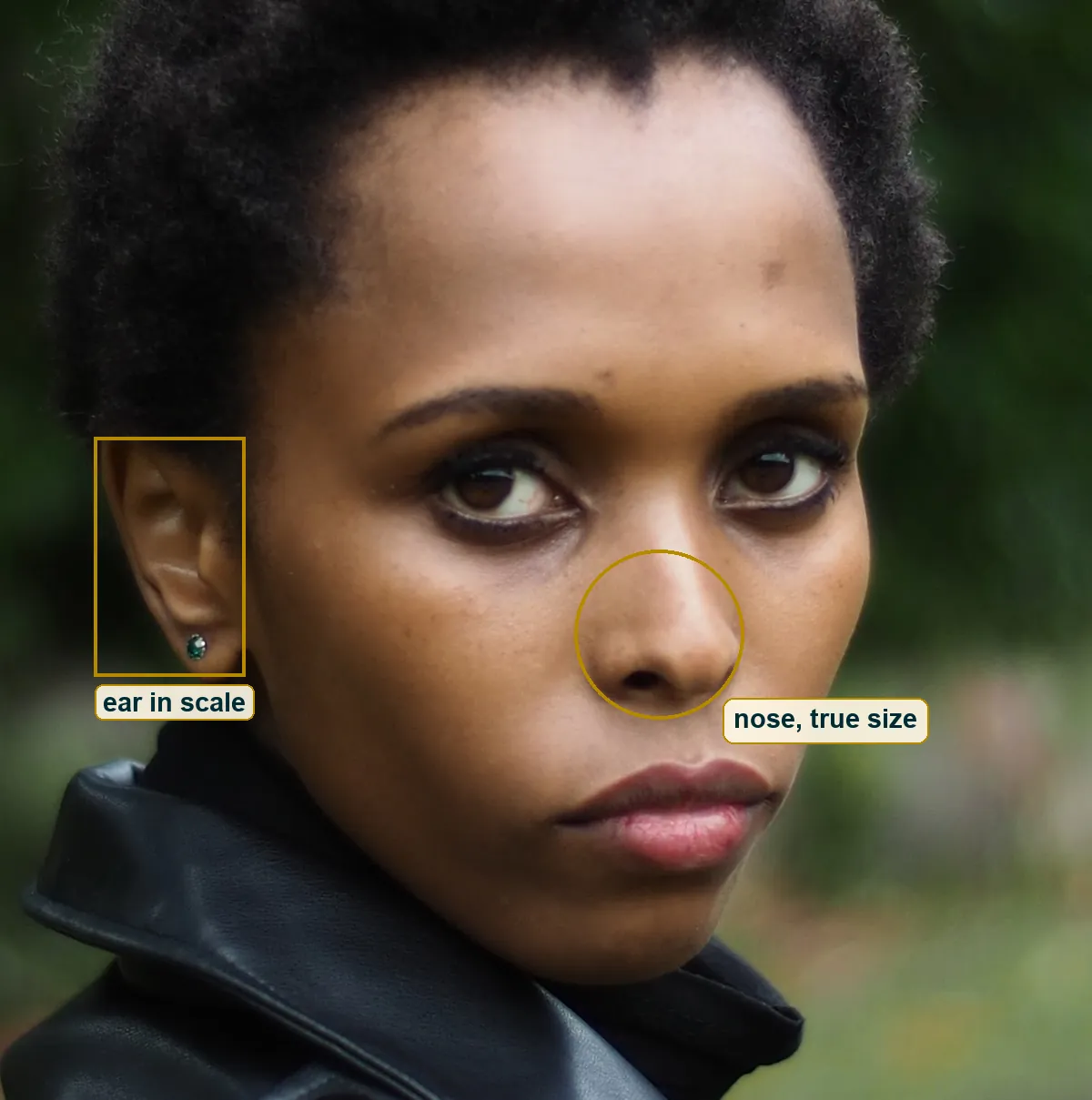
Perspective depends only on distance. The tip of her nose is about 10 cm closer to the camera than her ear. Shoot from 40 cm, the way a phone's main wide lens forces you to, and the nose is at 40 cm while the ear is at 50, so the nose comes out about a quarter bigger than it should. Shoot from 1.2 m and it's 120 against 130, so the nose grows by only about 8 percent and the eye reads that as normal. The frame here covers about half a metre of width, and on a full frame camera an 85mm lens shows that width at about 1.2 m. So the most likely reading is a short tele, something like 75 to 105mm in full frame terms, from about 1.1 to 1.5 m away.
The 4:3 shape adds a clue but not an answer. It's the native shape of Micro Four Thirds sensors and of most phone sensors. On Micro Four Thirds the same view would come from a lens of about 40 to 50mm. On a phone it would be the 2x or 3x lens, not the main one. It could also be a crop from a 3:2 frame. The picture cannot settle that, so this essay doesn't either.
A slice of focus a few centimetres deep
Focus sits on the near eye, the one on the left of the frame. The far eye is a touch softer. The ear, only a few centimetres further back, is already soft at the edges, and the shoulder in the lower left is clearly out of focus. The trees behind her have no leaves left, only shapes.
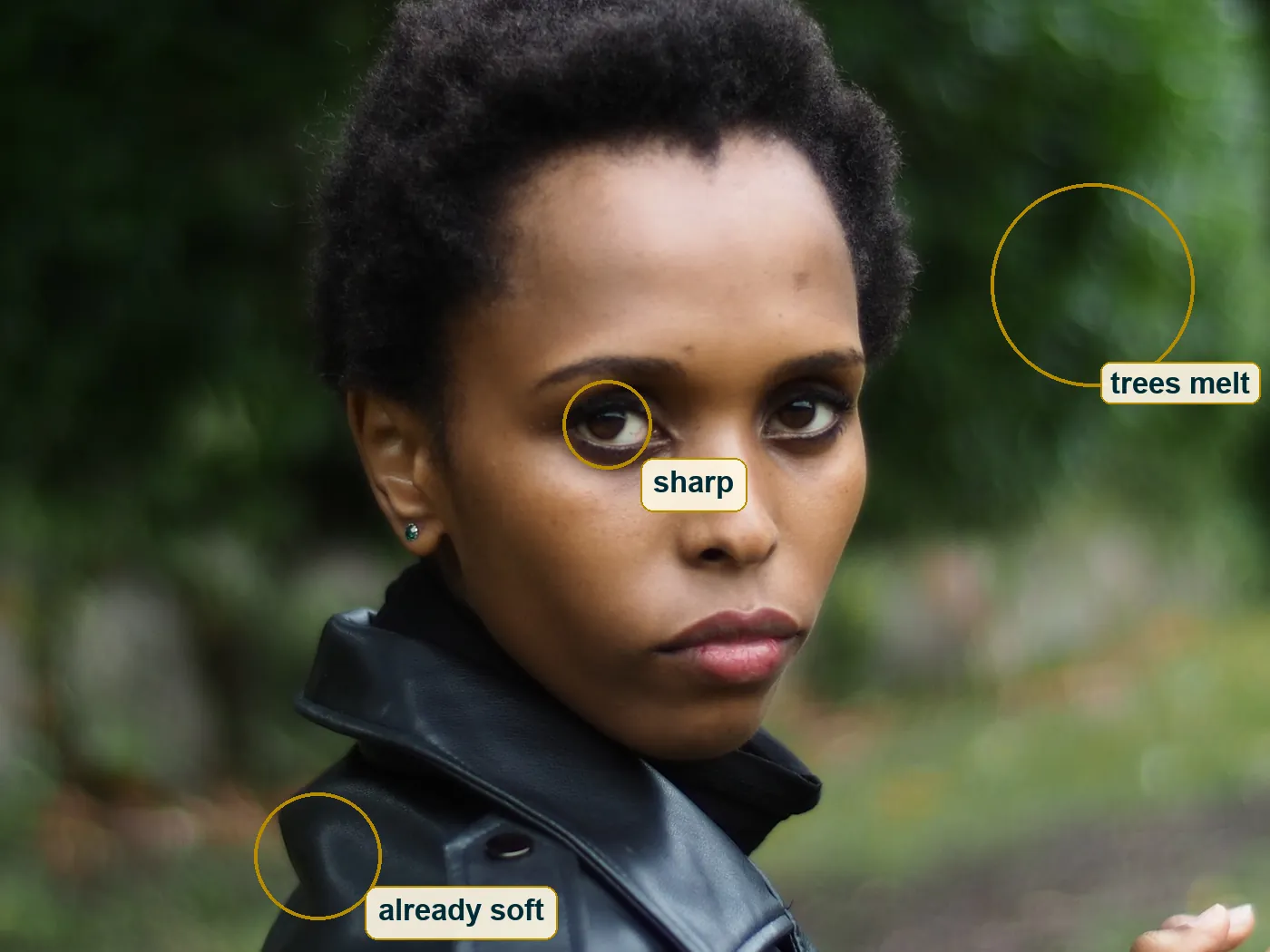
At 85mm, 1.2 m and f/2 on full frame, the zone of sharpness is about 2 to 3 cm deep. That fits what you see. Now the same scene at f/8. The sharp zone grows to about 10 cm, so the ear, the earring and the collar all come in sharp. The trees start to show branches and leaves, and the grey shapes below would become readable objects. To keep the exposure, the shutter would drop four stops, from about 1/500 s to about 1/30 s, which brings back the motion risk from the last section, or the ISO would climb to about 1600. f/2 is the choice that keeps the place a mystery and the look clean.
Some bright patches in the upper right look like crescents more than full discs. That is what fast lenses often do toward the corners when wide open. The blur here is too dense to be sure, so take it as a hint, not a fact. The bigger point is distance. The trees are several metres behind her, and distance behind the subject melts a background as much as the aperture does.
Film or digital
Film grain clumps. It looks like fine sand with uneven heaps, and you see it best in flat dark areas. Here the dark leather and the flat green are smooth, almost waxy, with no clumps and no colour speckle.
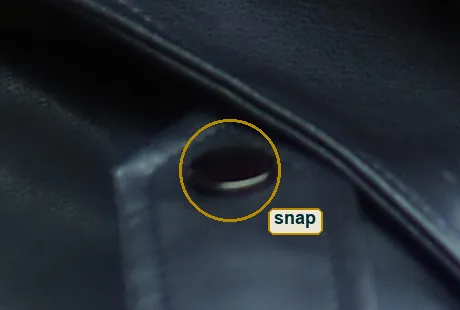
That smoothness points to a digital file with noise reduction, or a phone that merged several frames. The size points the same way. About 4 megapixels is small for a modern camera, so this is likely a resized export or a crop. The 4:3 shape exists on film as 6x4.5 medium format, but the texture doesn't match that. So the reading is digital with a gentle grade, and the slightly analogue mood comes from the soft contrast and the muted greens, not from grain. A lot of what people call the film look is just old lenses and lower contrast.
Green against green
This is a colour photograph with a small palette. Greens fill the background, warm browns live in the skin, deep blacks belong to the hair and the jacket, and the lips add a muted rose so the face doesn't go flat.
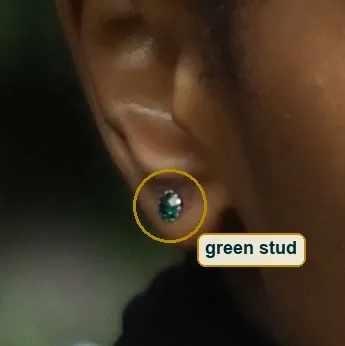
The best colour moment in the frame is tiny. The green stud in her ear repeats the green of the trees. It ties the person to the place without showing the place, planned or found.
The white balance reads neutral to slightly warm on the skin, with a faint green cast in the shadows. That cast is probably light bouncing off leaves before it reaches her. The blacks are deep but not crushed. You can still see the folds of the leather and the texture of the hair, which tells you the exposure was set for the face and the shadows were allowed to sit low without falling into pure black.
Where this look comes from
The head that turns back out of the dark with an earring near the face has an old ancestor. Johannes Vermeer painted Girl with a Pearl Earring around 1665. Here the dark is replaced by blurred green and the pearl by a green stone, but the grammar is the same. The turn implies a moment, and the earring gives the eye a resting point.
In photography the closer relative is Mama Casset, the Senegalese studio photographer who opened African Photo in the Medina of Dakar in 1942. Women were his most frequent sitters and patrons. An essay on MoMA's magazine site describes how he kept his sitters' gazes at the centre, under bright light and against blurred backdrops, with metal earrings and hennaed lips catching the light. The essay also gives Wolof words for kinds of looks. Jàkk is looking straight ahead, xool is eyes open, and xulli is eyes bulging. In those words the look in this portrait would be jàkk with xool and without xulli. Open, straight, not wide. Having words that precise reminds you that a gaze is something people practise and read.
The same essay opens with bell hooks and her text The Oppositional Gaze, about Black women as film spectators who looked critically at what the screen showed them. Her point is that looking can be an act, not only a way of receiving. That is why the link holds. This portrait doesn't ask you to look at her. It shows her looking at you, and the photographer kept everything else quiet so that the act stays the subject.
The one mistake
Fingertips with pale nails come in at the lower right corner, out of focus. They pull the eye to the edge and raise a question the picture never answers. Whose hand, and what was it doing?
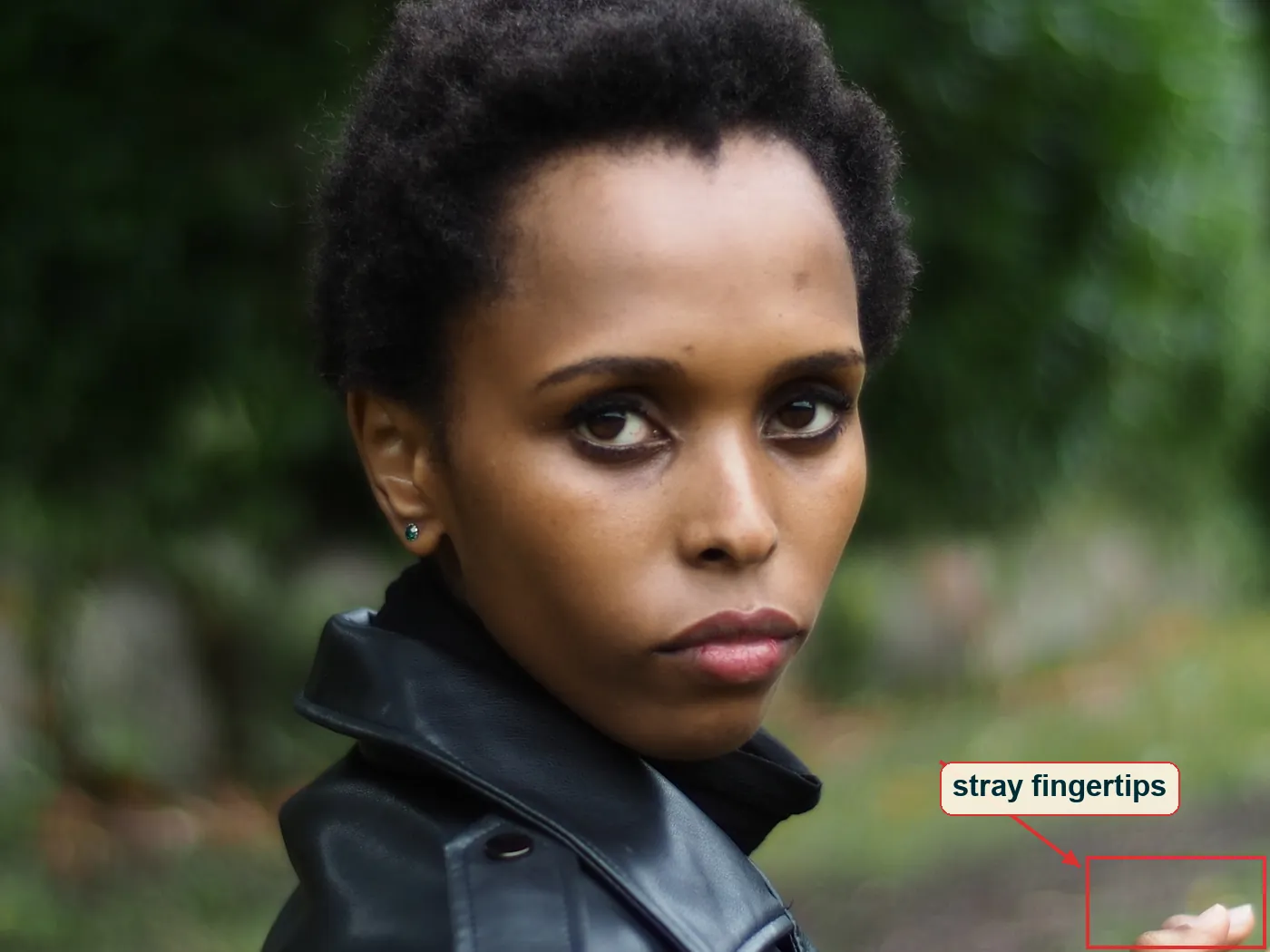
The fix is cheap. Trim the bottom tenth of the frame and the fingertips go, and the frame becomes close to 3:2. Better still, fix it before you shoot. Half a step to the left or a quick word to drop the hand, and the corner is clean. Or go the other way and bring the whole hand into the frame as part of the gesture, near the collar. Half a hand is the only option that doesn't work.
Try this
You need one person, one tree and twenty minutes, and the picture is mostly about where you stand and when you press.
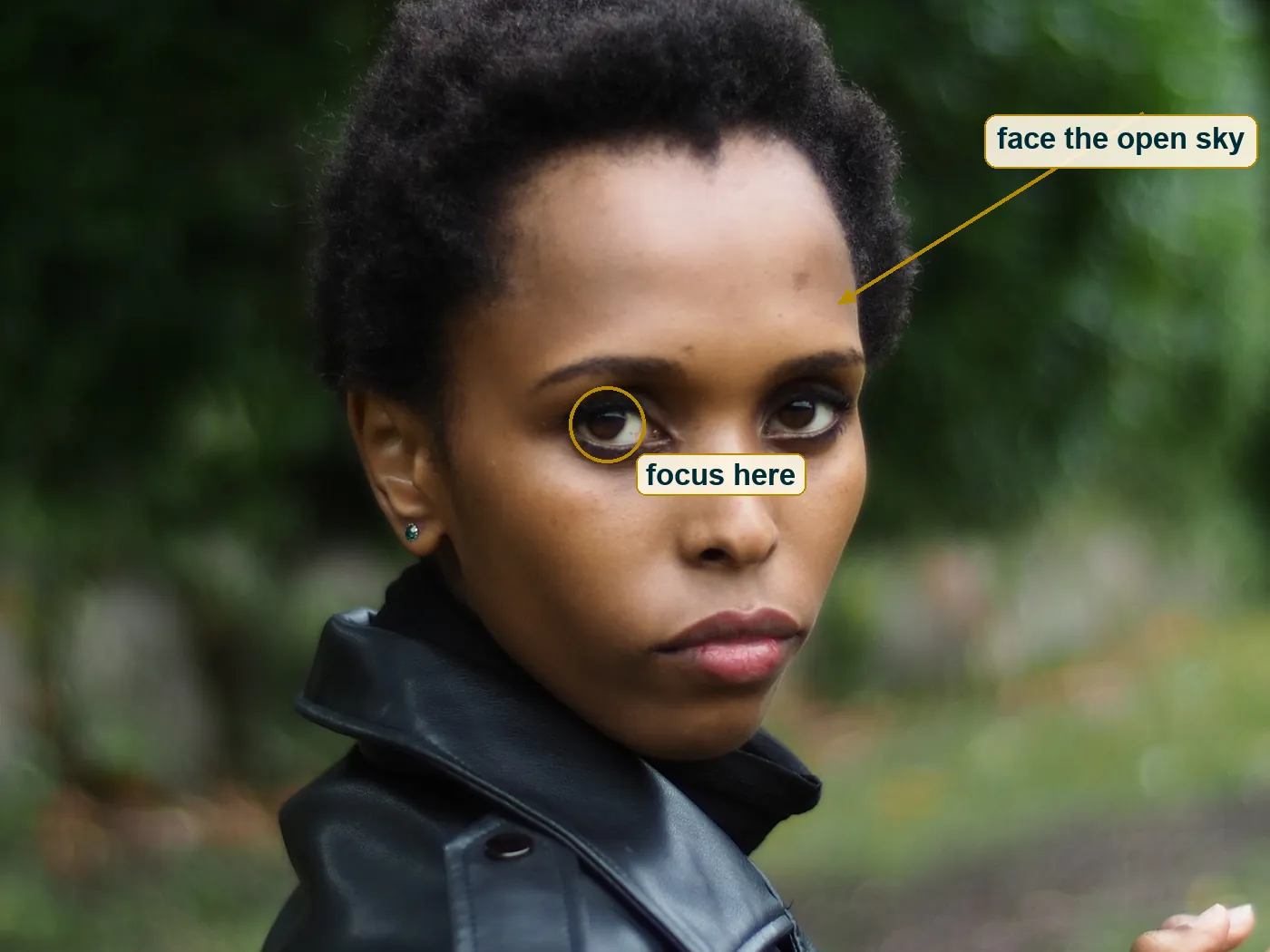
Put your person just inside the shade of a tree, turn their face toward the open sky, and look for that thin line of light at the top of each iris before you shoot. Ask them to face away, then turn only the head back, and shoot five frames as the turn lands, because the right one is rarely the first or the last. Use the longest lens you have, a 2x or 3x on a phone or about 85mm on a camera, at the widest aperture, from about 1.2 m, with the focus on the near eye. Then check the four corners for hands, bags and bright spots before you call it done.
Why it stays
Most portraits we scroll past want something from us. They smile, they sell, they reassure. This one doesn't.
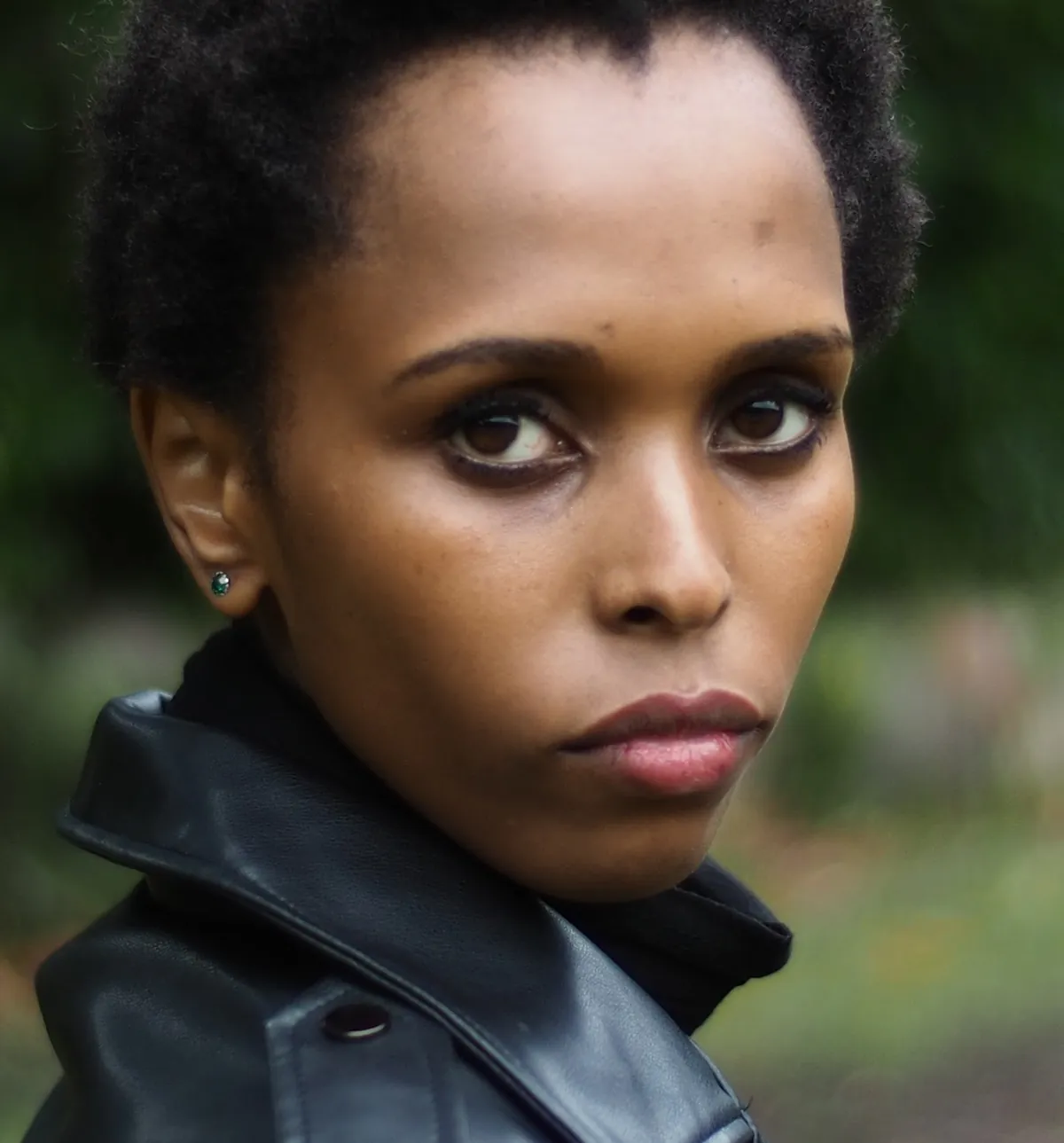
Soft sky light, a short tele from a respectful distance, a slice of focus a few centimetres deep and three colours are modest tools. Here they all exist to get out of the way of one look. Go back to the first thing you saw. It's the same look, but now you know it's the eyes doing the turning, a band of sky lighting them, and a frame cut close enough that you can't step back. The picture leaves you with the feeling of having been noticed, which is the reverse of what a photograph usually does.