The sun cannot be covered with mud
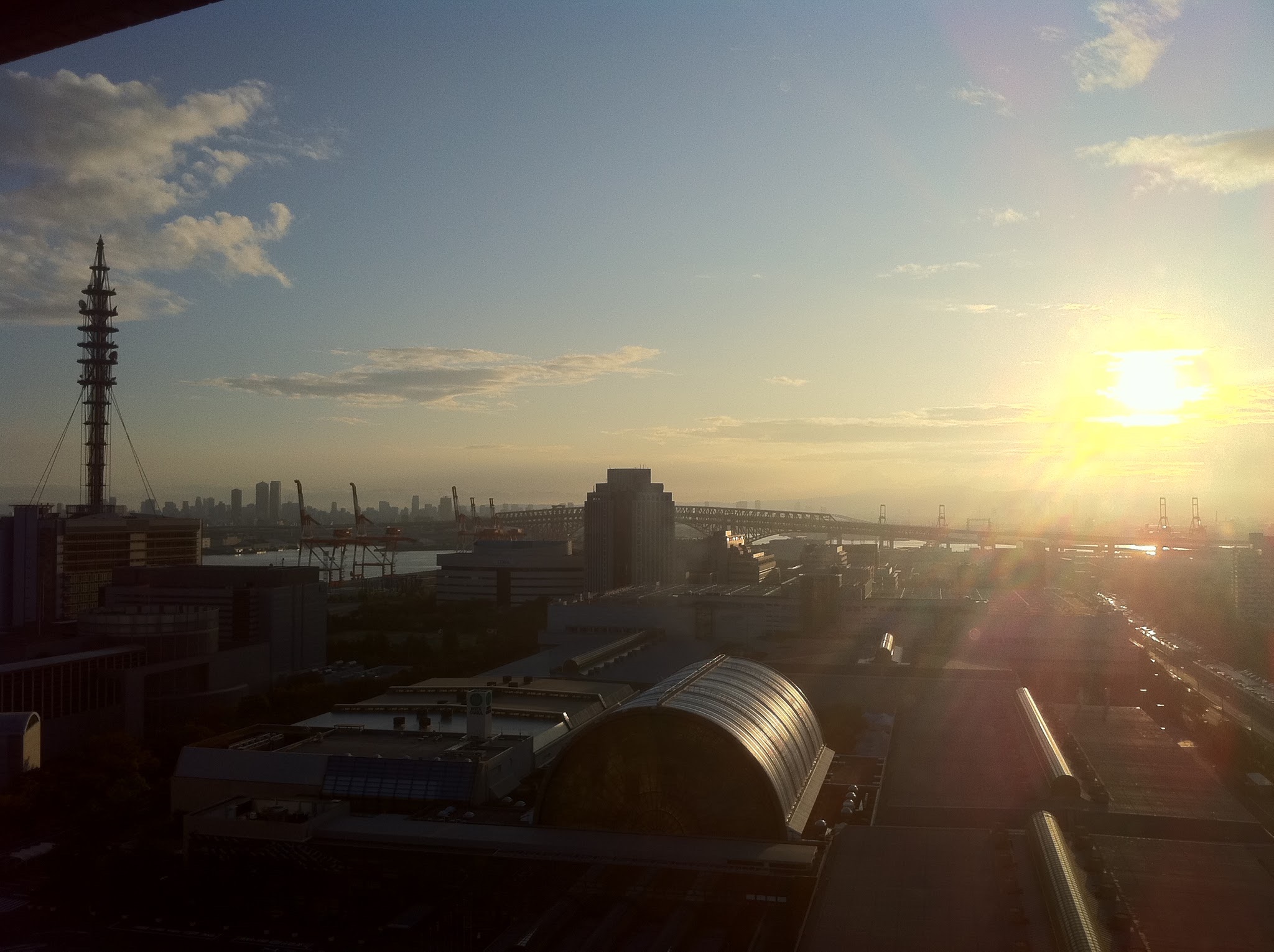
TL;DR: A high view across a working harbour, shot straight into a sun about five degrees above the horizon. Cranes, a truss bridge and a tower all live in one thin band. The flare is a soft one-sided fan with no star spikes, which points to a smudge on the lens or on a window, not to the lens design. No camera data exists. The clues read as a phone near 28 mm, about 1/2000 s at base ISO, and one fixable mistake in the top left corner.
The title is a Turkish proverb, Güneş balçıkla sıvanmaz.
The sun gets you first
You can't look anywhere else first. The sun sits near the right edge, about 90 percent across and 40 percent down, a white blob with no clean rim, and it takes your eye before you have decided anything. Only when the eye gives up on it does it start to move, and it moves left. It slides along the horizon, over a long steel truss bridge, past a dark tower and a row of red and white cranes, and stops at a lattice mast near the left edge.
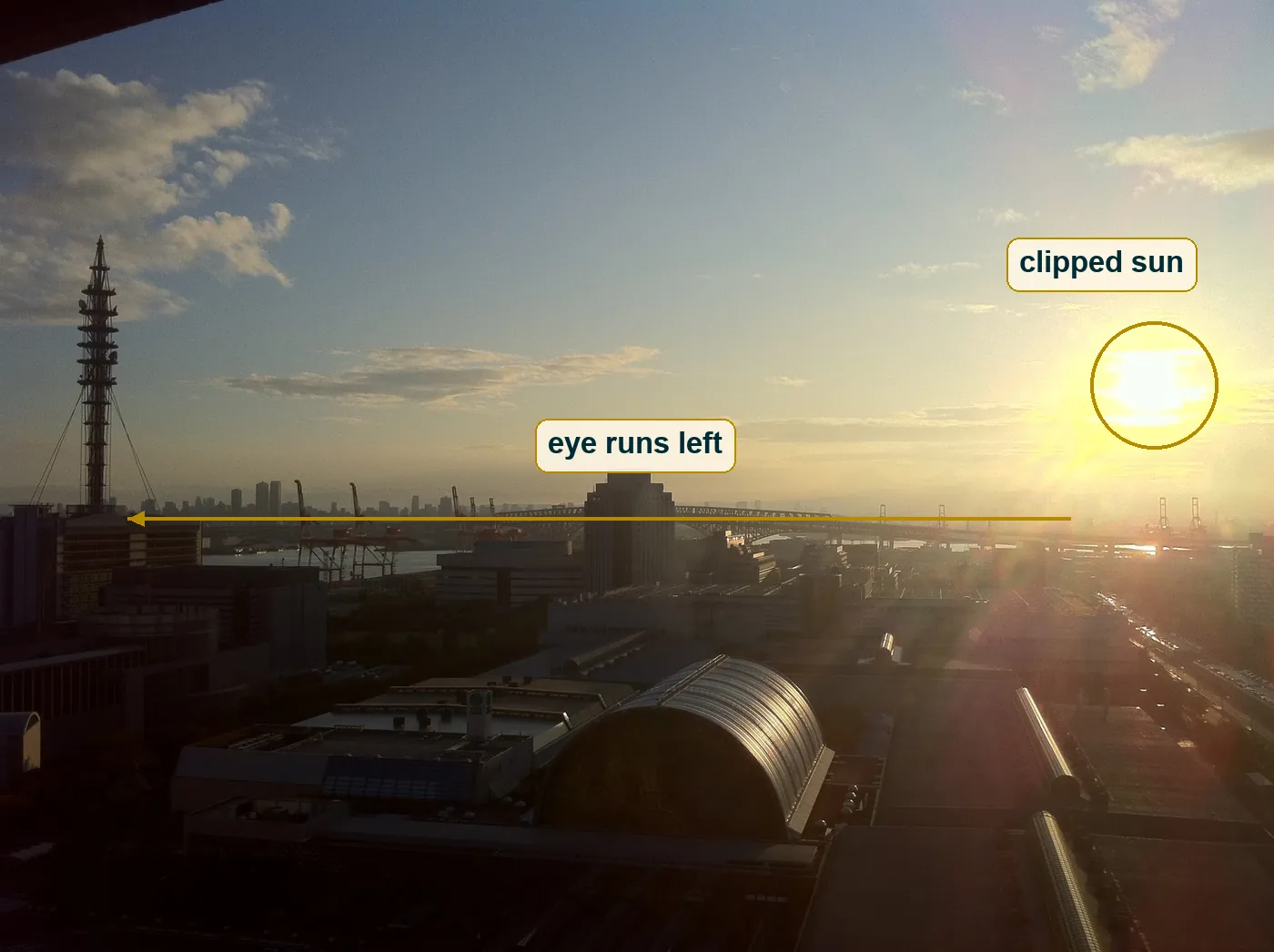
That path is the picture's reading order, and it is not an accident of taste. Your eye goes to the brightest thing in a frame and then to the strongest edge near it, and here the strongest edge is the long horizontal of bridge and skyline. The mast at the other end works like a full stop. Without it your eye would run out of the frame on the left. With it, the trip ends on something tall and dark that answers the sun across the whole width.
A port in one thin band
Almost everything that makes this a port sits in one strip. From the top of the central tower down to the quay below the cranes, it is about 200 pixels of a 1,530 pixel frame, roughly a seventh of the height. Above it is sky. Below it is roofs. The harbour itself is only a few grey and bright slivers of water.
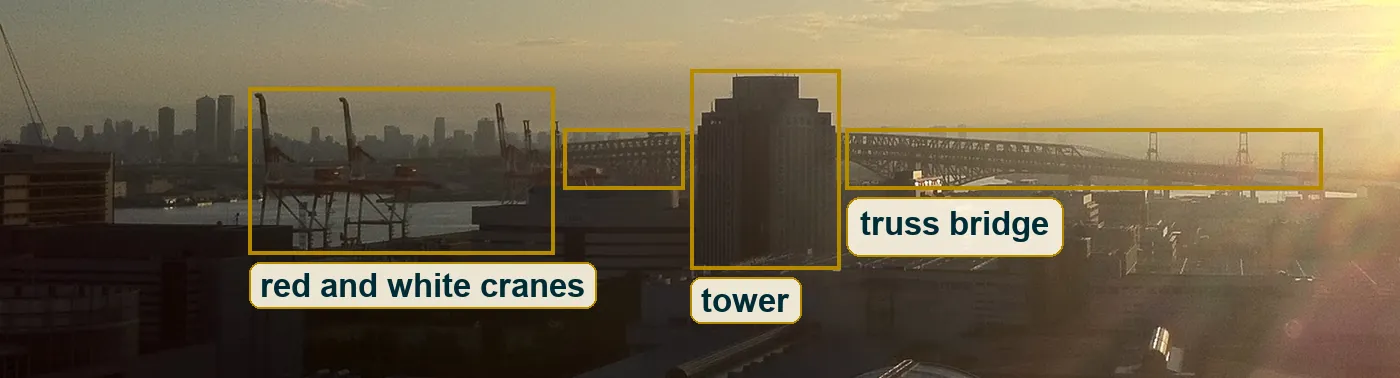
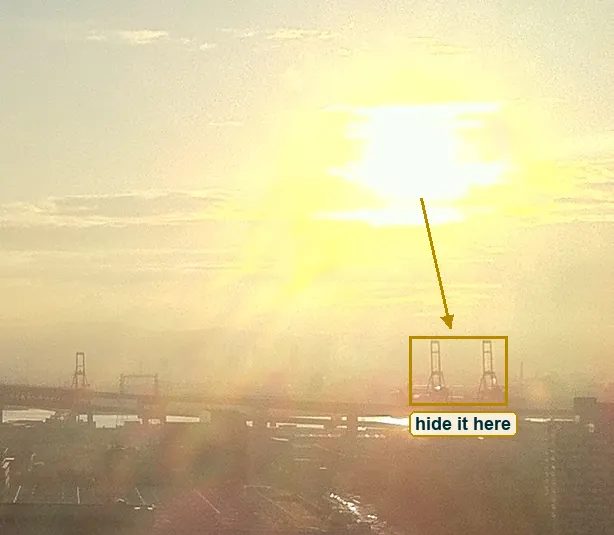
Look along that band and you can count the things a port is made of. On the left, two big gantry cranes with raised booms, their machinery houses painted red and white. In the middle, a boxy high-rise with a stepped crown. To its right, the truss bridge, tallest around its middle, built for traffic, not for postcards. Further right, in the glare, two more small cranes stand almost under the sun. Far behind all of it, a skyline of towers fades into the air. Nothing here was put in the frame to be pretty. It is just what a working harbour looks like from above.
Light coming the wrong way
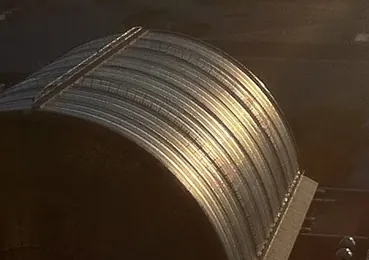
This is contre-jour, light coming straight at the lens. Everything that faces you is in shadow, and only edges turned toward the sun catch light. The clearest proof is the big barrel-vaulted roof in the lower middle.
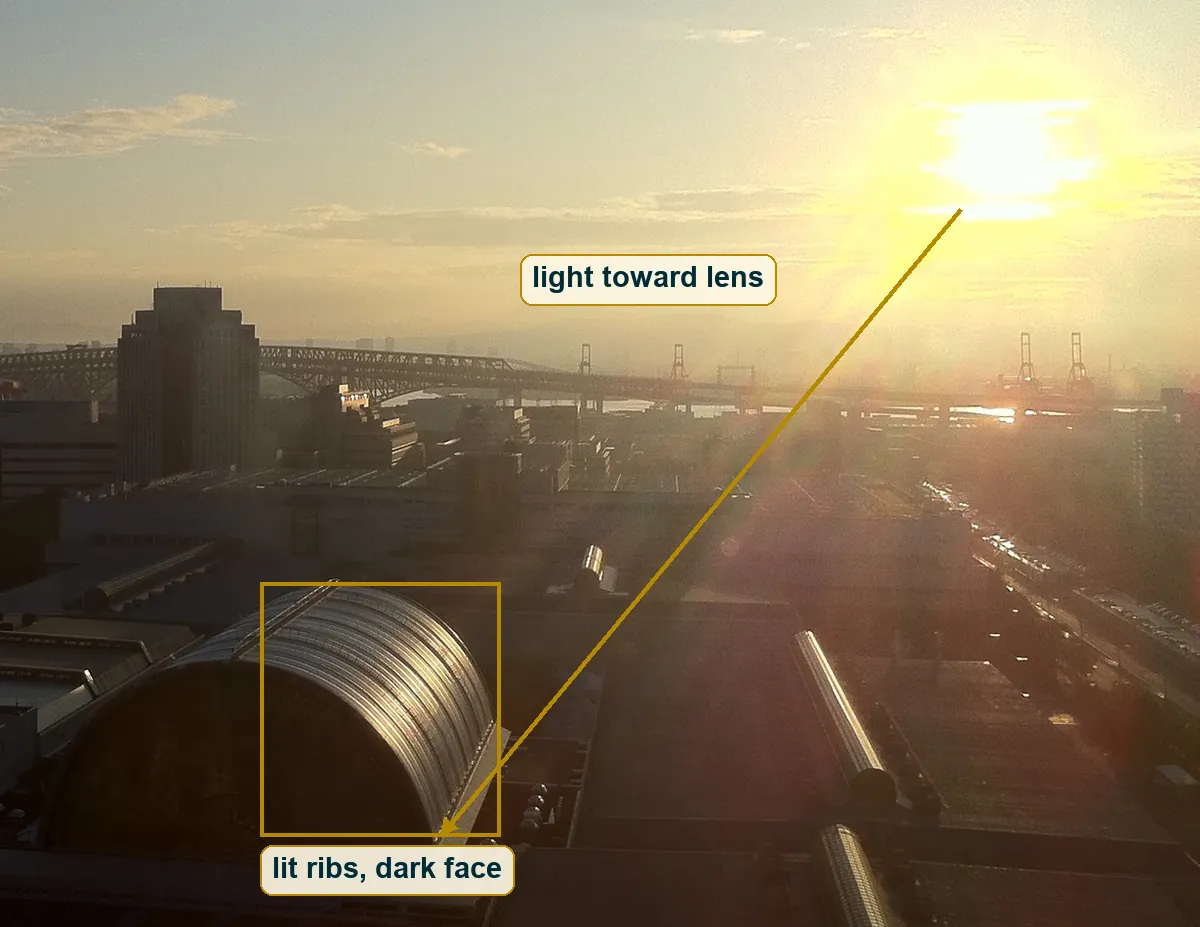
Its curved ribs on the sun side light up as thin gold lines, around 200 out of 255 in brightness. The half-round end wall that faces you sits at about 33, 18, 6 in red, green and blue, almost black with a brown cast. Same roof, same second, and a gap of several stops between two surfaces a few metres apart. That is what backlight does. It draws outlines and drops the faces.
The same thing happens everywhere you look. Car roofs on the road at the right glint as tiny points. The water under the bridge throws one hard glint straight below the sun. The mast and the cranes become cut-outs. If the sun were behind the camera, all those faces would show their windows and paint, and the picture would become a survey. With the sun in front, it becomes a drawing in lines.
Haze does the depth
The far towers on the left are pale and soft. The cranes in front of them are darker and sharper. Nobody edited that. The air did it.
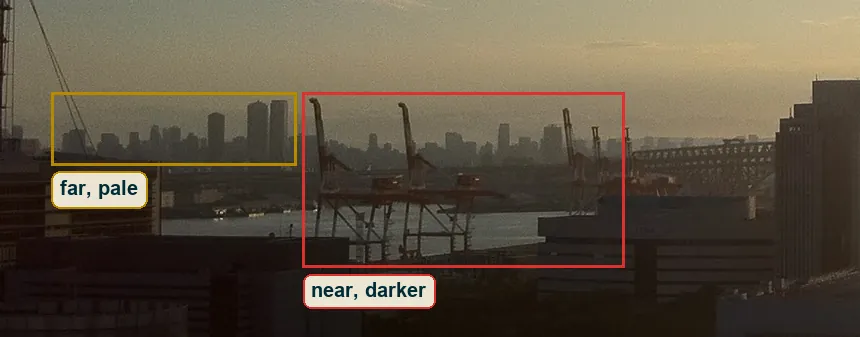
Painters call it aerial perspective. The more air between you and a thing, the more light the air scatters into your line of sight, so the thing loses contrast and drifts toward the colour of the air itself. Leonardo used it to push mountains back. Here it pushes a skyline back. In the file the far towers average about 90, 84, 70, while the crane structure in front averages about 78, 71, 59. Small numbers, but your eye reads that gap as kilometres.
Notice that the haze is warm here, not blue. Near the sun, the air is full of light that has already travelled a long way through the atmosphere and lost its blue, so the veil it lays over the far city is cream and olive. Turn your back to the sun on the same evening and the same haze would look blue grey.
The flare up close
Now go back to the sun and look properly. The clipped white area is about 160 pixels wide and 120 tall. Around it a yellow halo bleaches the sky, and from it a soft wide fan of glare spreads down and to the left, across the bridge and onto the roofs.
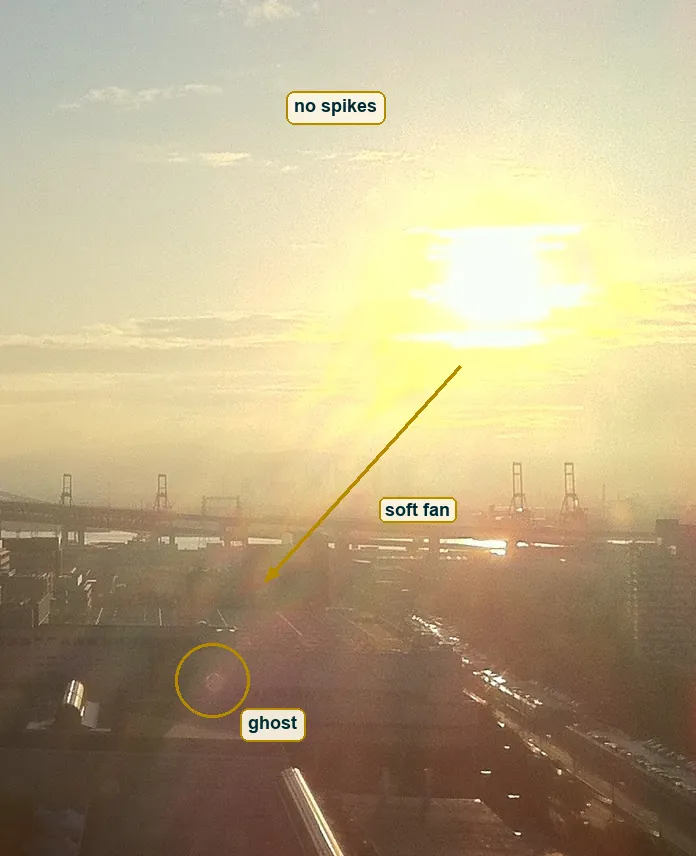
Two things are missing, and they tell you more than what is there. First, there are no star spikes. A sunstar comes from diffraction at the blade edges of a stopped-down iris, so many phone lenses with a fixed round opening never make a clean one. Second, the fan is one-sided. A clean lens throws glare evenly around a bright source. A smear of grease, a fingerprint or dirty glass in front of the lens scatters light across the direction the smear was wiped, and you get a fan on one side.
Then there is the ghost. A small faint warm disc sits below and left of the sun, near the quay at the right. Internal ghosts in a clean lens usually line up on an axis from the light source through the centre of the frame and land on the far side, which here would put them out on the left half of the frame. This one sits on the sun's own side, well off that line. So the honest reading is a smudged lens, a window between lens and sun, or both. The photo can't tell you which.
Two skies in one frame
The left half of the sky is cool and the right half is warm, and you can measure it. A patch of clear sky above the left middle averages 111, 126, 137 in red, green and blue. A patch left of the sun averages 229, 218, 180.
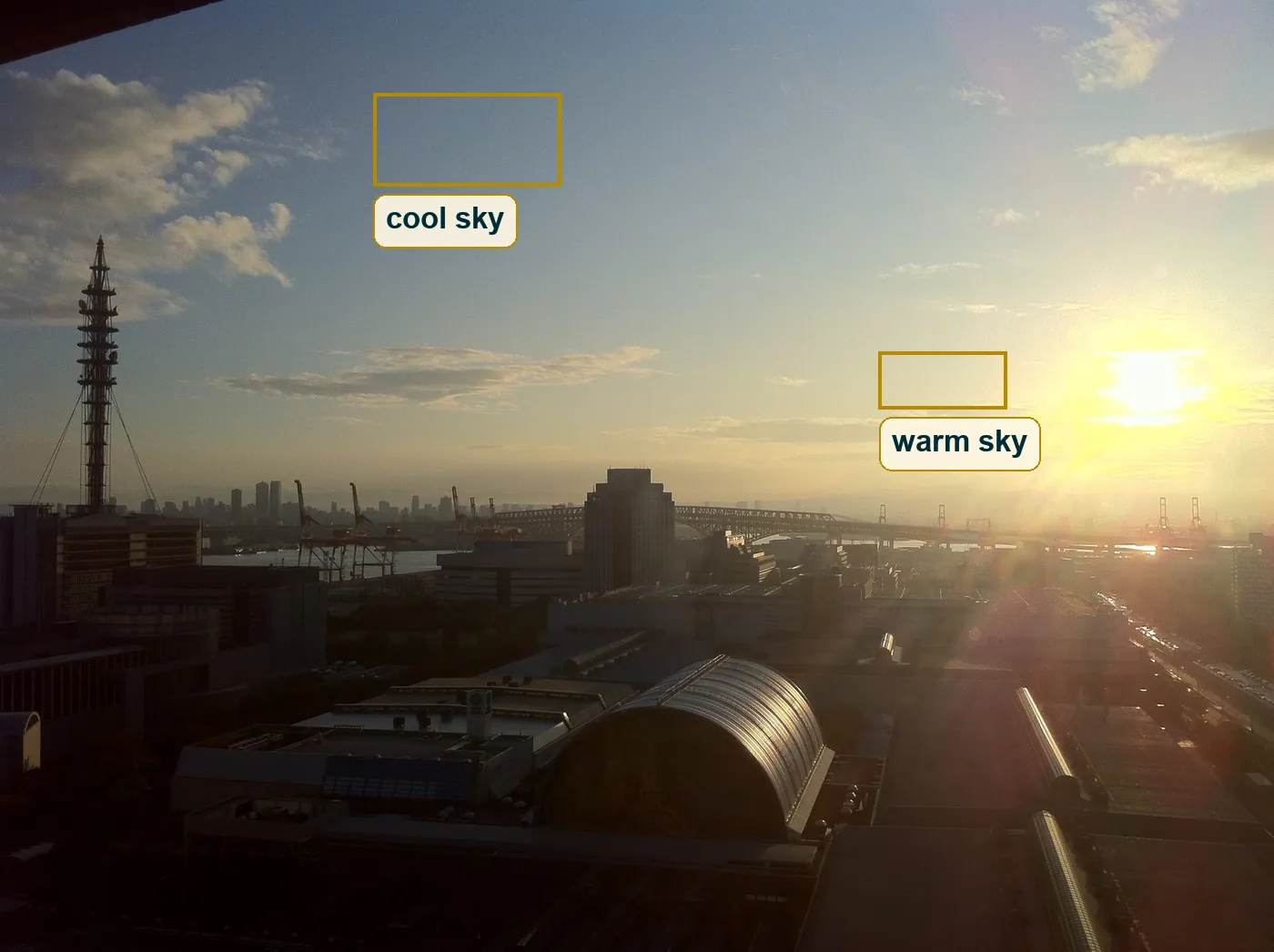
The first has more blue than red. The second has more red than blue, and twice the brightness. That split happens in any low-sun scene, because light near the sun's direction has crossed more air and lost blue on the way, while the sky away from the sun is still lit by scattered blue. The flare pushes it further, washing the right third in orange and pink.
What the camera did not do matters too. The red of the cranes reads as red and no more. Nothing has the pumped look of modern phone processing, where skies go electric and shadows glow. The colour here is the colour of the air, slightly overcooked by the glass.
A horizon in the middle
The horizon sits at about 52 percent down from the top, so just under the middle. The mast stands about 8 percent from the left edge. The sun burns about 90 percent across.
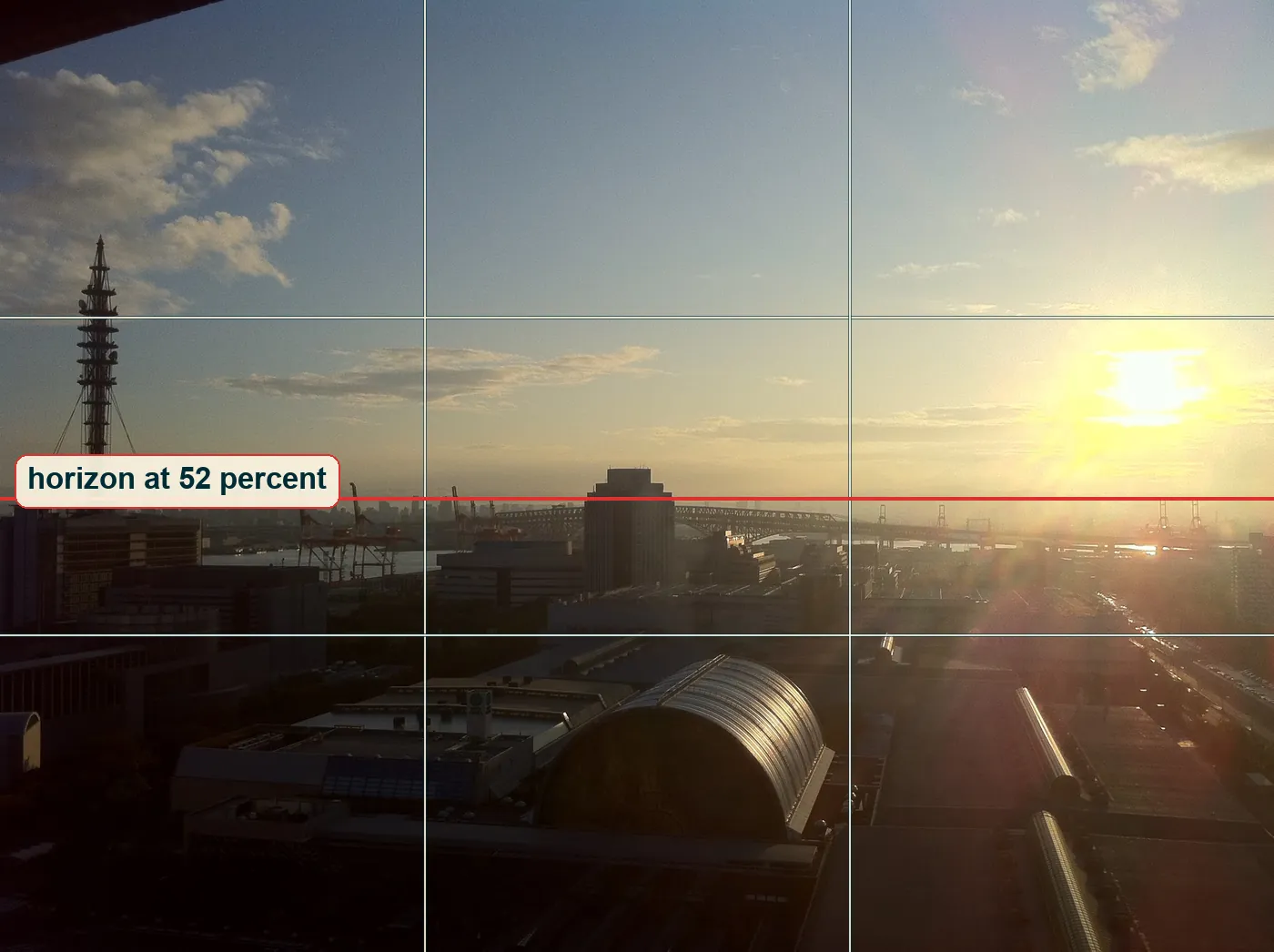
Teachers will tell you to put a horizon on a third, and they have a point. A horizon on a third tells the viewer what matters, sky or ground. A horizon near the middle refuses to choose, and that gives a frame a flat, even calm, more like a survey than a postcard. Here it works because the tension comes from somewhere else, from the two strong points at the far edges, mast and sun, with the bridge between them like the beam of a scale.
The height of the camera does the rest. You look down on roofs, a road, skylights, and that turns a messy port into something close to a map. Carl Sandburg wrote a six-line poem about fog that sits looking over a harbour and a city. The camera here sits the same way, quiet and high, and lets the city lie flat under it.
What lens saw this
The file is 2,048 by 1,530 pixels, a ratio of 1.34, which is almost exactly 4:3, the native shape of most phone sensors. It carries no camera data at all. So the lens has to be read from the picture.
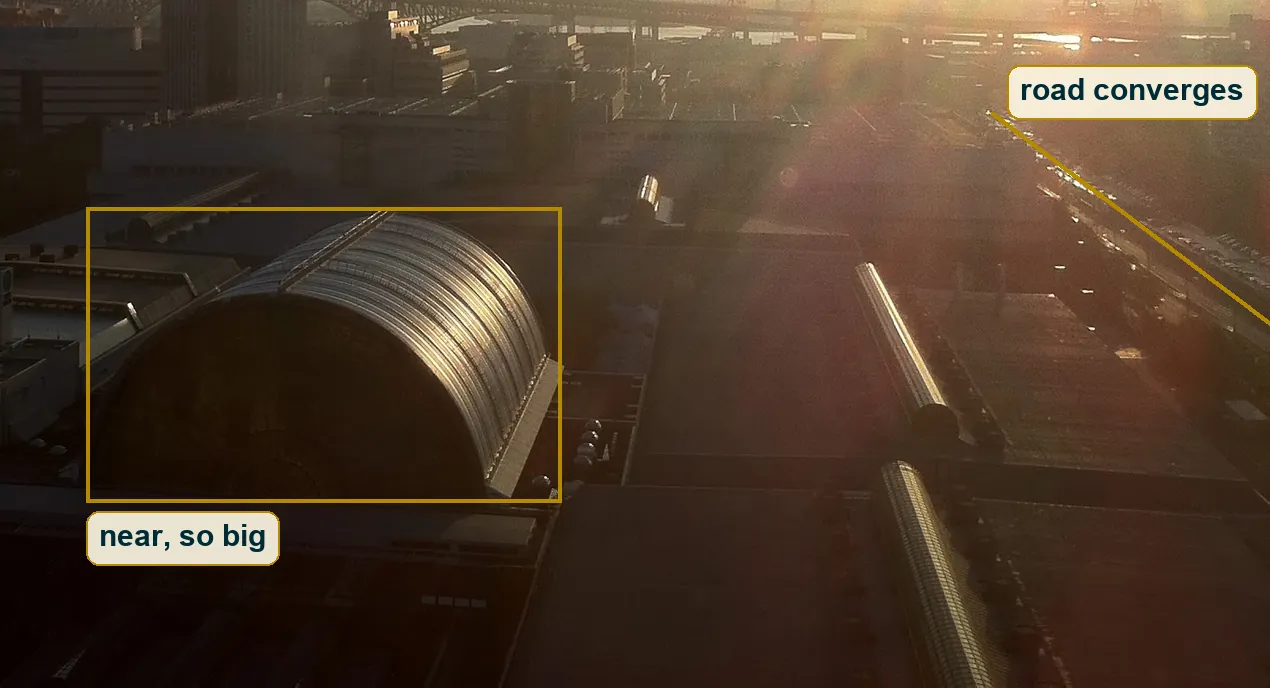
The near vault looks big and the skyline looks tiny. Near roofs show clear foreshortening. The road on the right converges hard toward the sun. A long lens would squeeze bridge and skyline together and make them loom, and that does not happen. So the angle of view is moderately wide, something like 28 to 35 mm in full-frame terms, which is where most phone main cameras sit.
The sun gives you a ruler. It is about half a degree wide in the sky. At a 28 mm equivalent the frame is about 63 degrees across, so the real disc should be about 17 pixels wide in this file, maybe 21 at 35 mm. The clipped white blob is about 90 pixels across if you take its area as a circle. So most of what you call the sun here is glare. The same ruler gives the sun's height. Its centre sits about 180 pixels above the horizon, which is about five degrees, a little more at 28 mm and a little less at 35 mm. That is golden hour, low enough to sit in a horizontal frame, high enough to still burn white. The picture does not say if it is morning or evening.
An exposure read from the wires
Without data, the exposure is a reasoned guess. The best clue is a thin one, the guy wires that hold the mast. They run diagonally down from its middle and are about one pixel wide.
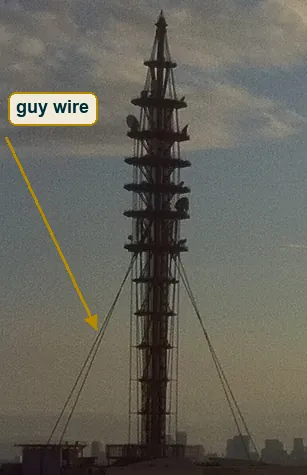
If the hand had moved during the exposure, those wires would double or smear sideways. They don't, so the shutter was short. Now the arithmetic. Sunny 16 says full sun at ISO 100 and f/16 needs about 1/100 s. Phone lenses of the 4:3 era often had a fixed aperture near f/2.4, which is about five and a half stops more light than f/16. Base ISO on such phones was often 50, one stop less sensitive. Put together you land near 1/2000 s. The meter was looking at a bright sky with the sun in it, so anything from 1/1000 to 1/4000 s is a fair range. All estimates, none of it in the file.
Now the side by side. A rough simulation in linear light gives you the trade. At the exposure you see, less than half a percent of the sky above the horizon is pure white. Add one stop and about 16 percent of it clips, a sixth of the sky gone, while the darkest roofs in the lower left only rise from about 3 to about 6 out of 255, still black. Add two stops and more than half the sky is white. So brighter would not have saved the city. It would only have lost the sky. The meter made the right call, and the dynamic range of one small sensor did the rest.
Phone not film
Look at the dark end wall of the vault at 100 percent. There is no grain in the film sense, no fine even random specks. There is smear, soft blotches of brown and olive, a few faint blocks in the flattest parts.
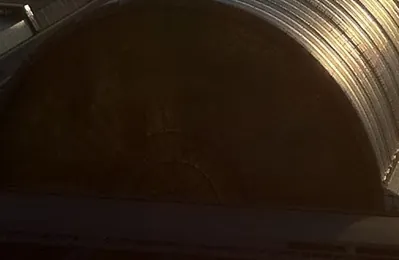
That is what in-camera noise reduction does to a small sensor's noise. It wipes fine texture into mush and leaves colour blotches where the chroma noise was. The bottom left of the frame has a median brightness of about 3 out of 255, so there is almost nothing left to wipe. Film fails differently. A colour negative in the dark gets grainier and muddier but keeps some texture, and in the highlights it rolls off softly instead of cutting to flat white the way the sun does here. Everything about this file reads digital, most likely an older phone. It is a reading, not a fact.
Monet, the Bechers and a poem about fog
The oldest ancestor of this picture is a painting. In 1872 Claude Monet painted the port of Le Havre, part of a series he made partly from a hotel room looking down over the harbour. He called it Impression, Sunrise, because, as he told it, it could not really pass for a view of the town. A low sun, masts and smokestacks melted into haze, light winning over structure.
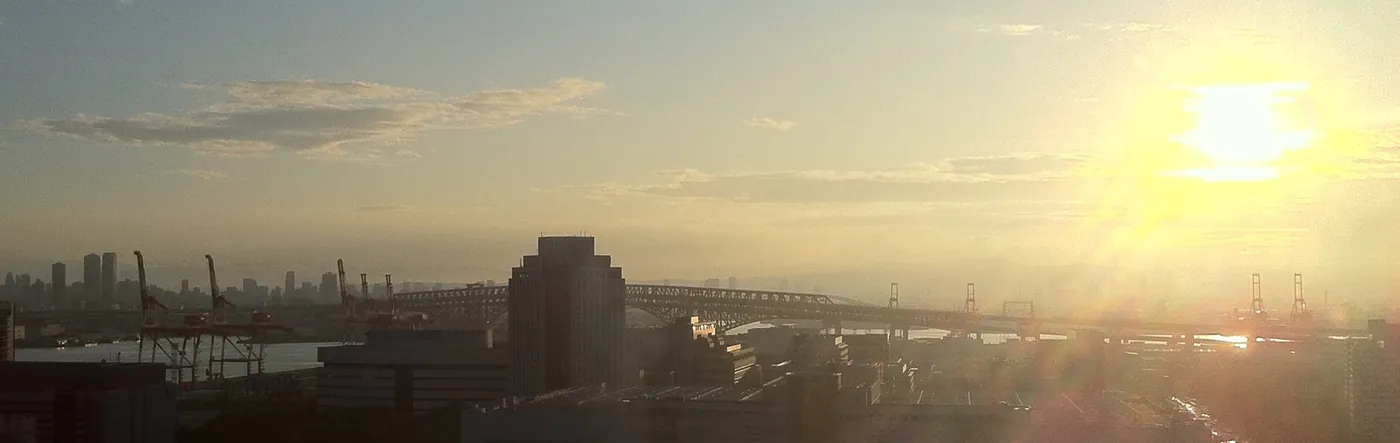
Crop this photo to the band between the cranes and the sun and you get the same idea in a phone file. High window, working port, sun low and strong enough to dissolve the steel. The difference is that Monet chose his blur with a brush, and here the blur came from air and a smudged lens.
The second line is German and industrial. Bernd and Hilla Becher spent decades photographing cooling towers, gas tanks and coal bunkers as plain objects, often in grids, and they were in the 1975 New Topographics show that took man-made places seriously as subjects. Cranes, a truss bridge and a mall roof are that kind of subject. This photo is far less exact than their work, but it shares the refusal to pick a beauty spot.
The third is a poem. Carl Sandburg wrote Fog in Chicago, waiting forty minutes for a judge, after walking through a park and seeing fog over the harbour. He was carrying a book of Japanese haiku and called the result an American haiku. Six lines. The fog comes on little cat feet, sits looking over harbour and city, and moves on. That is the mood of this frame. Not drama, just weather sitting over a port for a moment and then leaving.
The one mistake
The flare is not the mistake. It is half the subject. The mistake is the dark wedge in the top left corner.
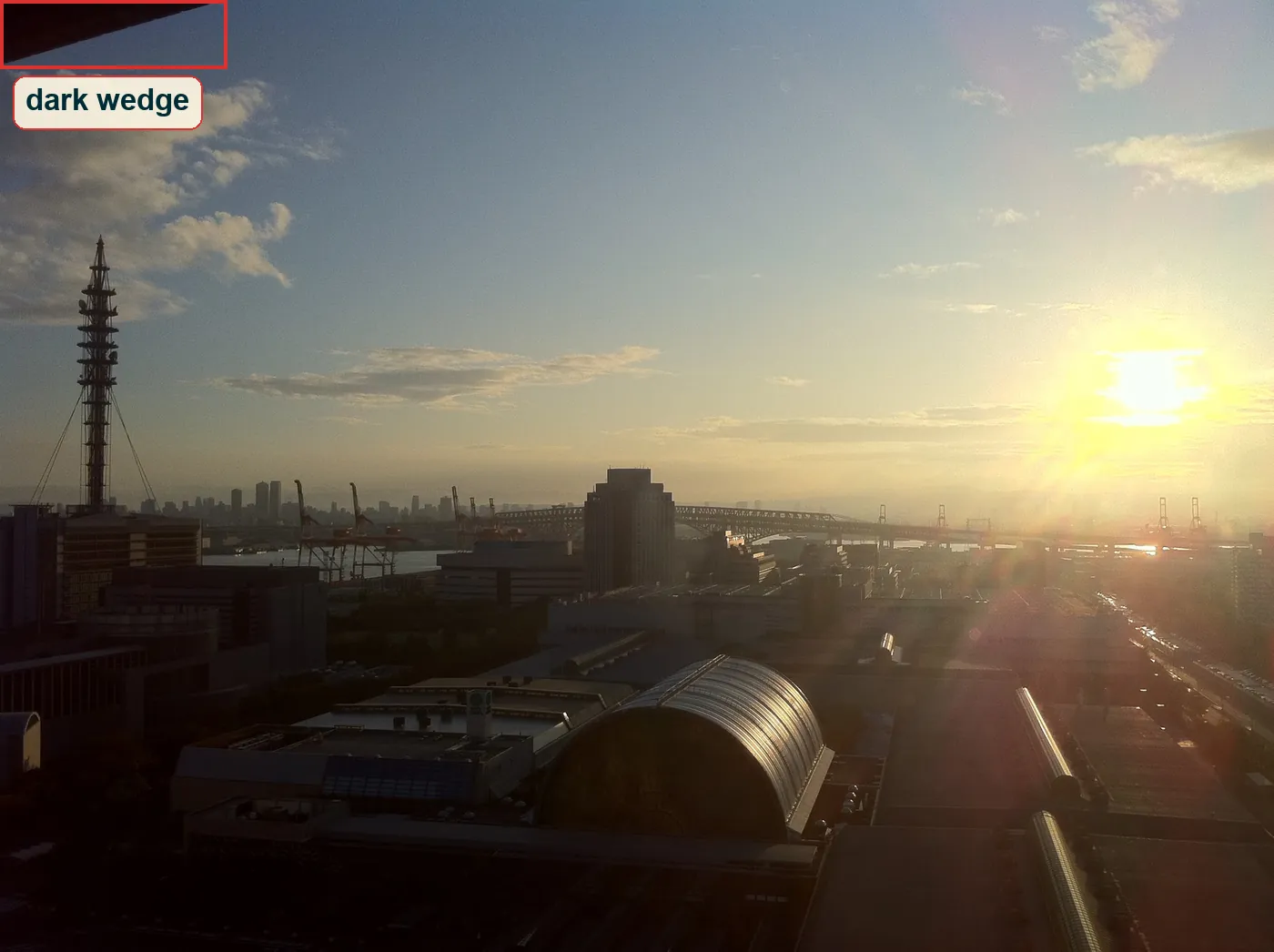
It is a soft black triangle, about 360 pixels along the top and 100 down the side, almost certainly part of the building the photo was taken from, an eave or a window frame far out of focus. It pulls your eye into a corner with nothing in it, and it is the only thing in the frame that looks like an accident. The fix costs nothing. Lean forward one hand-width, or tilt the phone a degree down, or crop about 110 pixels off the top afterwards. The crop also pulls the horizon a little closer to the top third. A smaller second note is the sun, pressed close to the right edge. Ten percent more room would let the halo breathe. But the wedge comes first.
Try this
Find a high window that faces the low sun, about an hour before sunset. Clean the phone lens with a soft cloth and shoot once, then rub a thumb lightly over it and shoot again, so you see the one-sided fan appear. Clean it again and step sideways until a crane, pole or building edge just covers the sun, and watch the glare drop and the contrast come back. Then tap and hold on the bright sky, pull exposure down one stop, and compare the sky and the shadows with your first frame.
Back to the sun
Go back to where you started, the white blob near the right edge. At first it was the subject. Now you know that only a sliver of it is the sun, and the rest is air and glass.
Most sunset pictures are about the sun. This one is about everything the sun does at once, to the cranes, to the haze, to a glass roof and to the camera. It flattens steel into lines, pales a whole skyline, draws gold along a few ribs and smears itself across a dirty lens. The photo doesn't hide any of that. Once you have seen it here, you will see it in every window you shoot through.