It is not taboo to go back and fetch what you forgot
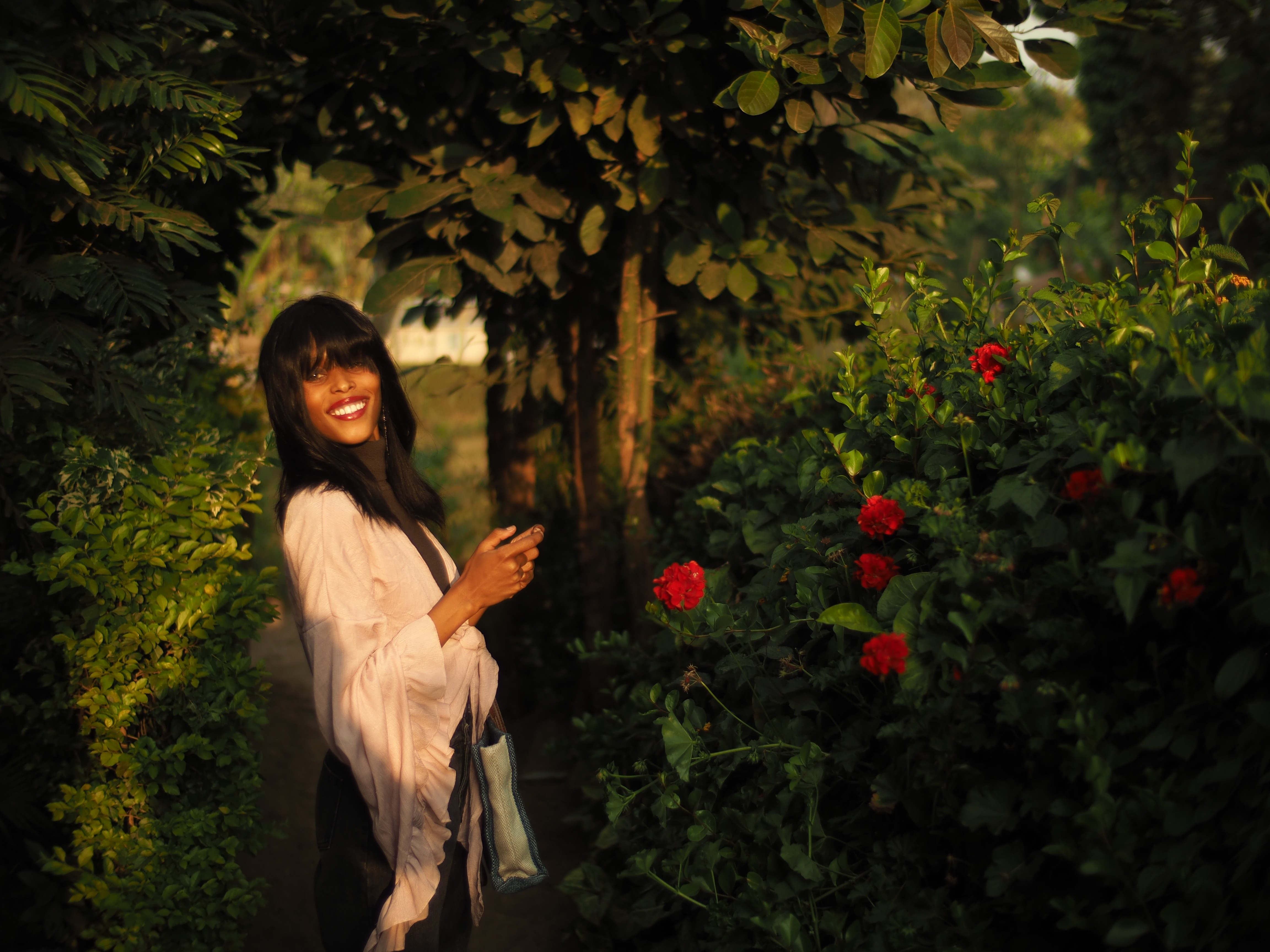
TL;DR: A woman walks on along a shaded garden path and turns her head back to the lens, and the whole picture lives in that turn. The real EXIF says Olympus E-M5 Mark II, manual exposure, 1/3200 s at ISO 100, and empty lens fields, which points to a manual lens, likely a Voigtländer 25mm f/0.95. Low warm sun, a frame of leaves and about 40 cm of sharp focus do the work, and the one fix is the bright gap glowing beside her hair.
The title is an Akan proverb, Se wo were fi na wosankofa a yenkyi.
The look comes back
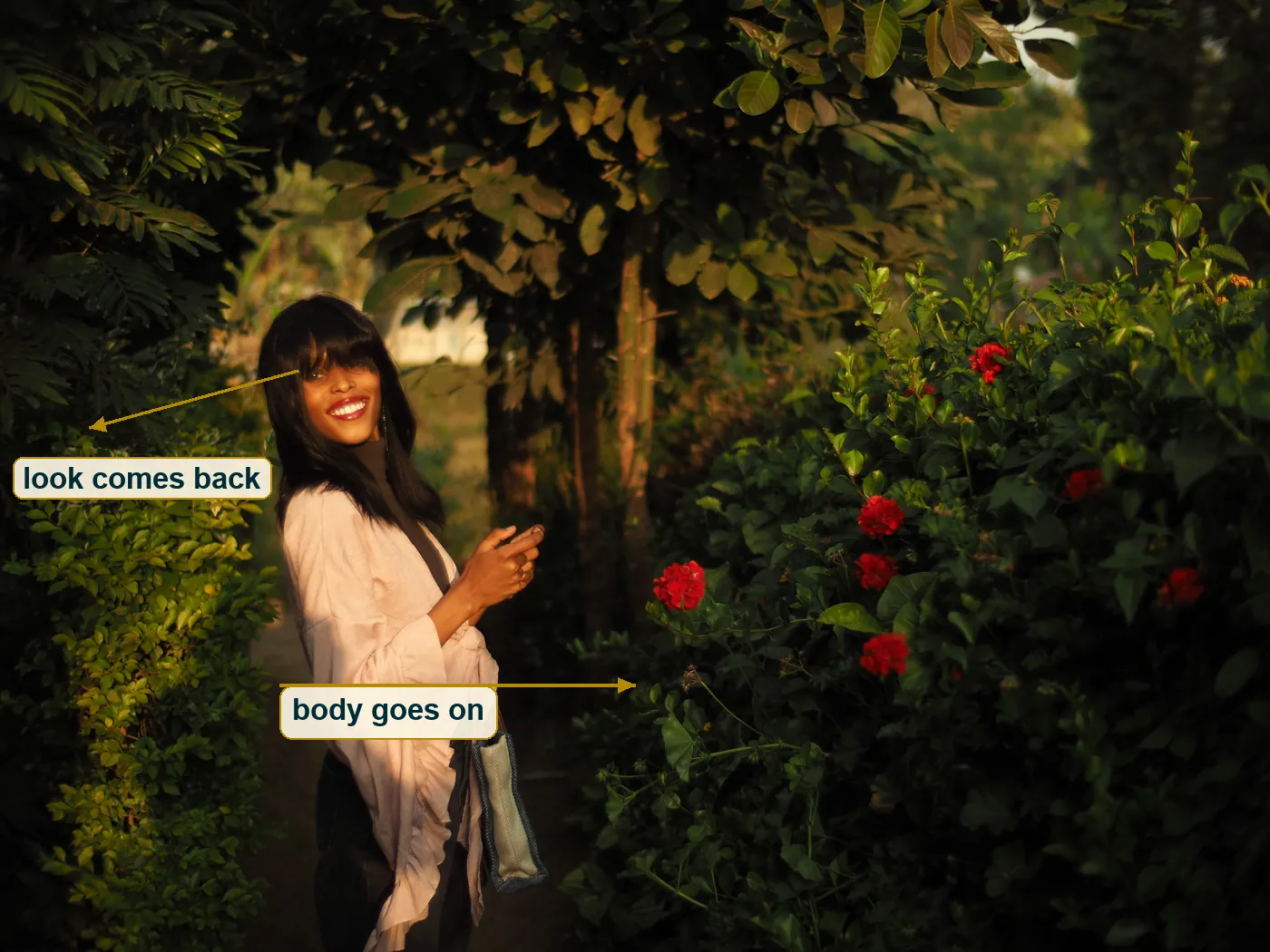
She was already walking on. Her body points to the right, along the path and toward the red bush, and then her head comes back over her shoulder and she smiles straight into the lens. It's a big open smile with teeth, the kind you can't hold for long, and that tells you the picture was taken in the second it happened and not a second later. Everything else in this frame, the leaves, the light, the blur, is there to keep that one turn of the head in the middle of your attention.
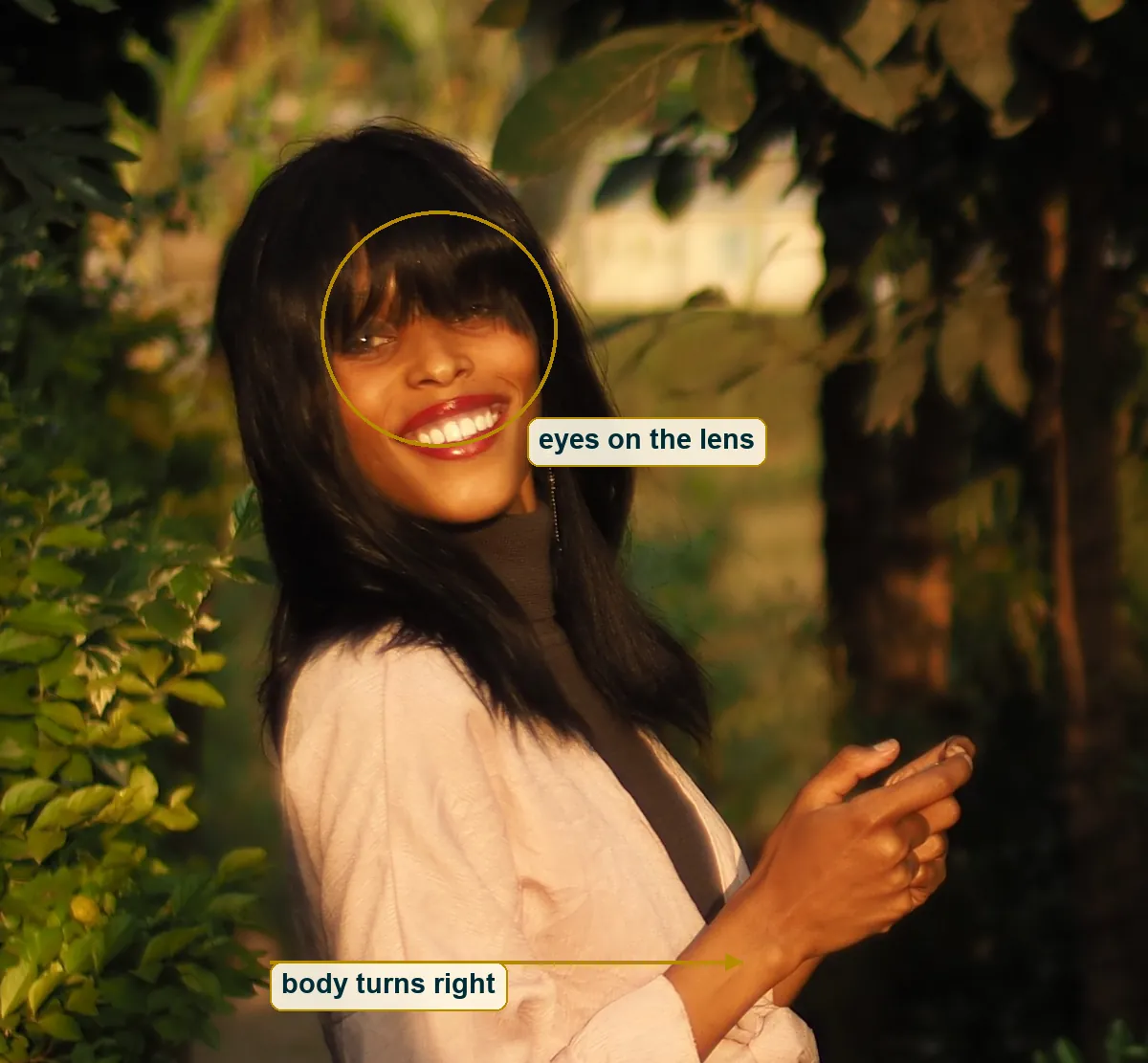
A face that is squared up to the camera looks posed. A face that turned back looks like it chose to look. The twist between shoulders and head is what you read first, even before you notice her clothes or the garden. Long dark hair with a heavy fringe that falls almost into her eyes. Long earrings. Hands held together at the chest, the fingers busy with each other. She doesn't look surprised and she doesn't look like she was told to stand there. She looks like someone who heard her name and turned around because she wanted to.
Pink, red and blue-grey
Then the colours come in. A pale pink blouse with big ruffled bell sleeves over a dark turtleneck. A blue-grey woven tote on the hip with a dark trim. And in the bush on the right, clusters of deep red flowers, the only strong saturated colour in a frame that is otherwise green and brown and black.
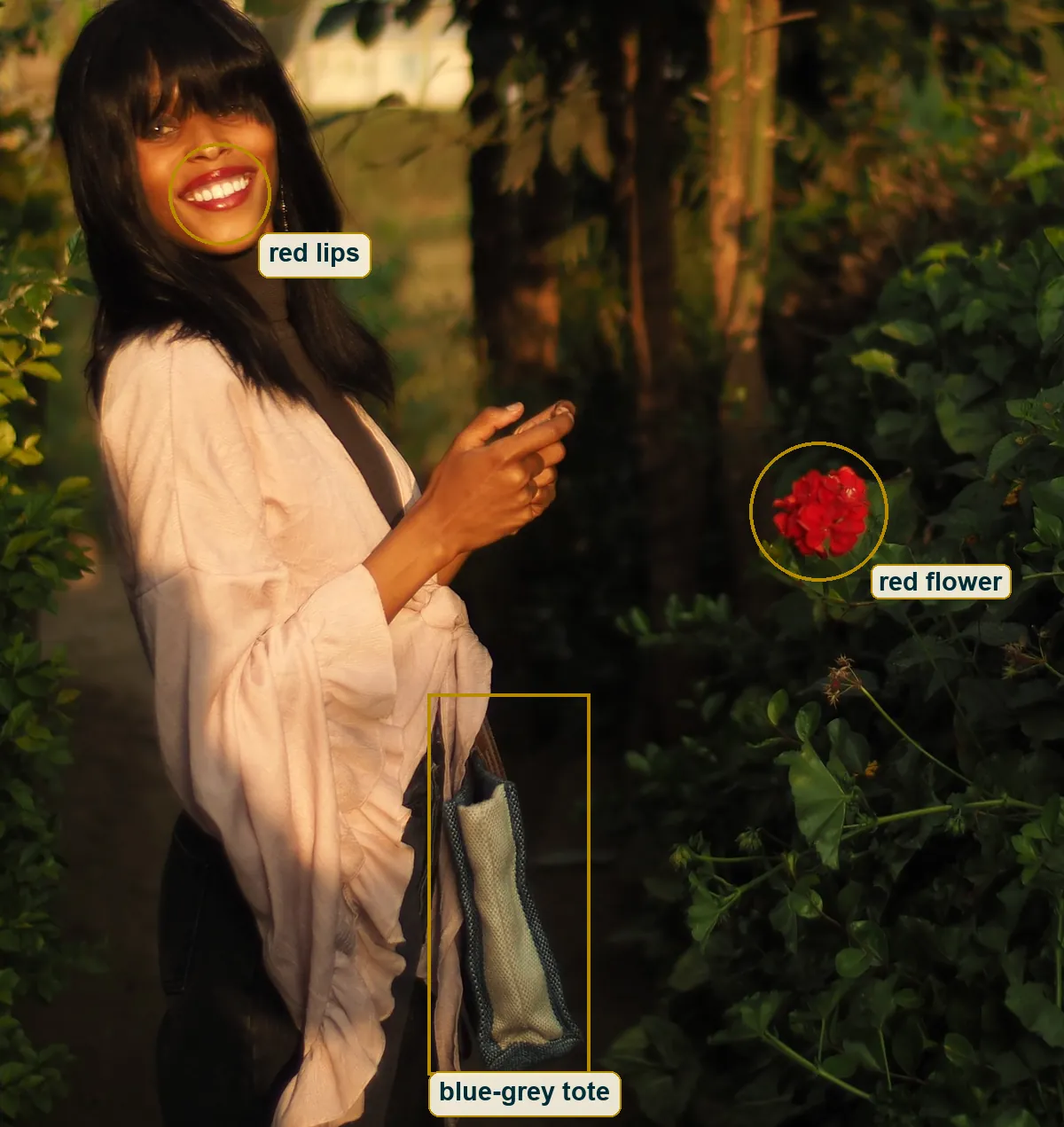
The red is the trick. Her lips are the same deep red as the flowers, and the nearest flower cluster sits just right of her hands, at about the same height. So your eye jumps from her mouth to the flower and back again, and the picture gets a second line of movement that runs across the frame. Measured with PIL, the nearest flower averages about 104, 20, 15 in red, green and blue, almost pure red with very little else. The blouse in the sun averages about 219, 170, 126, warm and bright. The tote is the one cool thing, and it keeps all that warmth from turning into one orange soup.
A frame inside the frame
Look at the edges before you look at her again. The top of the picture is a dark ceiling of leaves. The left side is a sunlit hedge, the right side is the shaded flower bush, and the path runs away behind her between them. The garden builds a second frame inside the real one, a dark window with her standing in the light part of it.
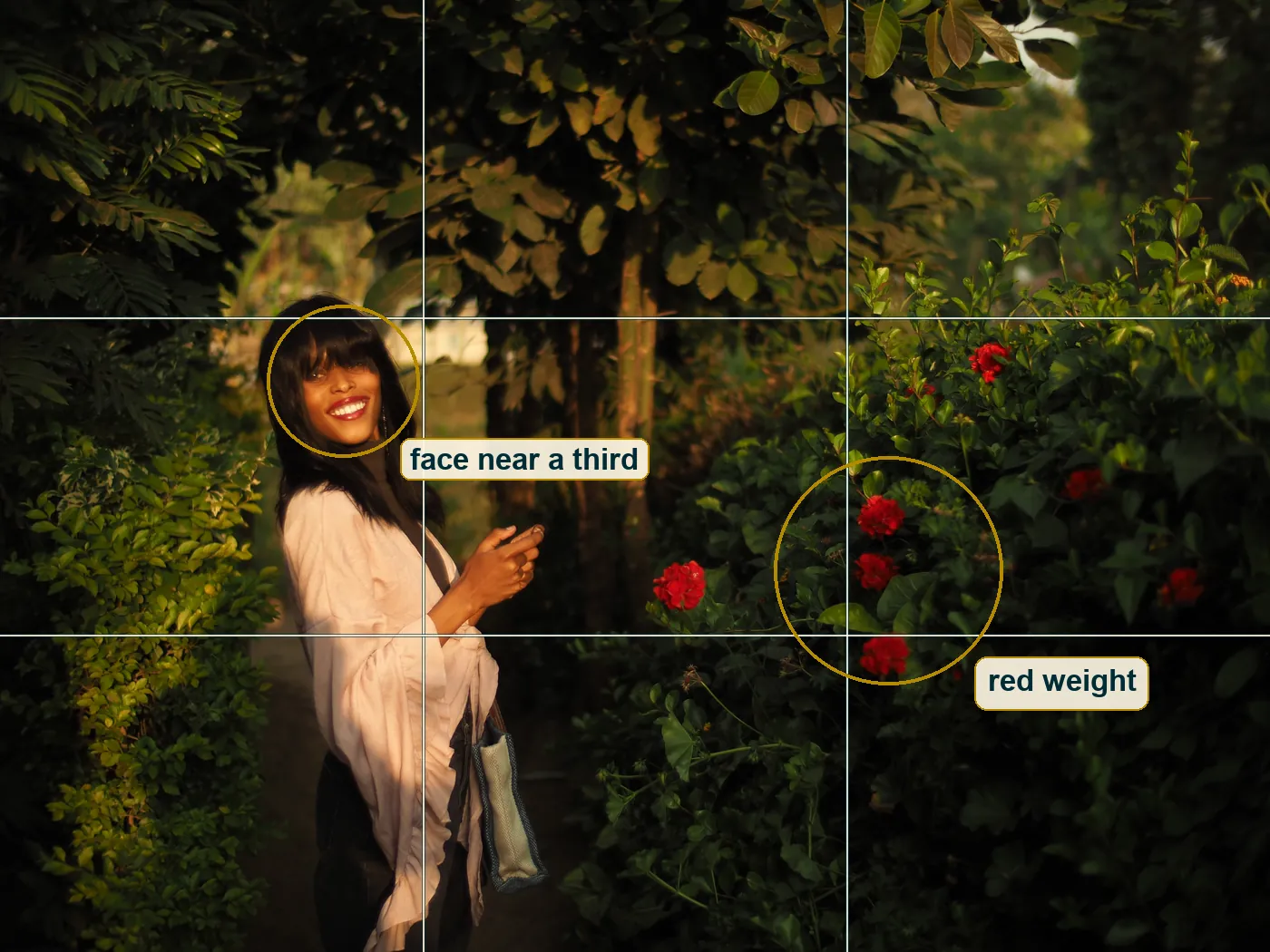
Her face lands close to the upper left crossing of the thirds grid, a little lower and a little more to the left. The densest group of red flowers sits right on the lower right crossing. That is a diagonal, from her face down to the flowers, and the eye travels it again and again. It works because the two things are different in kind. She is big and light, the flowers are small and dark red, and they weigh about the same.
The frame is 4:3, the native shape of a Micro Four Thirds sensor, and it was not cropped. The file is 4608 by 3456 pixels, which is the full 16 megapixels of this camera. So the framing was decided in the viewfinder, not later on a screen.
Low sun from the left
The light comes from the left and it comes in low. You see it on the hedge at the left edge, where the small leaves glow yellow green, on her near cheek and on the front of the blouse, and on her hands. Her far cheek, the side of her neck and the hair behind her ear fall into shade. The shadows under the leaves have hard edges. That is direct sun, not cloud and not open shade.
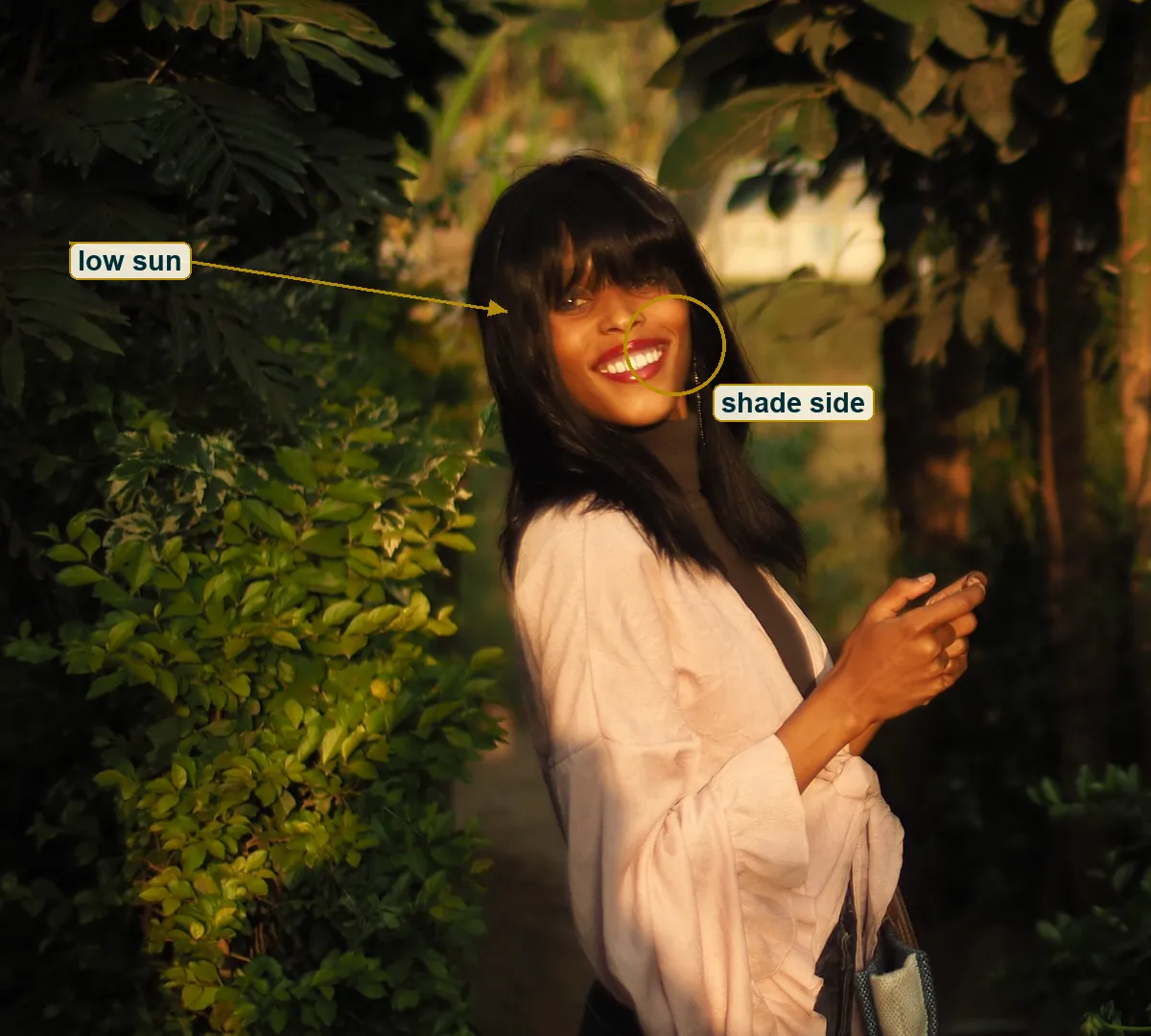
The camera clock says 17:26, late afternoon. The colour agrees. The skin on her lit cheek measures about 137, 71, 32 in red, green and blue, a strong warm cast. Part of that is the low sun, which travels through more air and loses blue on the way. Part of it is a choice, because the file says custom white balance, so someone told the camera what neutral should be and the warmth that stayed in the file is the warmth they wanted.
Hard low light on a face is risky. It can make squints and harsh lines. Here it works because her head is turned toward the light, so the sun lands on the front of her face and the shade only takes the far side. That gives the face shape without cutting it in half.
What the file says
This photo comes with its original camera data, so you don't have to guess the basics. The camera is an Olympus OM-D E-M5 Mark II, a Micro Four Thirds body with a crop factor of 2. Exposure mode manual. Shutter 1/3200 s on the mechanical shutter. ISO 100. Image stabilisation on, in S-IS Auto. Manual focus. Picture mode Natural, no art filter, custom white balance, ESP metering. Date 21 August 2025, 17:26:35 on the camera clock. There is no GPS data, so the file says nothing about where this garden is, and neither does this essay.
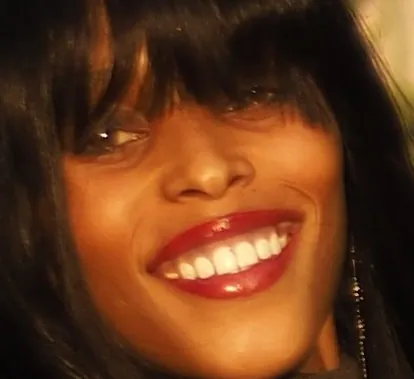
At 100 percent you can see where the focus fell. The edges of the teeth and the lips are the hardest edges in the face. The eyes are close but a touch softer, partly because the fringe shades them. On a lens this fast the difference between the eyes and the mouth is a few centimetres, and with manual focus that is a matter of the hand on the ring. It's close enough that nobody looking at the whole picture will see it.
ISO 100 is not the base ISO of this camera. The base is 200, and 100 is an extended Low setting. Reviews of this body note that it is more likely to clip highlight detail, and it costs about a third of a stop of headroom at the bright end. Here that cost is small, because so little of the frame is bright. Only about 0.07 percent of the pixels touch 254 in any channel.
The lens with no name
The lens fields in the file are empty. Focal length 0 mm, aperture 0. That happens when the lens has no electronic contacts and can't tell the camera anything. So this was a manual lens, and the file alone can't say which one.
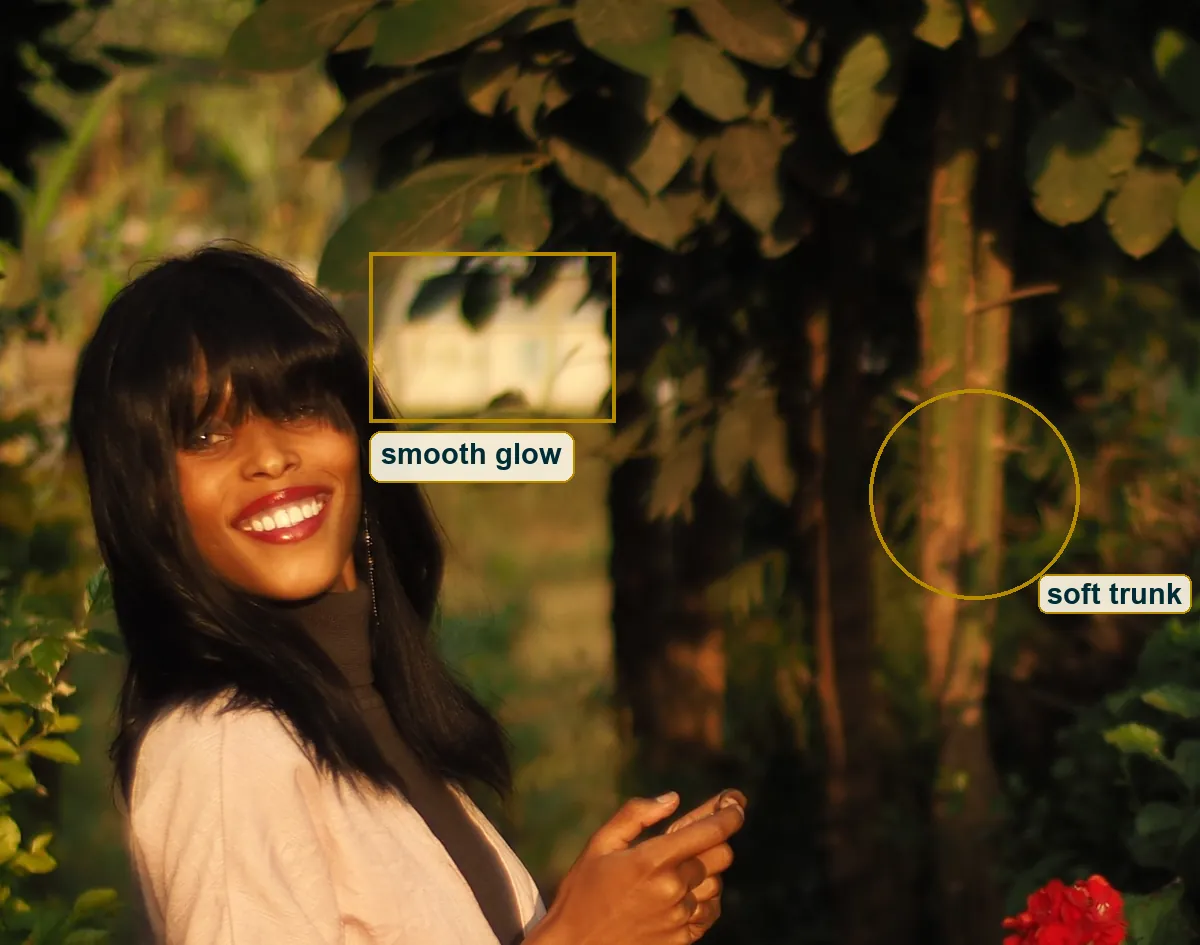
There is good evidence for a likely answer, though. An earlier post on this site shows this exact camera body paired with a Voigtländer Nokton 25mm f/0.95, a fully manual lens with no contacts. Then the picture itself. Manual focus is set in the file, as it must be with that lens. The background melts in a way that only a very wide aperture gives at this distance. The bright gap at the end of the path is a smooth glow with no edges, the trunk behind her has lost its bark texture, and the leaves overhead are soft shapes. And the exposure, 1/3200 s at ISO 100 in low late sun with most of the frame in shade, makes most sense if a lot of light was coming through the lens.
So the likely reading is the Nokton 25mm at or near f/0.95. It's likely, not certain. A different manual lens at a very wide aperture would leave the same empty fields. What the evidence rules out is a small kit zoom at f/5.6, because that would have written its data into the file and would never have blurred the path like this.
A slice of focus forty centimetres deep
On Micro Four Thirds, 25 mm frames like 50 mm on full frame, because the sensor is half as wide. The depth of field works the same way. Multiply the f-number by the crop factor and f/0.95 on this camera draws depth like about f/1.9 on a full frame camera with a 50 mm lens. That is still very shallow, the kind of look people buy expensive lenses for.
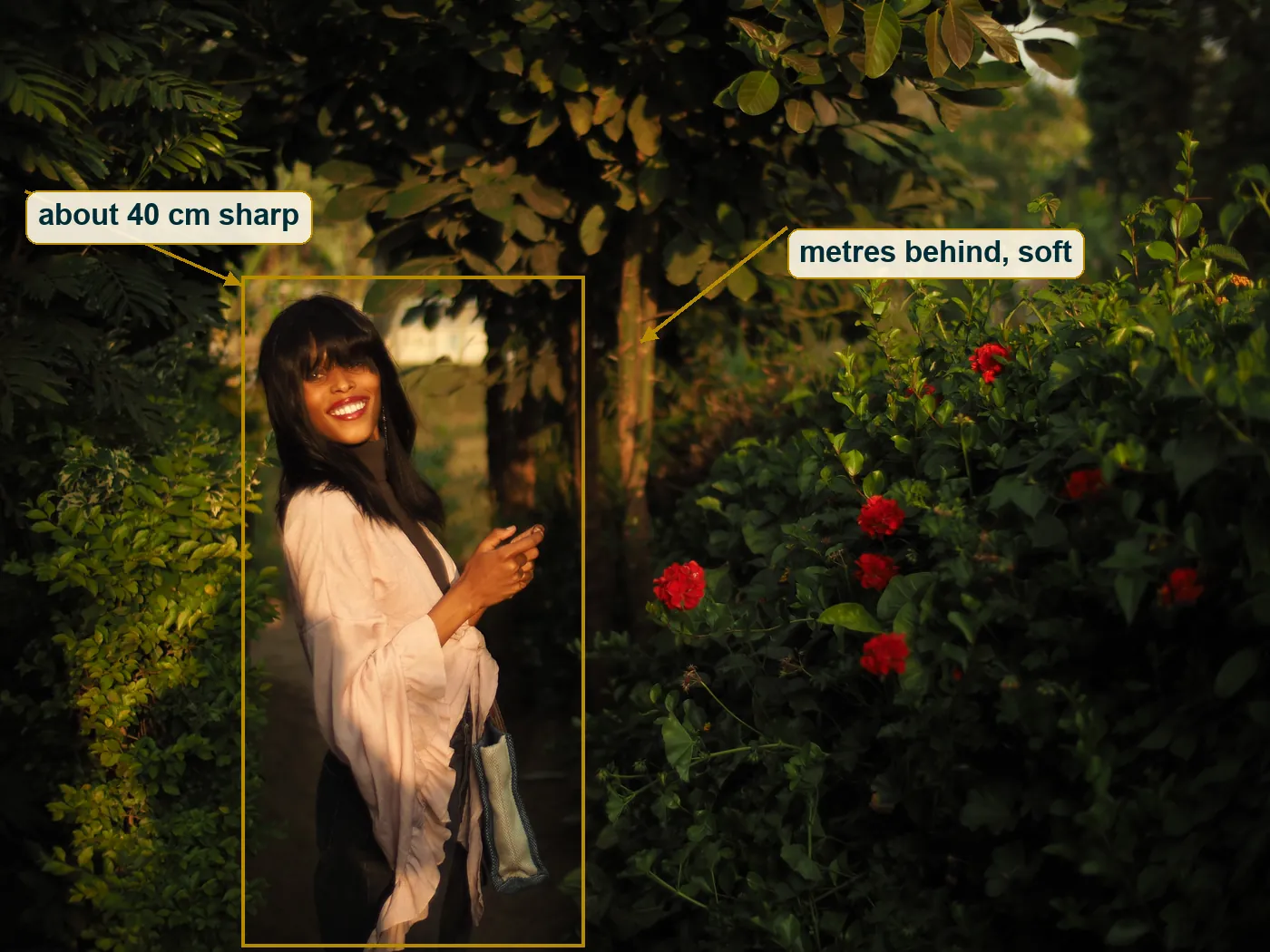
How far away was the camera? She fills about two thirds of the frame height from the top of her head to mid thigh, which is roughly a metre of body. A 25 mm lens on this sensor sees about 1.5 m of height at 3 m distance, so the camera stood about 3 m away. At that distance and f/0.95, the sharp zone is about 40 cm deep, enough for her face, her hands and the bag and not much more.
Now the side by side. At f/2.8 the sharp zone grows to about 1.25 m. The red flowers would sharpen and the gap at the end of the path would start to show shapes. At f/8 it grows to several metres. The trunk would get its bark back, every leaf in the canopy would be sharp, and the garden would talk as loud as she does. You would also need to slow the shutter by about six stops to keep the same exposure, to around 1/50 s, which is still fine for a standing person. The picture would be correct and much busier. The wide aperture is what makes this a portrait of her and not a picture of a garden with a person in it.
Why the shutter was so fast
1/3200 s is far faster than any motion here needs. A smiling face and two hands are frozen at 1/250 s. So the shutter was not chosen to stop movement. It was chosen to stop light.
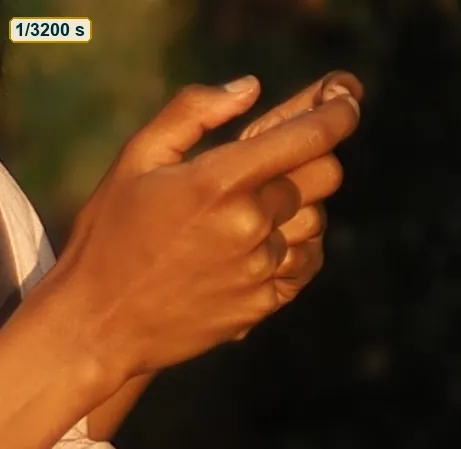
With a lens wide open at f/0.95 in sun, you get a lot of light. The aperture is fixed by the look you want, the ISO is already at its lowest, so the shutter is the only control left, and it has to go very fast. f/0.95 at 1/3200 s lets in about the same light as f/2.8 at 1/400 s, or f/8 at 1/50 s. Same exposure, three very different pictures. This body has a mechanical top speed of 1/8000 s, so there was room to spare. On a brighter day or facing the sun, the limit comes fast, and that is when people put a neutral density filter on a lens like this.
The stabiliser was on, and at 1/3200 s it does nothing you can see. It would matter at 1/15 s indoors. With a manual lens it also needs to be told the focal length in the menu, because the lens can't report it.
Letting the shadows go
This is a dark picture, and it is dark on purpose. The median brightness of the whole frame is about 23 on a scale of 0 to 255. About 45 percent of the pixels sit below 20 and about 21 percent below 10. The bottom right corner, deep in the flower bush, averages about 13. That is a low key photograph, most of it shadow, with a few things in light.
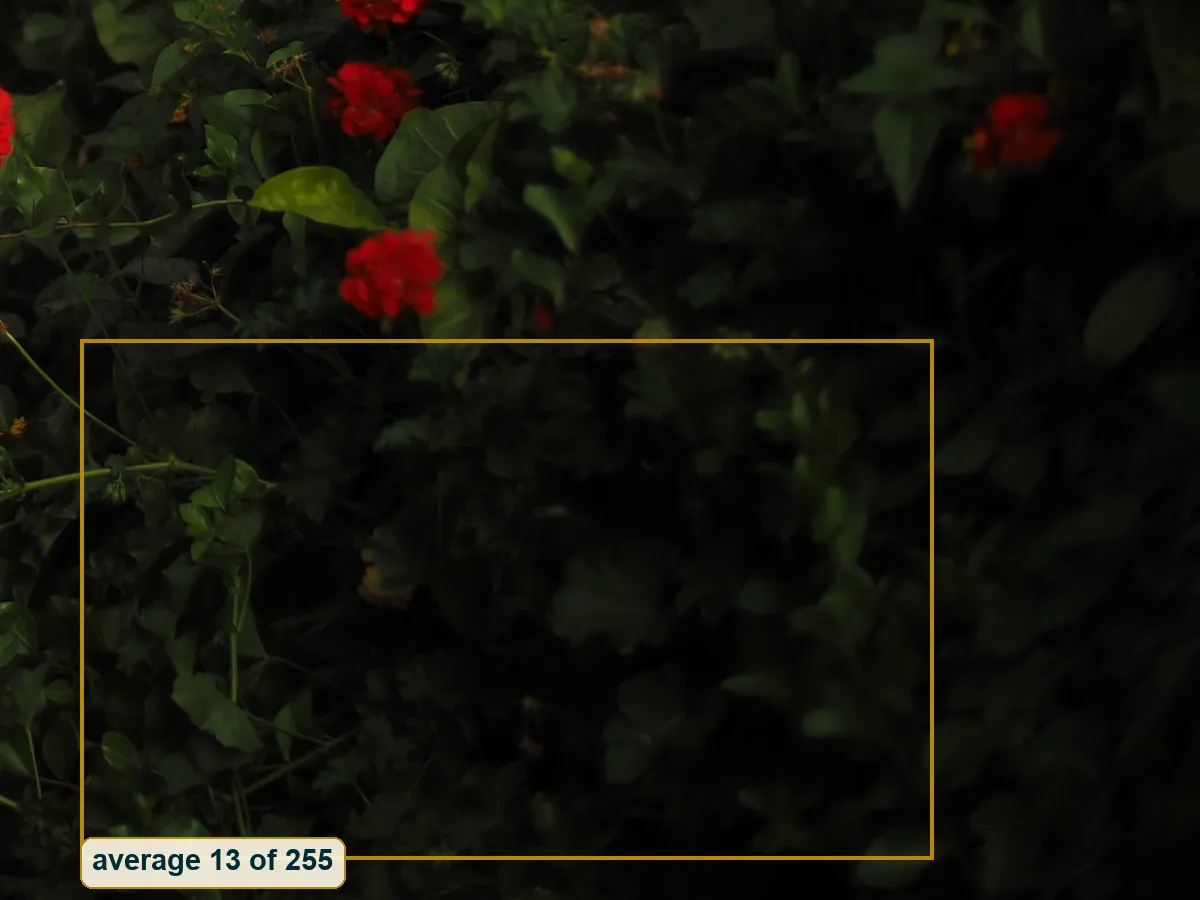
The exposure was set by hand, and it was set for her. Her lit cheek averages about 86, the blouse in sun about 179. If the camera had been allowed to brighten the frame until the average looked normal, her blouse would have burned out and the shadows would have turned grey and muddy. Instead the shadows were let go. They lose detail, and in return the light parts glow and the red flowers jump.
This is digital, not film. There is no grain, only fine noise in the deepest shade, and the colour comes from the Natural picture mode, which keeps contrast and saturation moderate. Film would roll off the bright blouse more gently. A digital file at ISO 100 holds the shadows better than you see here, but someone chose to keep them dark.
A bird that looks back
The title comes from Ghana. Sankofa is an Akan word, and the symbol for it is a bird with its feet pointing forward and its head turned all the way back. The proverb behind it, Se wo were fi na wosankofa a yenkyi, is translated on a Smithsonian object page with the words of this title. The bird walks on and still looks behind. That is exactly the shape of this photo.
Painters knew this pose long before cameras. Hishikawa Moronobu, a Japanese artist of the 1600s, painted Beauty Looking Back, a woman in a kimono turning around. Around 1948 it became a postage stamp design. The appeal is the same one at work here. A person caught between going and staying is more alive than a person standing still.
And from Ghana again, a photographer. James Barnor opened his Ever Young Studio in Accra in 1953 and later shot fashion with Black models against London backdrops, often for the covers of Drum. About retouching faces in his studio years, he said, "Long before Photoshop existed you would use a pencil." His portraits do what this frame does. It lets a person look straight back at the camera, in her own clothes, in the middle of her own day.
The one mistake
Look next to her head. Just right of her hair, at the end of the path, there is a bright soft gap where the light comes through. It is the brightest large area in the frame, and it touches her hair.
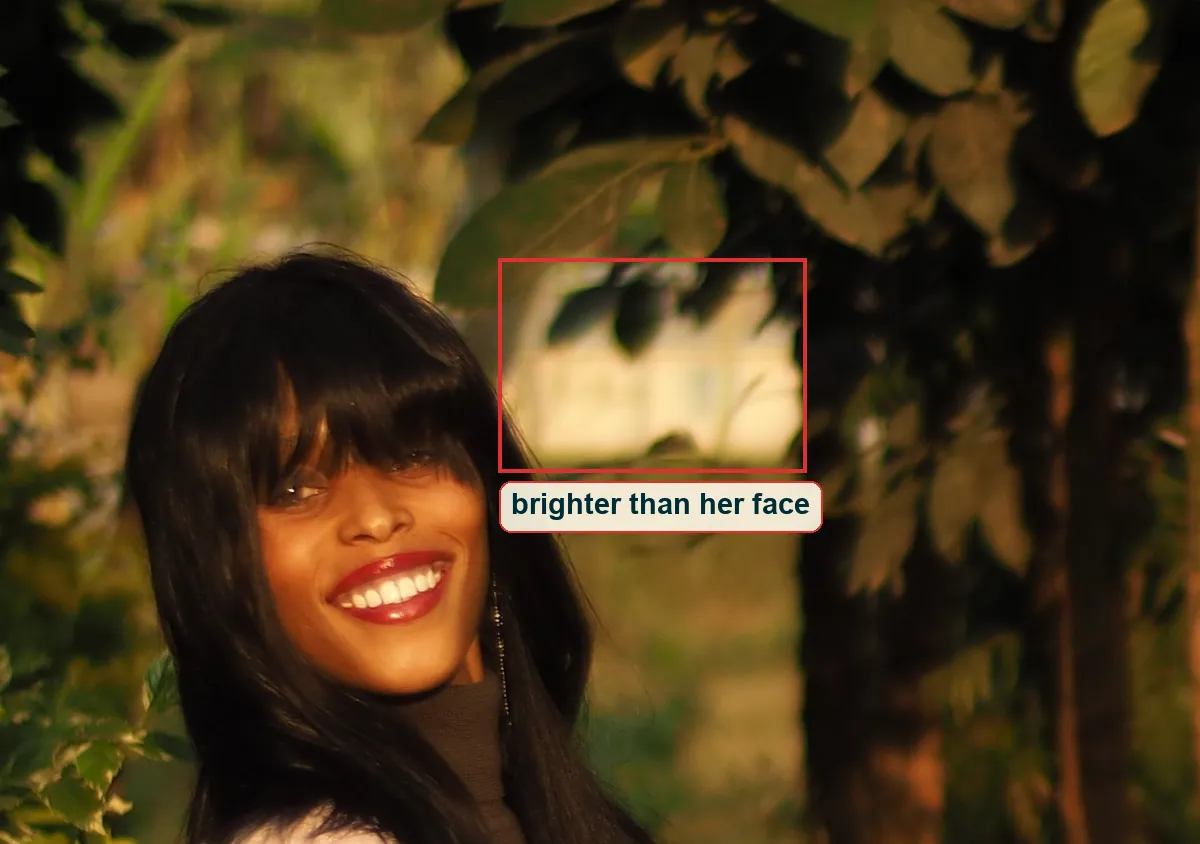
Measured, that patch averages about 151 in brightness. Her face averages about 86. The eye always goes to the brightest thing first, so for a moment it goes past her face to the empty glow beside it, and then has to come back. In a frame this dark that pull is strong.
The fix is cheap. Half a step to the right moves the camera, and because the gap is far behind her and she is close, the gap slides away from her head and dark leaves fill the space beside her hair. Or drop the camera a little so the dark trunk sits behind her. Either way her face becomes the brightest thing near the centre of the frame again, which is where it should be.
Try this
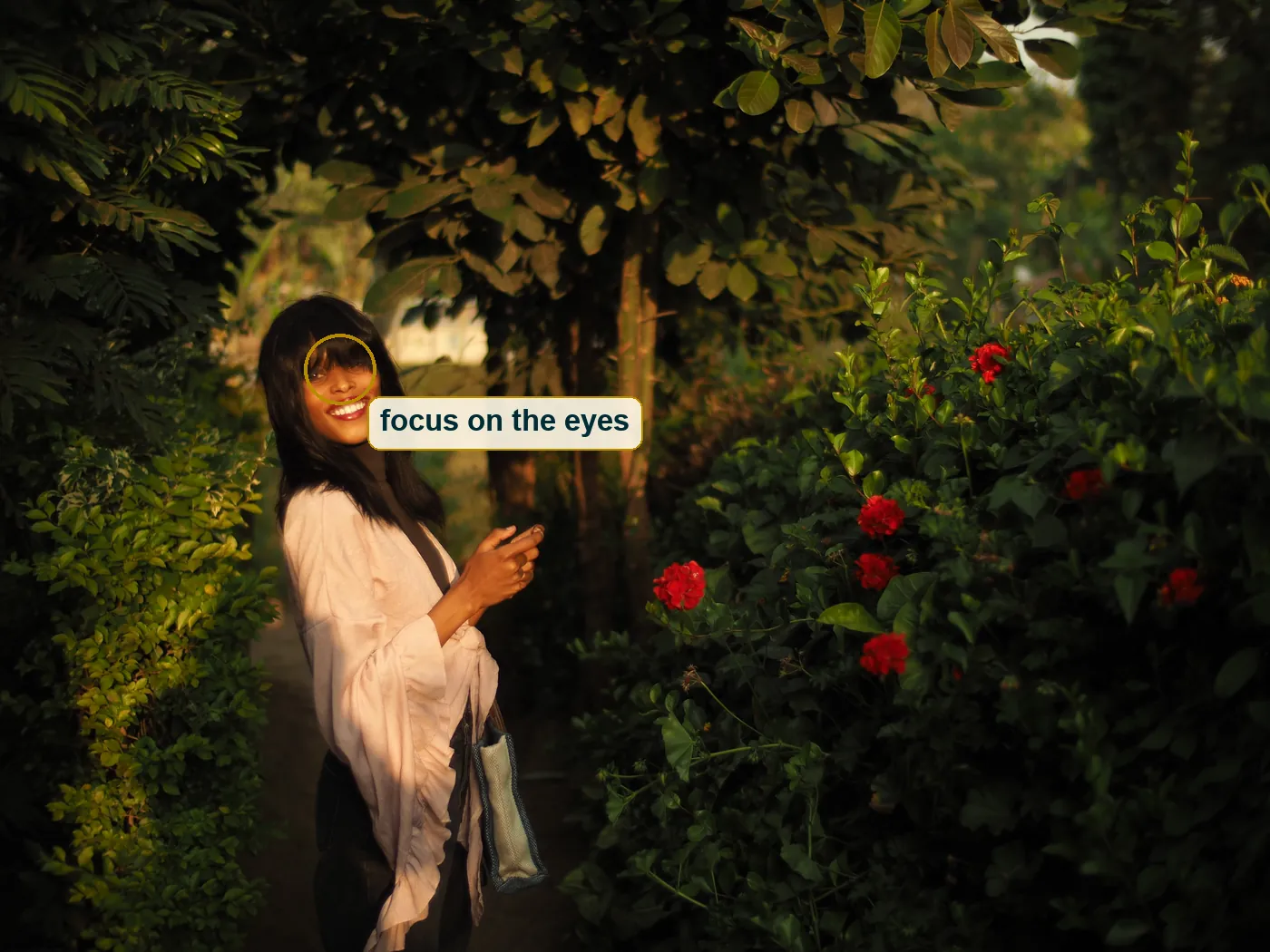
Take any lens you have at its widest aperture, go out in the last hour of sun and find a path with dark leaves on both sides. Ask a friend to walk away from you along it, focus on where their head will be, and call their name. Shoot the moment they turn, with the sun coming from the side they turn toward. Then check the background next to their head, and if it's brighter than their face, take one step to the side and do it again.
Going back for it
At first the picture is a smile on a garden path. After a while it becomes a small story about direction. She goes one way and looks the other, the light comes from one side and the dark waits on the other, and the red on her lips is answered by a red flower she is about to walk past.
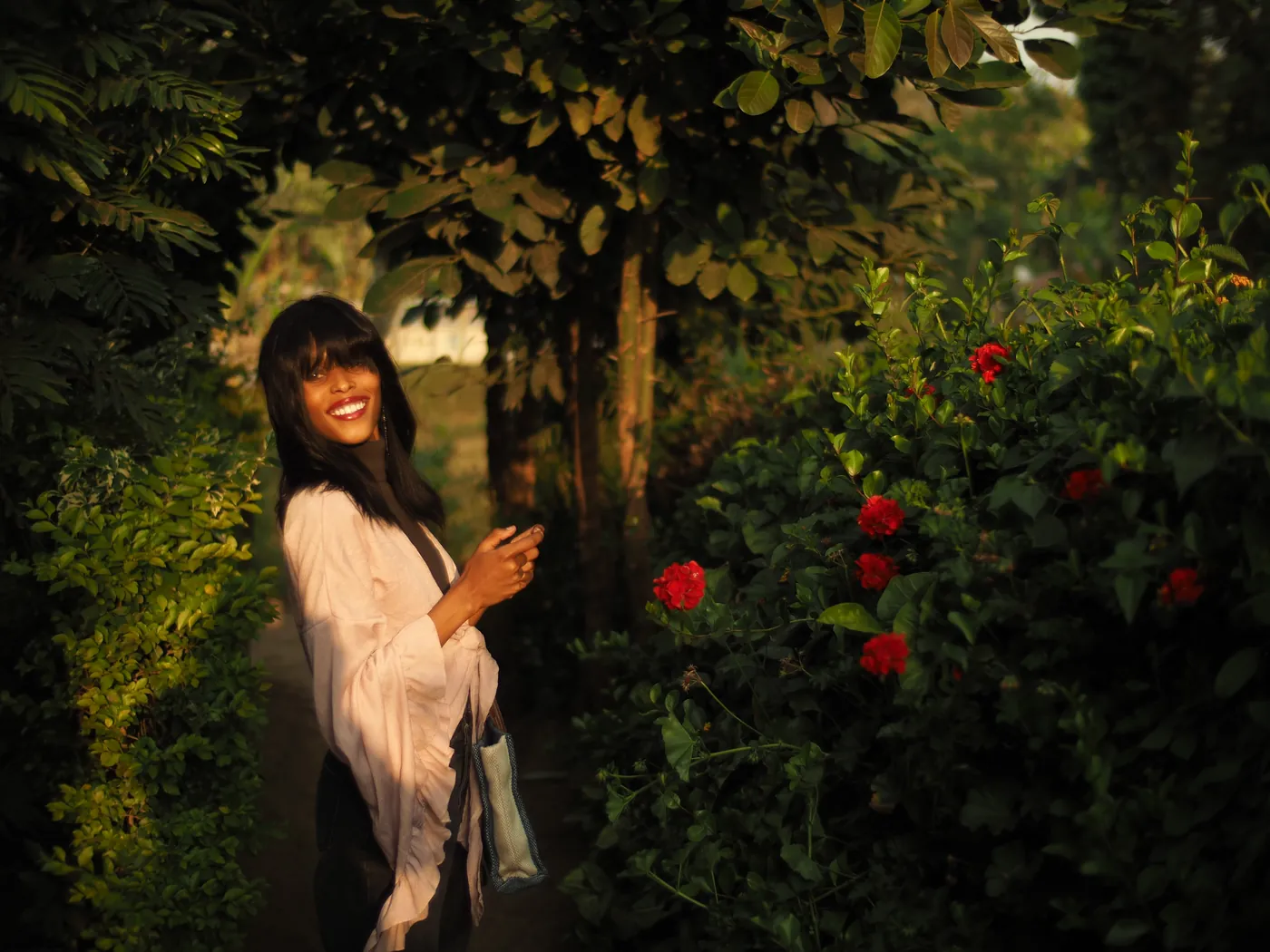
The camera saw 1/3200 of a second of it. A very fast lens kept 40 cm of the world sharp and let the rest go soft. The proverb says it isn't taboo to go back for what you forgot. This photo is what going back looks like when it's fast, warm, and only lasts one turn of the head.