A Darwin-like quantum thought experiment on entanglement, competing states and quantum Darwinism

TL;DR: Entanglement is correlation, not a remote control, and no-signaling rules out using it to change B's surroundings. The Darwin-like part of quantum physics already has a name, Quantum Darwinism: the environment selects pointer states and copies them. The test is redundancy, many environment fragments carrying the same record, and Zhu et al. 2025 observed it with superconducting circuits. Aligning D and T spins can raise the fusion cross section by about a factor of 1.5 under ideal assumptions.
This is my whole chain of questions about Darwin-like behavior in quantum physics, put in order. What entanglement really means and what it can't do, why measurement and decoherence feel like selection, which degrees of freedom can be entangled, where nuclear spin fits in, and what the cleanest test for a Darwin-like mechanism looks like. That mechanism already has a name, and it's Quantum Darwinism.
My questions, in order
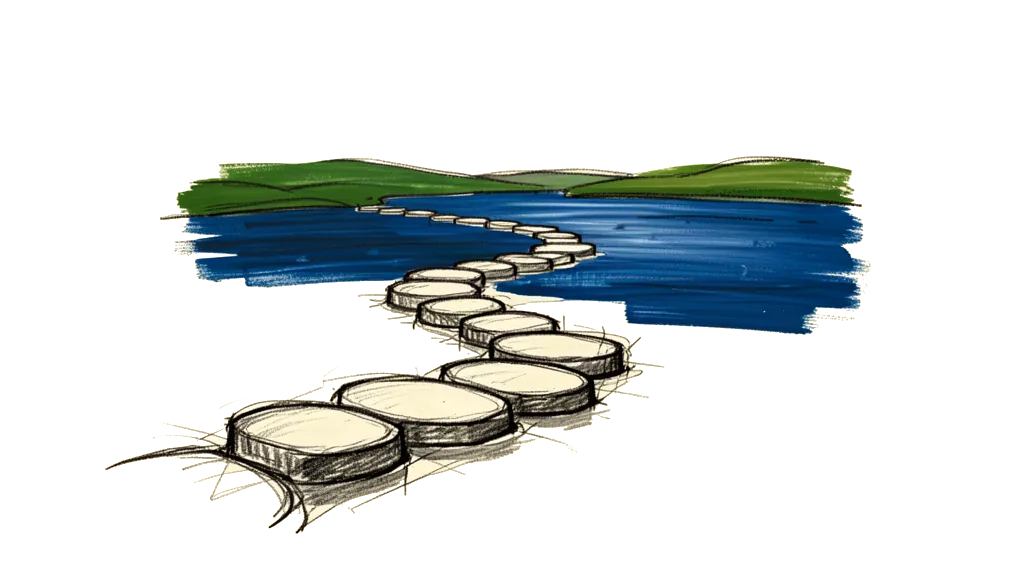
I was trying to build one Darwin-like picture of quantum physics, and I had nine questions. The first three were about entanglement itself, then four and five about proof and spin, six about quantum computing, seven and eight about nuclear physics and the whole universe, and the last one was the bottom line.
It started like this. Entanglement looks like a connection across distance. If systems A and B are entangled, then when A changes, B updates, even far away. And if B updates, B should affect its surroundings, because in real physics things like spin, polarization, frequency and energy change how something interacts with what's around it. So I asked, if entanglement updates B, shouldn't B's environment respond? But everyone says entanglement can't send any influence or information, and I suspected these limits might be wrong, because the update feels real.
Then I wanted to know how we even prove entanglement. Do we need to measure both sides at the same time? Do we need to change A and B together to keep them entangled, or can we work on one side only? And is entanglement only about spin and 0 and 1, or are there other entangled properties, maybe more physical ones, that act on the surroundings in a different way?
Quantum computing is hard because looking at the state changes it and errors are everywhere. I asked if that is a kind of competition between states, where a lot of possibilities fight and one survives, which sounds a lot like Darwin. Then nuclear physics. Spin matters in fusion and fission reaction channels, so could changing spin in the middle of the process give different reaction paths, and could entanglement plus nuclear reactions make a Darwin-like selection mechanism? And if we zoom out to the whole universe, with black holes, expansion and the creation of matter, could deep entanglement networks create chaos somewhere else, like a Darwinian influence in physics?
The bottom line was one question. What is the closest experiment, and the closest thought experiment, where quantum physics really behaves Darwin-like, and what would count as proof? The rest of this post answers all of it and keeps the Darwin idea, but it separates correlation from cause.
Entanglement is correlation and not a remote control
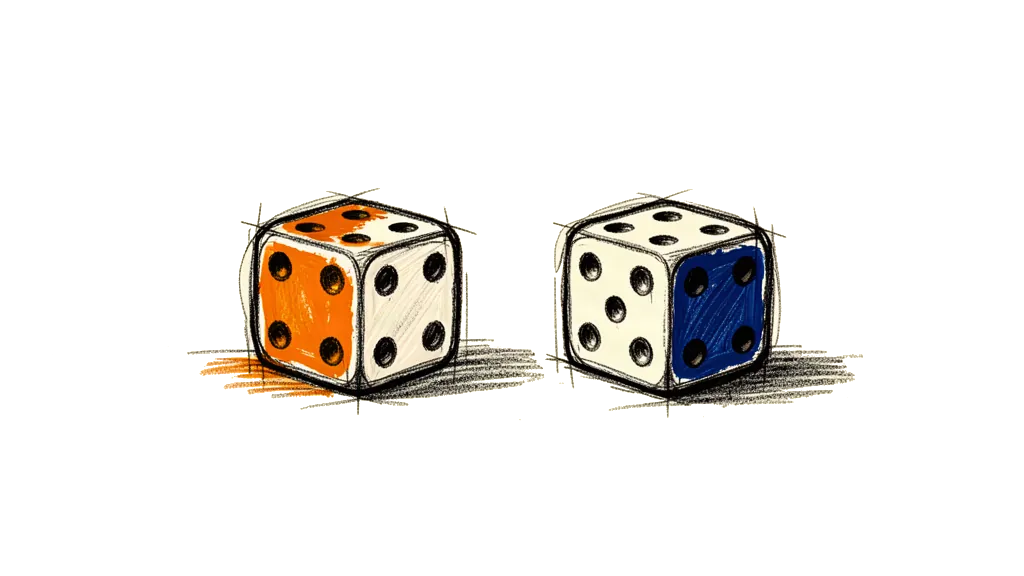
Entanglement gives you strong correlations between outcomes when A and B are measured and the results are compared later. If A and B are entangled and you measure the same kind of thing on both sides, you get results like up–down, up–down, or up–up, down–down, in a very strict pattern. It's stronger than any classical shared random seed can reproduce.
What entanglement doesn't give you is this. I pick an action on A, and that forces a change at B that B can detect locally, and so also in B's environment, without any normal signal. This is the no-signaling or no-communication rule, and it says local actions on A can't be used to send controllable information to B. The clean statement is the no-communication theorem, often presented as the no-signaling principle, and there is a good overview at the Wikipedia page on the no-communication theorem.
So my step "B must influence its environment" doesn't follow. I was thinking that A updates B, B sits in an environment, so the environment should react in a different way. But the update you get from entanglement is mostly an update of the relationship, the correlations, and it only becomes usable once the outcomes are compared. Locally B still looks the same in its statistics until B gets ordinary information from A, and that is classical communication at light speed. The update is real in the joint statistics, but it never becomes a controllable local push at B.
I also said that even without measuring we can know mathematically that the joint state changed, so B is changing. The clean version keeps that thought and fixes the conclusion. Quantum theory lets you describe the global A–B state and also the local description of B alone. Acting on A can change the global correlations. But the local description of B, the part that decides how B interacts with things nearby, doesn't become controllably different just because you did something at A. So "B changed" is true for the global correlation structure and false for the behavior you can detect locally at B.
The technical term I was looking for, for two distant systems where a change here changes what we can say about the other side, is entanglement, meaning shared nonclassical correlations. A related term that sometimes fits the intuition is quantum steering. By choosing what you measure on A, you can steer the conditional ensemble you would assign to B. But B still can't tell which ensemble it is in without classical information from A, so there is no remote control. Entanglement is the main term and steering is a refinement.
How we prove entanglement
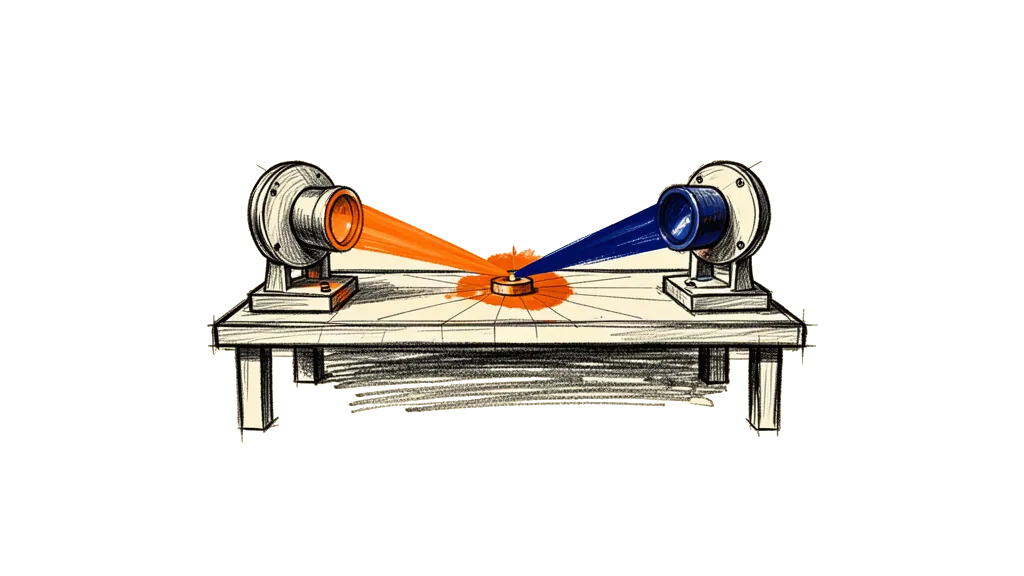
In the lab the gold standard is to measure A and B in several settings and show that the correlations break a Bell inequality, often the CHSH one. A well known loophole-free Bell test is Hensen et al. 2015 in Nature.
We don't need the same time in the everyday sense. But in the cleanest Bell tests the setting choices are independent and made late, and the measurement events are spacelike separated, so ordinary signals can't coordinate the results. That rules out classical coordination as the reason for how strong the correlations are.
And we don't need to work on both sides to keep entanglement. You can do a lot of operations on one side, unitaries and rotations, and the entanglement stays. A measurement on one side usually turns the entanglement into a classical correlation, because the measurement creates a definite record of the outcome. So you can act on one side, but you can't use that to force a controllable change at the other side that someone there could detect.
Entanglement is also not only spin and 0 and 1. Spin is just the easiest story. You can entangle a lot of degrees of freedom, like photon polarization, path or which route, time-bin as in early or late, frequency and energy, orbital angular momentum and vibrational or collective modes. And systems don't have to be two-level. Qubits have two levels because that is convenient, but qudits with d levels exist and so does continuous-variable entanglement. For my argument this means different degrees of freedom can act on their local surroundings in different ways, but none of them lets A control the local statistics of B from far away. No-signaling still holds.
Why quantum computing feels Darwinian

I put two facts together. In quantum computing, looking at the state changes it, and decoherence and noise create errors, so keeping superpositions is hard. This really looks like a kind of selection. A lot of quantum possibilities exist, the environment tends to destroy the fragile superpositions, and stable patterns last longer. But it isn't biological Darwinism. There is no open-ended adaptation, no evolving population of templates and no design that builds up. Still the intuition points at real physics, because the environment monitors the system and that filters states. And that leads straight to the main Darwin-like framework in quantum foundations, which is Quantum Darwinism.
Quantum Darwinism, from Zurek and the people who work with him, says the environment does two linked things. The first is selection, called einselection. The interaction with the environment picks out pointer states that are stable and survive being monitored. The second is replication, the redundant records. Information about those pointer states gets copied into a lot of independent fragments of the environment, so many observers can each read a different fragment and still agree on the same classical fact. The founding paper is Zurek 2009, Quantum Darwinism. An intuitive model with an everyday environment, where scattered photons create huge redundancy, is Riedel and Zurek 2010 in PRL. And an operational definition and analysis of redundancy is Zwolak and Zurek 2017 in PRA.
This fits the Darwin analogy much better than entanglement alone. The variants are the quantum alternatives in a superposition. The selection pressure is decoherence, the environment monitoring the system. The survivors are the pointer states that stay stable under that pressure. And replication is many fragments of the environment recording the same pointer information. That is exactly the Darwin-like story I was looking for, and it isn't remote influence. It's local selection and copying of information into the surroundings.
A two-wing thought experiment
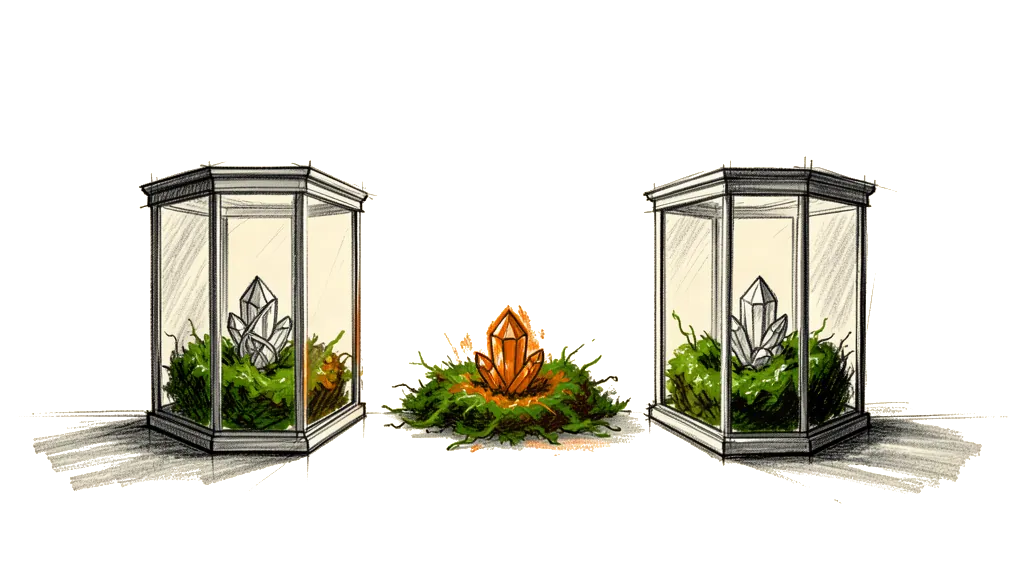
I wanted entanglement, two distant systems, each sitting in its own surroundings, surroundings that react in a Darwin-like way, and a clear way to test it. Here is the cleanest version that keeps all of that and still respects no-signaling, and I call it two-wing Quantum Darwinism.
First you prepare two systems, A and B, in an entangled state. Then you give each system its own environment. A interacts locally with an environment E_A made of many fragments, like many ancilla qubits or many photon modes, and B interacts locally with an environment E_B that also has many fragments. There is no cross-talk between the wings, only A↔E_A and B↔E_B. Next you let the environments monitor a preferred property. The interaction measures a certain property on each side, the pointer property, and that suppresses the fragile superpositions, which is the selection. Then the records spread. The pointer outcome gets copied into many fragments of each environment, and many independent observers can sample different fragments and reach the same conclusion, which is replication and objectivity.
So you used entanglement, my connection idea, but the Darwin-like part happens locally. The environments select and the environments replicate records. What you don't get is A making B's environment react differently, because that would be remote control and it would break no-signaling. Instead you get something more subtle and closer to my Darwin picture. Quantum correlations exist globally, but classical reality comes out locally through selection and redundant copying into the surroundings.
What would count as proof
I asked about the chance of an experiment to prove it. Quantum Darwinism is more than decoherence, and its key claim you can observe is that redundant records exist. Many different fragments of the environment each carry, on their own, nearly the same classical information about the pointer state of the system.
The simplest proof pattern needs no heavy math. You do many runs, and in each run you prepare the system, let it interact with its environment and then measure only a small subset of the environment fragments. If small subsets already show the pointer outcome reliably, and many different subsets do it independently, then the environment holds multiple copies, and that is redundancy. In the papers this is shown in plots of how much information you gain against how big a fraction of the environment you capture, with a fast rise and a wide plateau, the redundancy plateau. Riedel and Zurek 2010 and Zwolak and Zurek 2017 talk about this kind of signature, at the PRL paper and the PRA paper.
There is also a control test for selection. You repeat the same redundancy check for a different property that is incompatible with the first one. The prediction is that redundancy is strong for the pointer information and weak for incompatible observables, because the environment selects which information survives and gets copied.
And this has been done in a real lab. A recent experiment reports an observation of Quantum Darwinism signatures with superconducting circuits, Zhu et al. 2025, "Observation of quantum Darwinism and the origin of classicality with superconducting circuits" in Science Advances, at science.org and open access at PMC. For my question about proof this matters, because it shows the redundancy and record spreading program works in engineered platforms. My two-wing version, where you start with A–B entanglement, let each wing spread records locally and track how correlations become objective records, is simple as a concept but heavier in practice, with more qubits and modes, more calibration and more measurements.
The last part is spin. I asked if spin really matters physically, for example in fusion and fission, and if entanglement plus spin could change the reaction paths. Spin matters locally in nuclear reaction probabilities, and yes, aligning spins can change which reaction channels are favored. A concrete example is spin-polarized D–T fuel. Reviews and calculations say that aligning the D and T spins can raise the D–T fusion cross section by about a factor of 1.5, so about 50% more, under ideal polarization assumptions. The source is Heidbrink et al. 2024 in Frontiers in Physics, and the PDF mentions the factor of 1.5.
In the first version of this post the parts were numbered 0 to 11, with 10 and 11 at the end, and the sub parts 1.1 and 1.2 and 1.3 and 4.1 and 4.2 and 4.3 and 7.1 and 7.2 and 11.1 are all still here in the same order.